“I tend to grow attached to the most difficult paintings, because they must first be understood and listened to, and only afterward approached by finding the right key.”
Between Sea Salt and Renaissance Stone
Claudia Di Francesco’s artistic journey unfolds between two landscapes that seem to exist in quiet dialogue with one another. On one side lies Ostia Lido, the coastal district of Rome where she was raised, a place defined by the constant presence of the sea and the ritual rhythms of summer. On the other stands Florence, the city where she pursued her studies in Visual Arts and continues to live and work, surrounded by the enduring weight of Renaissance harmony. These contrasting environments shape the foundations of her sensibility, guiding her gaze toward both the elemental simplicity of nature and the layered complexity of historical memory. Her practice emerges from this ongoing movement between shoreline and stone, between sensory immediacy and the intellectual pressure of tradition. The anticipation of sunlit days by the water, the tangible residue of salt on skin after returning home from the beach, and the act of observing subtle natural details all contribute to a worldview grounded in attention and emotional presence.
Life in Florence introduces another dimension to her experience, one that can feel both inspiring and overwhelming. The city’s refined equilibrium, forged through centuries of artistic achievement, creates an atmosphere that invites admiration while also demanding introspection. In response, Di Francesco often seeks refuge in moments of retreat, returning to Ostia’s open horizons or immersing herself in green spaces where contemplation becomes possible. These intervals allow her to reconnect with what she describes as the simplicity of things, the quiet significance of seemingly minor occurrences. A single droplet falling from a railing and catching sunlight can become an event worth studying, an encounter that holds the potential for transformation into artistic language. This sensitivity to fleeting phenomena reflects a broader commitment to rediscovering wonder in everyday life, even within the dense cultural fabric of a city celebrated for its historical grandeur.
Equally formative is her relationship with Rome itself, a metropolis where antiquity and modernity overlap in ways that shape daily perception. Archaeological fragments appear unexpectedly within urban settings, reminding inhabitants that time is never linear but layered. Growing up amid these visible intersections of eras instilled in Di Francesco a deep awareness of continuity and recurrence. Memory, therefore, becomes not merely a subject but an atmosphere surrounding her work, informing both thematic direction and emotional tone. Beyond her academic training, she has participated in exhibitions at national and international levels and developed professional experience as a graphic designer and content creator. Despite the many practical roles she has embraced within the arts sector, she insists that her true motivation remains rooted in the earliest impulses that drew her toward creation. Dedication, perseverance through uncertainty, and a kind of faith in artistic vocation continue to sustain her evolving path.

Claudia Di Francesco: The Enigma of Becoming
Questions surrounding identity and vocation occupy a central place in Di Francesco’s reflections on what it means to be an artist. She resists definitive answers, suggesting that artistic existence is something cultivated over time through research, practice, trust, and attention, as well as questioning, listening, observation, embracing errors, and continually pushing oneself, sustained by a constant faith and belief. This uncertainty does not trouble her. Instead, it fuels a process of ongoing self-examination. For her, creative practice begins with the willingness to confront one’s own contradictions, desires, and fears. Whether this pursuit enriches life or complicates it remains open to debate in her view. Yet she recognizes that without this questioning dimension, her experience of the world would feel unbearably dull. Artistic awareness thus becomes both a necessity and a challenge, an internal drive that demands engagement even when its rewards are intangible or delayed.
Moments of inspiration often arise from attentive observation rather than dramatic events. Watching light shimmer across the surface of the Arno River in Florence can become a catalyst for thought, particularly when she waits patiently for the precise instant when water appears to sparkle with heightened intensity. Similarly, the sudden passage of a seagull over the river, wings extended in a gesture that seems almost theatrical, may capture her imagination. These small encounters demonstrate how creativity for Di Francesco is inseparable from presence. Inspiration emerges not from distant abstractions but from lived experience, filtered through sensitivity and curiosity. Her artistic identity takes shape through this sustained attentiveness, transforming minor episodes into sources of meaning that resonate beyond their immediate context.
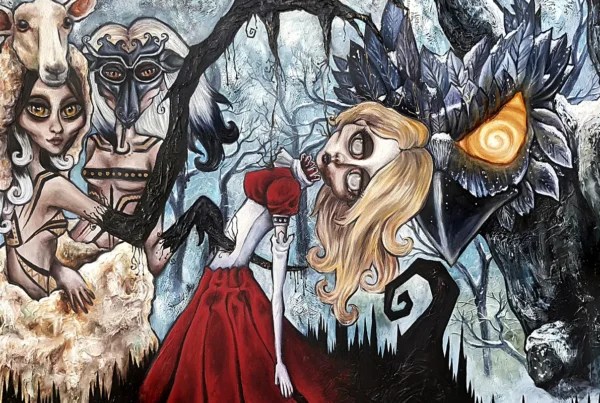
At the same time, she acknowledges the practical realities that accompany artistic production. Becoming conscious that one’s work exists within an economic framework introduces a level of responsibility that cannot be ignored. Such awareness does not imply surrendering personal vision or conforming to external expectations. Rather, it involves making thoughtful choices while maintaining integrity. Alongside this pragmatic perspective, Di Francesco preserves a deeply romantic image of the artist as someone who creates courageously and defends the capacity to dream. Her visual language reflects this balance. She describes it as containing a partially revealed mystery, something intimately familiar yet strangely distant. Motifs ranging from angels and demons to stars, departures, returns, dreams, and nightmares coexist within shifting compositions. Instead of fixed themes, she conceives of ideas as material forms that evolve, disappear, and reappear over time.

Windows of Memory and the Ritual of Making
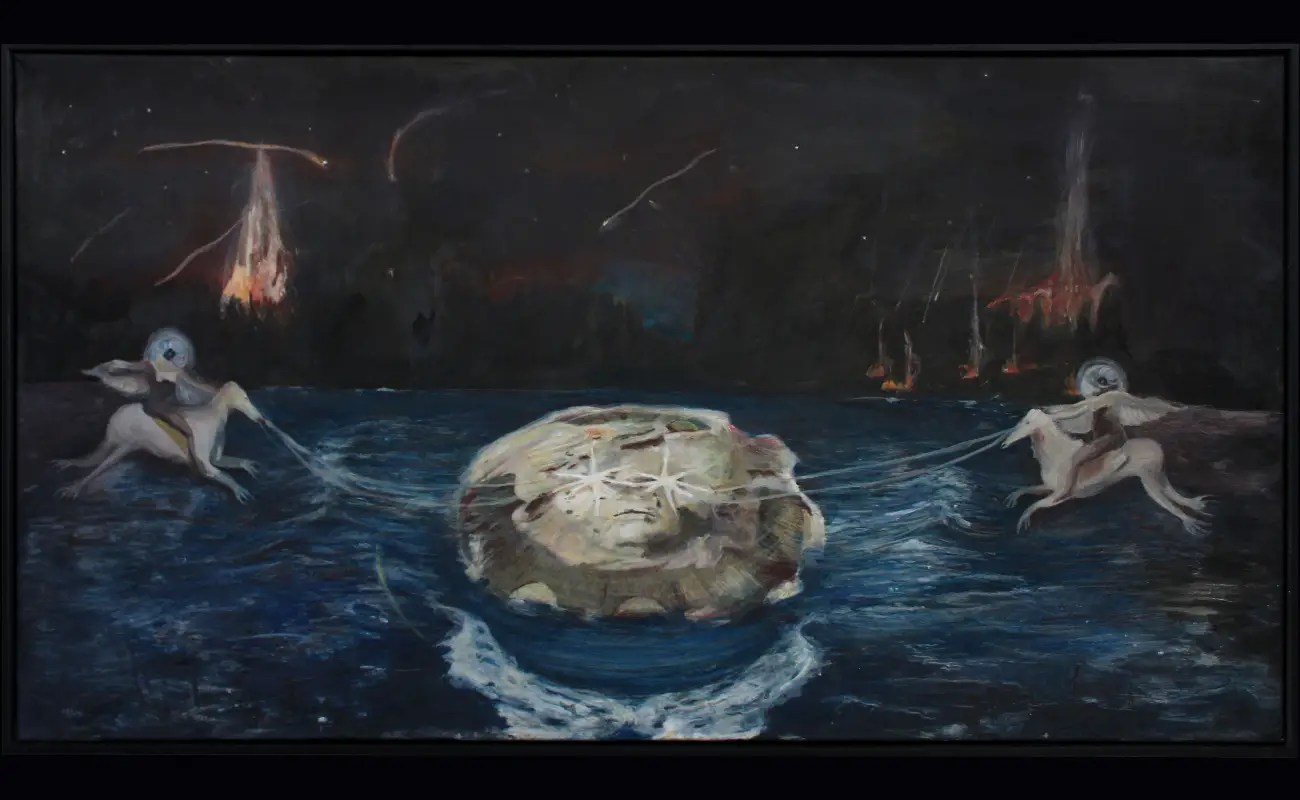
Selecting a single artwork that encapsulates her practice proves challenging for Di Francesco because each piece functions as an opening onto specific memories. Nevertheless, she expresses a profound attachment to the painting titled I drank marine crystals and to a more recent triptych known as That Day You Told Me You Knew How to Tell the Streamers. Emotional proximity to particular works fluctuates according to mood and circumstance. Some paintings seem to address her directly, reminding her of past experiences or suggesting new interpretations long after completion. Among these, I drank marine crystals stands out as especially significant. Created during a single night marked by intense inner urgency, the work emerged without external deadlines or constraints. She recalls speaking quietly to herself while painting, revisiting a personal episode that had triggered the need to create. Through this solitary dialogue, the painting gradually offered its own form of response, transforming uncertainty into visual presence.
Di Francesco often finds herself most connected to works that initially resist understanding. Difficult paintings demand patience and attentive listening before they can be approached effectively. This process frequently unfolds during nighttime sessions, when concentration deepens and external distractions diminish. With the arrival of daylight, she perceives subtle shifts in meaning, as if the artworks themselves were proposing new possibilities. Over time, they reach a point of equilibrium where form and intention align. Another composition she remembers with particular pleasure is Ether Wave, inspired by a constellation of impressions gathered during a visit to Rome. Encounters with a sculpture by Gian Lorenzo Bernini, the luminous intensity of an orange sky scattered with white clouds, and the simple act of collecting flowers in a field all contributed to the painting’s conception. Returning to Florence and noticing a familiar star from her balcony completed the sequence of perceptions that would later converge on canvas.
The technical preparation behind her paintings constitutes a ritual that anchors these emotional and conceptual explorations. She begins by constructing the stretcher frame and proceeds to a moment she considers especially meaningful: attaching paper to the canvas. This material reconnects her with beginnings, reducing the illusion of control and encouraging the acceptance of mistakes. For Di Francesco, error is not a failure but an essential component of growth. Her method involves drawing with pencil, applying oil paint, partially erasing marks, and allowing traces to remain visible beneath translucent layers. Gradual accumulation of gestures creates surfaces that echo the stratification of thoughts and memories. Through this layered approach, she translates intangible sensations into tangible form, constructing images that retain the vitality of their origins while inviting viewers to participate in their unfolding narratives.

Claudia Di Francesco: Light as Companion and Guide
Among the many forces that influence Di Francesco’s work, light occupies a position of undeniable prominence. She regards it as a primary source of inspiration capable of transforming perception and emotional state. Its presence becomes particularly powerful in darkness, when even a faint glimmer can appear almost enchanted. A solitary star shining overhead may evoke feelings of reassurance, suggesting that one is not entirely alone. Morning light filtering across a tiled floor can produce an unexpected sense of welcome, prompting simple gestures such as preparing coffee with renewed enthusiasm. The glow of a candle during nighttime hours offers comfort and intimacy. These experiences illustrate how illumination functions not merely as a visual phenomenon but as a companion that accompanies daily existence. Capturing this elusive presence in painting presents an ongoing challenge that requires sustained observation and reflection.
Mood represents another crucial factor shaping her creative decisions. Contrary to popular myths that associate artistic production exclusively with suffering, Di Francesco believes that what truly matters is maintaining an internal spark. Each day demands the rediscovery of motivation, a willingness to test personal limits and move beyond familiar territory. This inner energy drives her commitment to continuous improvement, ensuring that stagnation never takes hold. When considering historical influences, she adopts an inclusive attitude, learning from artists she admires as well as from those whose approaches she finds less compelling. Painters such as Georges de La Tour and Vilhelm Hammershøi attract her attention for their intense investigations of light, while Jean Baptiste Camille Corot’s atmospheric sensitivity and Joseph Wright of Derby’s suspended scenes offer additional points of reference.
Her curiosity extends to the enigmatic qualities found in Flemish masters like Petrus Christus and Gerard ter Borch, whose works seem to conceal stories beneath composed surfaces. She also responds to the delicate tension and spiritual fervor present in Beato Angelico’s imagery, alongside the dramatic vitality of Bernini’s sculptures. Ultimately, however, Di Francesco describes her method of study as primarily visual. She attempts to gather insights simply by looking, absorbing details with the hope of transforming them into something distinct. This process continues within her daily routine, which combines rigorous research with imaginative reflection. Books spread across a table, photographs revisited, and glimpses of a garden from her balcony contribute to the formation of mental images composed of numerous fragments. These visions evolve further once translated into paint. Looking ahead, she expresses particular excitement about a forthcoming solo exhibition at the Museum of Kazanlak in Bulgaria, an opportunity connected to her participation in a residency and the Enyovden festival. Immersion in local traditions and natural surroundings during that experience has already begun to shape the direction of future works.