“No definitive way exists to be fully heard and understood.”
Origins Across Borders and Disciplines
Clara Fortis stands within a generation of artists whose work is shaped by movement across countries, languages, and social environments. An Austrian interdisciplinary artist living and working between Zürich and Paris, she brings together experiences formed in Switzerland, Russia, France, and the United States. That layered background informs a practice concerned with belonging, exclusion, communication, and the fragile ways people encounter one another. Her route into contemporary art was not narrow or predetermined. Instead, it developed through study, relocation, and a willingness to reconsider what kind of creative life felt honest. This international perspective gives her work a rare emotional reach, since questions of identity are not approached as theory alone, but as lived experience. Viewers encountering her installations, sculptures, and paintings often meet spaces charged with intimacy and tension. These environments reflect someone who understands how social codes shift from place to place, and how the body carries those shifts. Fortis uses that understanding to create works that feel personal while speaking to collective human concerns.
Her academic training played a decisive role in refining that vision. Fortis graduated with departmental honours from Parsons Paris, The New School University, earning a Bachelor of Fine Arts in Art, Media and Technology. During an exchange year at Parsons School of Design in New York City, sculpture became a central focus and a turning point in her artistic development. Exposure to new materials, new conversations, and a different urban pace appears to have sharpened her attraction to three-dimensional form. Sculpture offered more than object making. It provided a language capable of addressing the body directly through scale, posture, proximity, and implied movement. That physical immediacy continues to define her mature practice. Rather than treating art as detached image-making, Fortis constructs experiences that place the viewer in relation to pressure, vulnerability, and gesture. Her educational path therefore did more than supply credentials. It gave her the tools to transform internal questions into structures that occupy real space and demand a bodily response.
After her studies, a year-long residency at Ateliers Sculpture Paris–Montreuil strengthened her commitment to continue as a sculptor. Residencies often test whether an artist’s interest is temporary or essential, and for Fortis the period appears to have confirmed sculpture as an enduring necessity. Yet her work extends beyond the studio through sustained social engagement. She assists in facilitating weekly art therapy workshops for individuals facing mental health struggles, and she is involved with the non-profit organisation Brief Shalimar, where she co-founded a support group for artists and creatives with disabilities. These commitments matter because they echo the ethics present in her art. Listening, care, visibility, and access are not abstract themes she adopts for aesthetic effect. They are values enacted through community work as well as through artistic production. This dual dedication enriches her practice, grounding formal experimentation in social reality. In Fortis’s case, art and care operate as parallel commitments that continuously inform one another.

Clara Fortis: The Body as Witness
Fortis did not begin in fine art alone. Her earliest studies were in fashion design, a direction that once seemed safer and more industry-oriented before she recognised a stronger need to create within her own framework. That shift away from fashion remains important because she did not abandon what she learned there. Instead, she carried forward an acute sensitivity to the body, surface, structure, and the politics of presentation. In her sculptural language, one can sense an understanding of how forms wrap, restrict, reveal, or frame human presence. Clothing and sculpture both negotiate space around the body, and Fortis turns that shared logic toward psychological expression. Her pieces often suggest postures, containment, and gesture rather than depicting the body literally. This gives them a charged ambiguity. They are objects, yet they also feel like traces of human states. The move from fashion to fine art therefore was not a rupture but a transformation, allowing concerns with embodiment to enter a more open and critical field.
Her research-led practice examines human behaviour through installation, sculpture, and painting. Drawing on psychology and related conceptual sources, she creates environments that feel emotionally immediate rather than academically distant. Fortis is particularly interested in how social dynamics leave marks on people, especially when individuals feel ignored, excluded, or unable to speak meaningfully. She often works with harsh materials, especially steel, to register the brutality that can hide inside everyday interactions. Metal in her hands is not simply industrial matter. It becomes a carrier of emotional weight, capable of expressing rigidity, injury, pressure, and endurance. Through this material language, viewers are invited to sense rather than merely understand the consequences of social cruelty. Her works can feel intimate and severe at once, combining vulnerability with force. That tension is central to her style. It resists sentimentality while refusing emotional emptiness, insisting that relationships and power structures are lived through the body.
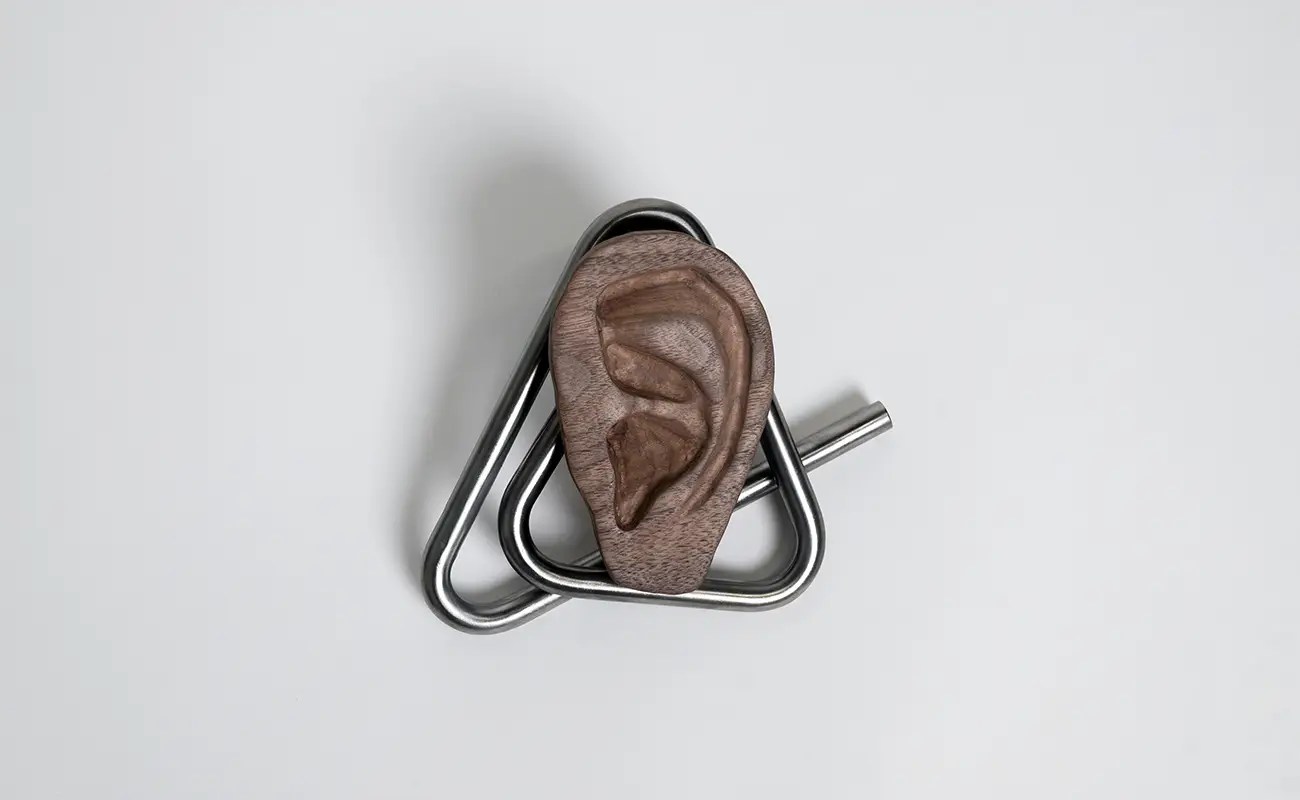
Recurring symbols such as ears, teeth, and entrapped figures reveal how carefully Fortis constructs her vocabulary. These motifs speak to hearing, speech, aggression, consumption, pain, and survival. Many sculptures are organised around bodily implication, suggesting communication through stance or withheld movement. Even when presented as static objects, they often carry the charge of performance, as though an action has just happened or is about to occur. This quality makes the viewer more than an observer. One becomes aware of one’s own posture, distance, and participation. Fortis uses that awareness to raise difficult questions: Who is listened to? Who is silenced? What emotional cost follows exclusion? How do casual behaviours shape another person’s internal world? Rather than offering moral slogans, she creates situations in which these questions can be felt physically. The result is art that asks for attention not through spectacle, but through sharpened sensitivity to human interaction and consequence.

Hearing, Silence, and the Pressure of Experience
Although Fortis notes that her work is rarely autobiographical in a direct sense, personal experience has profoundly influenced the direction of her practice. A major turning point came through an injury to her middle ear that resulted in hearing loss and severe chronic tinnitus. For a long period, she avoided the subject of hearing because it touched an unresolved conflict in daily life. That hesitation is revealing. Some themes require distance before they can become material for art. When hearing finally entered her work, it marked not only a new topic but also a process of acceptance regarding bodily change and ongoing limitation. Rather than treating loss as a closed tragedy, Fortis transformed it into inquiry. This movement from pain toward investigation gives her practice unusual depth. It demonstrates how difficult experience can be neither denied nor simply confessed, but translated into forms that invite broader reflection on what it means to perceive, to miss, and to adapt.
Her research expanded beyond medical facts into historical and mythological references surrounding the ear. Such an approach shows how bodily experience can open into culture, symbolism, and collective imagination. The ear is not only an organ. It is tied to obedience, attention, intimacy, vulnerability, surveillance, memory, and social recognition. Through studying these associations, Fortis recognised that the need to be heard is fundamental to human life. Hearing and communication cannot be cleanly separated. To listen is already to enter a relationship shaped by power, care, patience, hierarchy, or neglect. Some of her works therefore focus specifically on auditory experience, while others move toward speech, silence, and the unstable exchange between speaker and listener. This widening field gives her art both specificity and universality. A personal injury became a lens through which larger questions about community and emotional survival could be examined with precision.
What makes Fortis’s treatment of these themes compelling is her refusal to trap the viewer inside her biography. Even when the source material is intimate, she seeks to transform and partially conceal it within the finished work so others can encounter their own histories there. Many people know the sensation of speaking without response, being misunderstood, or longing for acknowledgment. Others know the fatigue of noise, the burden of pain, or the loneliness of altered ability. Fortis creates conditions where such experiences can surface without being dictated. Her art therefore operates through recognition rather than explanation. Viewers are not told what to feel, yet many may find themselves thinking about moments when they were ignored, unheard, or unable to articulate distress. This openness is crucial. It turns personal struggle into shared space, allowing art to function as encounter rather than testimony alone.

Clara Fortis: Steel, Scream, and What Comes Next
Among the works Fortis values most are two steel sculptures exhibited together: The Posture of Hearing and The Anatomy of Screaming. Presented in dialogue, they form a compelling study of communication under pressure. The Posture of Hearing draws from historical depictions of listening, especially the familiar gesture of cupping a hand behind the ear to hear more clearly. Fortis translated that action into an abstract steel form that confines the body into a kneeling position. The posture evokes divinity, sexuality, submission, and penitence all at once. Born from the frustration of feeling unheard, the sculpture seeks to make room for genuine listening. Yet the space remains empty, waiting for occupation. That absence becomes central to the meaning of the work. It suggests there may be no final method by which a person can guarantee being fully understood, no perfect posture that compels another to truly hear.
Set against it, The Anatomy of Screaming approaches communication from the opposite direction. Inspired by stroboscopic imagery, the sculpture references vocal cords in motion and abstracts their appearance during a scream. If listening in the first work is marked by vacancy and waiting, this second piece confronts the body at the moment of extreme expression. A scream is immediate, involuntary, and unmistakable, often emerging under intense distress. Fortis positions the sculpture at throat level, inviting viewers to enter the space of the screaming vocal cords themselves. In doing so, she makes interior violence tangible. Something usually hidden inside the body becomes architectural and encounterable. The viewer does not merely imagine the scream but physically negotiates its space. Through steel, she converts sound into structure and emotion into environment. This capacity to materialise psychological intensity is one of the defining strengths of her sculptural practice.
The installation became especially meaningful through audience response. Visitors reportedly moved between the two works and instinctively aligned their own bodies with The Anatomy of Screaming, almost entering a performative state, only to meet the bodily absence of The Posture of Hearing. That sequence generated a quiet tension: expression without reception, urgency without listener, a cry with no guaranteed witness. Few themes could summarise Fortis’s wider concerns more clearly. Looking ahead, her daily practice continues to balance making with research, writing, journaling, and poetry, which form the emotional groundwork of new projects. She often develops titles and conceptual frameworks before final forms are complete, assembling ideas through a process akin to collage that draws on psychology, philosophy, and medicine. She is currently developing a series titled Nietzsche’s Dog, inspired by Friedrich Nietzsche’s comparison of pain to a loyal but unwanted companion. Through two-dimensional and three-dimensional works, Fortis aims to visualise chronic pain and continue her searching conversation between body, language, and endurance.