“The ultimate goal of art is joy.”
Painting a Brazil Carried Across Borders
Christine Drummond paints from a place where memory, movement, and color converge. Born and raised in Rio de Janeiro, the Franco-Brazilian artist now lives in France, yet the visual and emotional force of Brazil continues to shape her oil paintings. Rather than treating her birthplace as a distant subject, Drummond carries its atmosphere into the studio: the meeting of ocean and mountains, crowded beaches, Carnival celebrations, lively street markets, tropical vegetation, and communities spreading across Rio’s hillsides. These impressions have remained vivid through years spent living abroad and traveling through different countries. In her work, they are transformed rather than simply reproduced. Brazil becomes an internal landscape, remembered through sensation and interpreted through paint. This approach gives her canvases an emotional intensity that extends beyond geographic description. Her paintings communicate how a place can remain present within someone long after physical distance enters the story, with color serving as the bridge between recollection, identity, and the immediate experience of painting.
Drummond did not follow a conventional path toward an artistic career. She began painting at 37 while living in the United States, without anticipating that the activity would become central to her life. The experience quickly developed beyond a pastime and offered her a form of expression she had not previously possessed. That relatively late beginning is significant because her artistic language emerged from accumulated memories and experiences rather than from a lifelong professional trajectory. By the time she encountered painting seriously, she had already absorbed the colors, rhythms, and contrasts of Rio and had experienced life beyond Brazil. Those layers of experience gradually found their way onto canvas. Although international travel broadened her perspective, her strongest visual reference remained the city of her childhood. Beaches, favelas, markets, Carnival, people, and abundant vegetation became recurring subjects, connected not by documentary observation but by a shared sense of movement. Her paintings seek the emotional pulse beneath these scenes rather than an exact record of their appearance.
Joy occupies a particularly important position within this artistic outlook. Drummond describes color as her language and regards painting as a means of transmitting positive energy to other people. Her belief that “the ultimate goal of art is joy” therefore functions as more than an optimistic phrase. It helps explain the choices that recur throughout her practice, from saturated colors and animated surfaces to scenes where groups of people gather and move together. Her interpretation of joy does not depend upon denying complexity. Instead, it directs attention toward vitality, human connection, and the capacity to find creative energy within everyday environments. This distinction becomes especially important in her representations of Rio’s favelas, where she consciously acknowledges difficult social realities while choosing to depict qualities such as resilience, community, creativity, and life. Across her wider body of work, joy becomes both an aesthetic principle and a way of seeing, allowing personal memory to open outward into an experience that viewers can encounter on their own terms.

Christine Drummond: Finding Freedom at the Edge of the Palette Knife
A decisive shift occurred in Drummond’s practice in 2004, when she encountered the paintings of Ghanaian artist Ablade Glover. She was captivated by the force Glover achieved through color, texture, movement, and his use of the palette knife. The discovery changed her own approach so substantially that she stopped using brushes and committed herself exclusively to palette knives. This technical decision became fundamental to the character of her paintings. Unlike a brush, the knife gives her a degree of unpredictability that she actively welcomes. Paint can be pressed, spread, layered, interrupted, or scraped away, creating surfaces where physical action remains visible. Drummond does not seek total command over every mark. She allows gestures and colors to interact during the process, making surprise part of the work rather than something to eliminate. The resulting texture is not merely decorative. It records the movement of her hand and the progression of the painting, helping transform static imagery into scenes charged with rhythm and physical presence.
Her connection with Glover’s work later moved from influence at a distance to direct experience. In 2009, Drummond traveled to Accra, Ghana, where she had the opportunity to paint beside him in his studio. Working alongside the artist whose paintings had encouraged her to adopt the palette knife carried profound personal significance. Yet she did not interpret influence as an invitation to imitate his visual identity. What mattered most was the freedom she recognized in his gestures, the energy generated through his handling of paint, and the expanded possibilities of the medium itself. Those lessons aligned naturally with Drummond’s own attraction to movement and spontaneity. Her palette knife became a tool through which memories could remain fluid rather than fixed. Layers meet and overlap, colors shift against one another, and irregular marks preserve the physical momentum of their creation. In this way, technique and subject become closely connected: a lively beach, a Carnival crowd, or a hillside community can be conveyed through paint that behaves with comparable vitality.
The physical nature of this process continues into Drummond’s daily studio routine. She works standing, moving around the canvas as she alternates between close observation and greater distance. Paint is added in successive layers, sometimes removed, and continually reassessed as the composition develops. She seldom begins with every decision established beforehand. A memory, an idea, or an exciting combination of colors may provide the starting point, but the painting is then permitted to change direction through the act of making it. Brazilian music is another important presence in the studio. Drummond often paints while listening to a Brazilian playlist, singing with the music and sometimes dancing when she steps away from the canvas to evaluate what is happening. This relationship between sound, bodily movement, and visual gesture reinforces the rhythmic quality of her work. Completion arrives when she senses that another addition would diminish the painting’s existing energy rather than strengthen it, making restraint the final decision within an otherwise exuberant process.

Between Alleys, Hillsides, and Collective Life
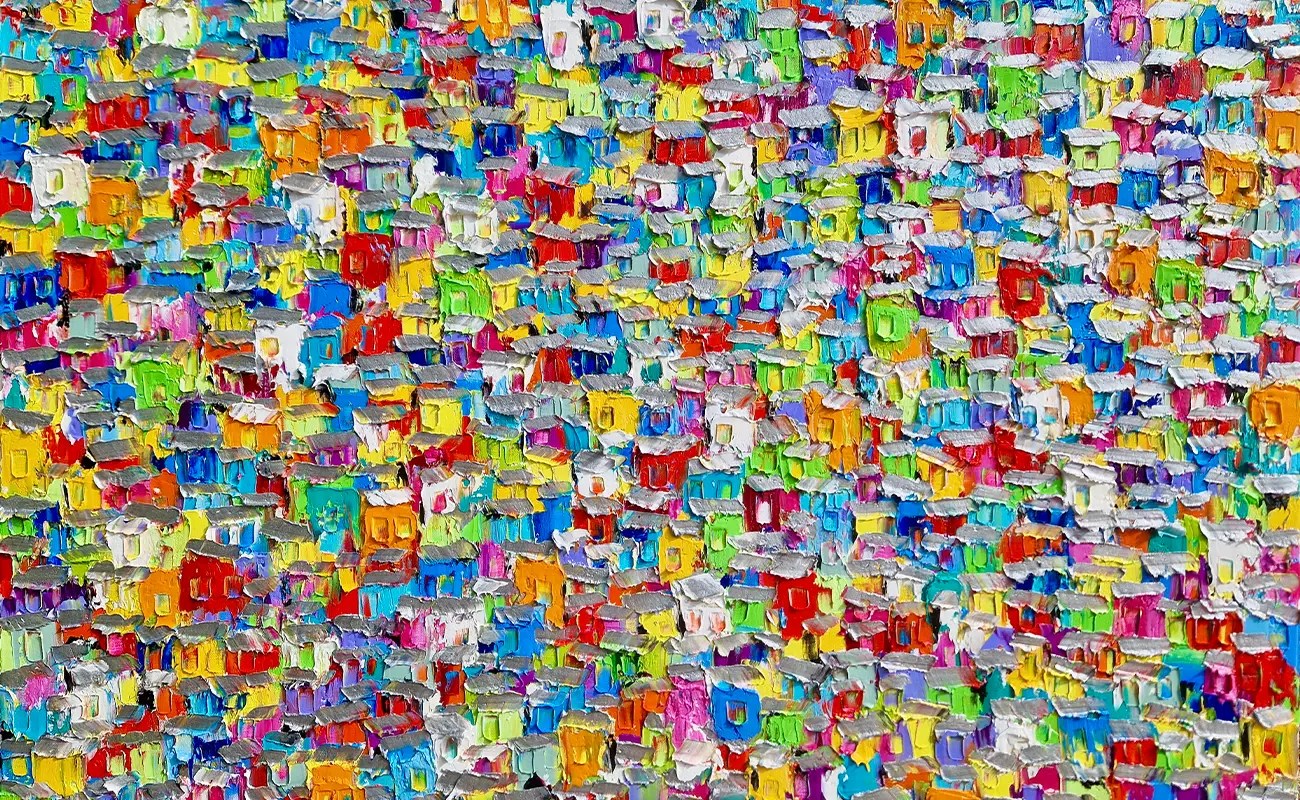
Among Drummond’s works, Entre Becos e Vielas holds particular meaning. Part of her Favela series, its Portuguese title refers to the narrow alleys and passageways running through Rio de Janeiro’s hillside communities. Drummond has long been drawn to their distinctive visual structure, where homes, colors, pathways, and daily lives appear tightly interwoven. Viewed from afar, buildings seem to accumulate irregularly across the slopes, producing a shifting pattern that responds to the contours of the landscape rather than conforming to a rigid order. In Entre Becos e Vielas, she wanted the viewer’s gaze to travel through that complexity, moving among fragments of color and discovering small indications of human presence. The composition therefore becomes an invitation to look rather than a fixed statement about what a favela is. Its visual rhythm reflects Drummond’s broader interest in scenes where many individual elements coexist within a larger collective energy, a recurring concern that also appears in her paintings of beaches, markets, people, and Carnival gatherings.
Created in oil on canvas entirely with palette knives, Entre Becos e Vielas demonstrates how Drummond uses technique to reinforce meaning. She built the surface through successive applications of paint, allowing some passages to become thick and tactile while leaving other areas comparatively exposed. Spontaneity and imperfection were deliberately retained because she considers them essential to movement. The varied surface gives the painting a physical rhythm suited to the maze of passages and structures it evokes. At the same time, the work carries a careful ethical position regarding its subject. Drummond does not deny the social difficulties faced within favela communities, and she does not seek to idealize those conditions. Her purpose is instead to make visible another dimension that international representations can overlook. Through color and animated mark-making, she draws attention to creativity, resilience, community, and everyday vitality. Her perspective resists reducing these neighborhoods either to hardship or to romantic imagery, focusing instead on aspects of lived experience that coexist with acknowledged social challenges.
The Favela series later acquired an unexpected life beyond exhibitions and the studio when some of Drummond’s paintings appeared in educational materials used in Brazilian schools. Watching young students encounter, discuss, and develop their own interpretations of the works affected her deeply. The experience revealed how an image rooted in personal memory could circulate far beyond the circumstances of its creation and become material for other people’s thinking. That possibility connects closely with her recurring fascination with collective experience. Many of her paintings contain numerous figures because she is interested in moments when separate lives seem to participate in a larger rhythm. Whether people are gathered on a crowded beach, moving through Carnival, visiting a market, or inhabiting a dense urban landscape, individuality and community coexist. Drummond describes this impulse through the idea of collective joy, an interest that turns populated scenes into more than depictions of crowds. They become visual explorations of how energy can pass among people and how shared spaces can generate a sense of connection.

Christine Drummond: Turning Memory Into an Immersive Future
Rio remains Drummond’s most persistent source of inspiration because its contrasts provide an almost inexhaustible visual vocabulary. The geometry and color of hillside favelas encounter the organic forms of mountains and tropical vegetation. Crowded beaches bring bodies, umbrellas, sand, and water into constantly changing configurations. Carnival supplies rhythm and movement, while markets offer another expression of public life and human gathering. These subjects might appear separate when considered individually, yet Drummond understands them as interconnected expressions of Brazil. Her paintings are therefore less concerned with creating literal records than with conveying what it feels like to inhabit or remember these environments. She searches for their pulse, concentrating on sensation and emotional presence. Travel and residence in different countries have sharpened that perspective rather than weakening it. Encounters with other cultures have made her attentive to common human behaviors, particularly the tendency to gather, move, celebrate, and share public space. These observations return to her canvases through recurring combinations of people, color, and motion.
That interconnected vision is also shaping Drummond’s ambitions for future exhibitions. She wants to bring several bodies of work together so that paintings of beaches, favelas, Carnival, markets, people, and tropical nature can communicate across their apparent differences. Rather than presenting each theme as an isolated chapter, she imagines a larger exhibition in which they collectively express her continuing celebration of Brazil, color, and life. Paintings at different scales could contribute to an immersive environment driven by visual movement, allowing visitors to experience relationships that are already central to her practice. Such a project would extend the logic of individual canvases into physical space. The same qualities that animate her painted surfaces, including density, rhythm, contrast, texture, and chromatic intensity, could unfold across a broader encounter. Her desire for a more ambitious presentation does not signal a departure from the subjects that have defined her work. Instead, it offers a way to let those subjects coexist more fully and reveal the shared emotional current running through them.
More than twenty years after painting became part of her life, Drummond still approaches the blank canvas with the excitement that accompanied her early discovery of the medium. That continuity is striking because her practice has developed through substantial changes: beginning unexpectedly at 37, abandoning brushes after encountering Glover’s work, painting alongside him in Ghana, and seeing images from her Favela series enter Brazilian educational materials. Throughout those experiences, certain foundations have remained steady. Brazil continues to supply the memories and subjects; oil paint provides material richness; the palette knife preserves physical spontaneity; and color carries much of the emotional message. Most importantly, Drummond continues to view painting as an active exchange rather than a predetermined exercise. Each canvas can redirect her through its emerging combinations of gesture and pigment. Her future plans build on that same openness, enlarging the scale of the conversation without abandoning its source. There are still stories she wants to paint, and the enduring excitement of beginning again keeps those stories in motion.
For more information, please follow Christine Drummond on Instagram: @christinedrummond_art