“Painting has become a way for me to slow those fleeting moments down.”
Where Digital Memory Finds a Physical Surface
Jesse Morsberger paints the familiar spaces where personal memory, ordinary life, and digital culture quietly converge. Based in Brooklyn, he focuses on experiences shared by a generation that came of age during the 1990s and 2000s, when video games, anime, and the early internet became significant parts of daily experience. For Morsberger, these influences are not simply nostalgic references or recognizable symbols from a particular period. They represent formative environments in which friendships developed, identities took shape, and young people learned to imagine both themselves and the wider world. His paintings consider what happens when those early encounters remain present in adulthood, embedded in recollection and perception long after childhood has passed. Instead of treating technology as an isolated subject, Morsberger looks at its subtle presence within domestic existence. A monitor casting light into a room, a game console occupying familiar space, or the glow of a phone can become emotionally charged elements within scenes that initially appear completely ordinary.
Oil painting gives Morsberger a means of slowing down images and experiences that might otherwise disappear almost immediately. This choice of medium creates an important contrast with the speed and transience associated with digital culture. Screens change rapidly, online imagery circulates endlessly, and technological devices are continually replaced, yet a painted surface requires sustained physical attention. Morsberger uses that difference to transform fleeting visual impressions into objects that can be encountered at another pace. His domestic scenes therefore function less as records of particular technologies than as reflections on how those technologies become woven into personal experience. Objects gain significance through their relationship to people, places, and remembered moments. The resulting paintings address a generation whose lives have developed across physical and virtual spaces without suggesting that the two can be neatly separated. Through oil paint, Morsberger gives visual permanence to experiences that are often difficult to preserve because they feel simultaneously commonplace, intimate, and temporary.
Memory remains central to this approach because Morsberger is interested in more than reproducing recognizable imagery from his youth. His paintings examine how environments and objects accumulate emotional meaning through repeated contact. The ordinary domestic setting becomes especially useful because it allows him to consider the places where technology is experienced most casually and personally. Digital culture enters these rooms without spectacle. It exists alongside furniture, animals, counters, glasses, screens, and the countless other details that form the background of daily existence. Such imagery allows Morsberger to explore a broader visual history of growing up during a period of profound technological change while keeping individual experience at the center of the work. His perspective is rooted in the understanding that cultural memory is often built from small encounters rather than monumental events. By translating these encounters into expressive oil paintings, he preserves the emotional texture of experiences that might otherwise remain unnoticed, giving ordinary scenes the duration necessary for viewers to reconsider what they remember.

Jesse Morsberger: From Comic Strips to a Language of His Own
Art entered Morsberger’s life through family experience long before it became a professional practice. He grew up surrounded by artists, with a musician father and an oil painter grandfather providing two distinct creative models. Some of his earliest memories involve sitting at the kitchen table with his father and making comic strips together. Calvin and Hobbes and Peanuts were important early references, introducing him to visual storytelling through images that could be direct, expressive, humorous, and emotionally resonant. Those experiences established a relationship between drawing and narrative that continues to inform the way he constructs paintings. Rather than regarding his childhood interests as influences that needed to be abandoned in favor of a more conventional artistic vocabulary, Morsberger has allowed them to remain active within his thinking. Composition and image making developed through sustained contact with popular visual culture, while his family environment demonstrated that creativity could be a serious and enduring part of everyday life.
A further shift occurred during middle school, when Morsberger discovered manga and became captivated by its visual possibilities. Together with comics, anime, and later digital media, manga expanded the vocabulary through which he understood storytelling and composition. These references now coexist with the language of painting rather than functioning as separate cultural categories. His current practice draws upon video games, anime, and the early internet because these forms genuinely shaped his visual education and the memories of his generation. Their importance lies not only in their appearance but also in the experiences surrounding them. They provided shared points of connection and contributed to how people understood identity, imagination, and friendship. Morsberger brings these sources into painting without attempting to imitate their original formats. Instead, he considers what happens when imagery associated with rapidly changing media is translated through the physical resistance, texture, and duration of oil paint. The transformation allows familiar visual experiences to acquire a different emotional weight.
The physical character of painting is consequently as important to Morsberger as the subjects he chooses. He wants the surfaces to register human presence, and his brushwork tends toward a rugged, expressive quality rather than polished detachment. This tactile treatment reinforces the contrast between the digital references embedded in his imagery and the unmistakably handmade process through which they are reconstructed. The tension is central to his style. Digital culture may provide memories, visual cues, and narrative associations, but paint supplies friction, irregularity, and evidence of touch. Morsberger does not conceal the act of making behind a seamless finish. Instead, expressive handling becomes part of how each scene communicates. His paintings can therefore feel immediate while also carrying the slower rhythms of sustained observation and revision. The visual language that emerged from childhood comics, manga, games, and internet culture meets a medium connected to his grandfather and to a much longer artistic tradition, allowing personal history and generational experience to occupy the same painted surface.

Finding Significance in the Unremarkable
Morsberger also locates his practice within a lineage of painters who treated personal experience and everyday surroundings as worthy artistic subjects. Philip Guston and David Park have been especially important in showing him how ordinary life can support paintings of considerable emotional and visual force. Their example reinforced an idea that already resonates throughout his work: significance does not require extraordinary subject matter. A familiar room, a mundane object, or an apparently incidental moment can become compelling when approached through a personal visual language. This principle connects naturally with Morsberger’s interest in memory because recollection rarely assigns importance according to conventional hierarchies. A minor detail can remain vivid for years, while seemingly important events may fade. Painting gives him a structure through which such uneven patterns of attention can become visible. His subjects retain their accessibility, yet expressive brushwork and careful choices about imagery encourage viewers to remain with scenes they might otherwise pass without a second thought.
A recent oil painting of a cat drinking water from a glass on a kitchen counter demonstrates this principle with particular clarity. Morsberger has said that he often finds it difficult to look back at much of his own work, yet this painting is one he feels pleased with. Its importance comes from the balance it achieves between an immediately relatable event and an image memorable enough to sustain attention. The subject is modest: a cat, a glass of water, and a kitchen counter. Yet that modesty is precisely what allows the painting to express one of the central ambitions of his practice. Morsberger seeks moments that viewers recognize instinctively while leaving enough visual and emotional openness for interpretation. The painting also captures the expressive brushwork he continually pursues, connecting the simplicity of the scene to the physical energy of its construction. Rather than elevating daily life by making it unfamiliar, he allows recognition itself to become the entry point for prolonged looking and personal association.

Jesse Morsberger: Painting Without Knowing the Destination
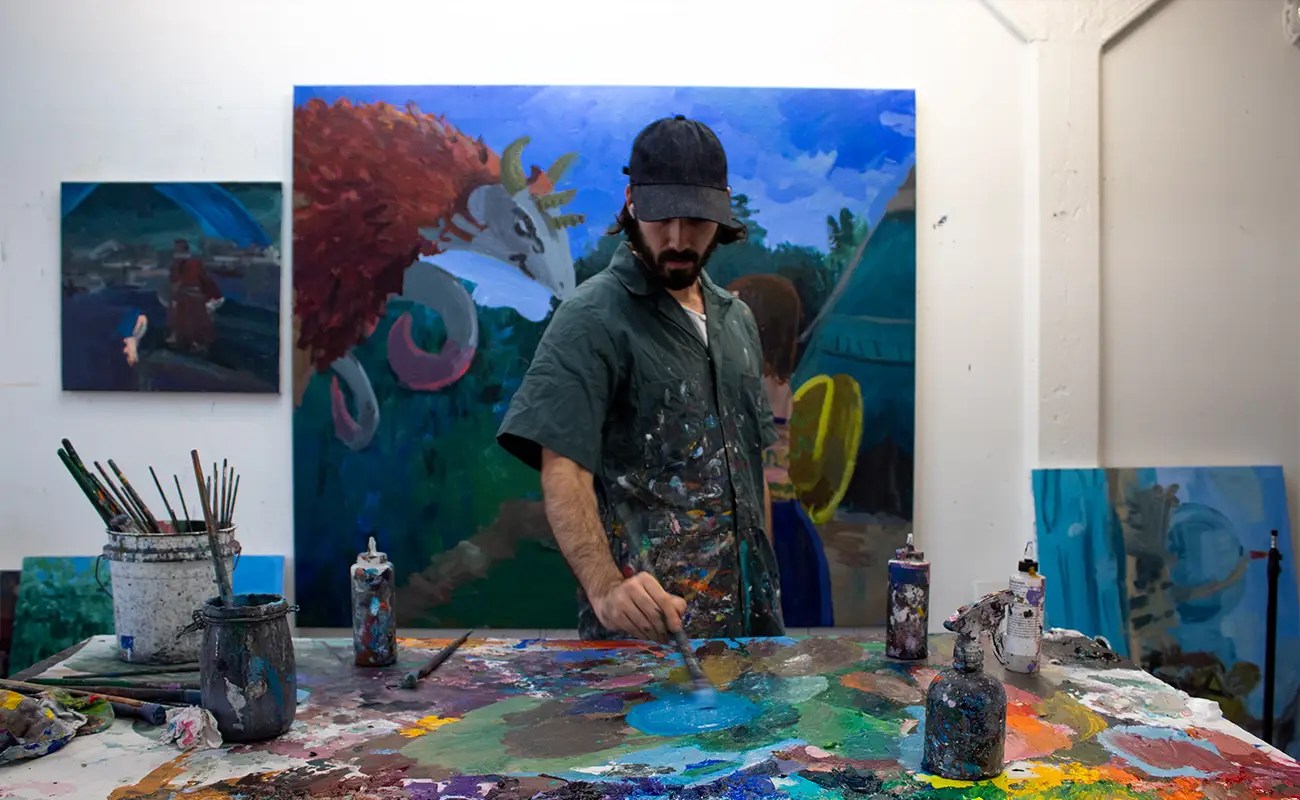
Morsberger’s studio process reflects the openness visible in his choice of subjects. He generally works on several paintings simultaneously, allowing each canvas to develop through an intuitive process rather than according to a predetermined plan. Preliminary sketches are not part of his usual method. Instead, he begins painting and discovers the image through the act of working, leaving space for decisions, changes, and unexpected developments to redirect the composition. This approach makes uncertainty productive rather than something to eliminate before the brush reaches the surface. A painting is not simply the execution of an idea already resolved elsewhere. It becomes the place where the idea is tested and found. Such a process aligns closely with his expressive handling of oil paint because both depend upon responsiveness. The visible surface can carry the history of choices made while the image develops, reinforcing the sense that these paintings have been constructed through human attention rather than produced according to a fixed visual formula.
Working across several canvases also gives Morsberger a practical way to manage periods when a painting stops progressing. Rather than forcing a solution, he can put one work aside and shift his attention to another. Returning later with fresh eyes creates the possibility of seeing what was previously difficult to resolve. The method acknowledges failure as an ordinary part of painting rather than an exceptional interruption. By his own estimate, perhaps one painting out of every ten truly comes together. That ratio reveals how much experimentation lies behind the works that ultimately succeed. Maintaining multiple paintings at once increases the likelihood that an unexpected image, decision, or combination will emerge. Discovery is therefore not only an aesthetic ideal but also a working structure. Morsberger creates conditions in which surprise can occur, accepting that many attempts will not produce the result he wants. The successful paintings gain their vitality partly from this willingness to proceed without certainty and to recognize when something unforeseen has begun to work.
That studio philosophy brings together many of the concerns that have shaped Morsberger from childhood onward. Comics taught him about visual storytelling, manga expanded his sense of composition and image making, family members demonstrated the enduring possibilities of artistic practice, and digital culture supplied a shared vocabulary of memory and identity. Oil painting gives those influences a physical form while resisting the speed with which many of their original images are consumed. His intuitive process keeps the resulting work from becoming a straightforward archive of cultural references. Each painting instead emerges through a negotiation between remembered imagery, immediate decisions, expressive touch, and the unpredictable behavior of the developing picture. Whether the subject is a technological object glowing inside a room or a cat drinking from a glass, Morsberger returns attention to moments easily overlooked. By keeping the process open, he allows those ordinary fragments to acquire unexpected presence, preserving not only what a generation saw but something of how its experiences continue to feel.