“Life is Art, and Art is Life!”

Author Photo
Polluted Water
Finding an Artistic Language in the Streets
Some artists search for extraordinary subjects, while Bobbi Mastrangelo discovered lasting creative possibility in objects most people walk across without a second glance. For more than four decades, she transformed manhole covers, water covers, drains, grates, cracked pavement, and other elements of public infrastructure into sculptural reliefs, embossed prints, assemblages, and environmentally conscious works. Her practice, which she named “Grate Works of Art,” grew from a fascination with circles into an extended investigation of overlooked urban forms. Influenced by American Pop Art and its elevation of commonplace objects, Mastrangelo developed an artistic identity around the visual vocabulary beneath everyday footsteps. The resulting works could be strikingly convincing. Her relief sculptures sometimes appeared so authentic that viewers accused her of taking actual manhole covers from streets and hanging them on walls. Behind that realism was an artist who learned to notice texture, deterioration, municipal design, and the hidden systems that make cities function.
Mastrangelo did not begin her professional life in an art studio. She first worked for six years as an elementary school teacher, then returned to college during her years at home as a mother, taking one art course each semester. Two professors helped redirect the course of her creative thinking. Printmaking professor Dan Welden encouraged her to establish a consistent theme, while art historian Lawrence Alloway observed a recurring formal characteristic in her work, telling her that she had “a penchant for circles.” At first, the observation created a problem rather than a solution. What meaningful artistic direction could emerge from circles? The answer arrived when Mastrangelo encountered photographs of manhole covers, objects that Sol LeWitt had characterized as urban art. Suddenly, an ordinary feature of city streets became an expansive source of visual ideas. In 1979, she committed herself to manhole covers, water covers, grates, and drains, giving a distinctive name and identity to the body of work that would define her career.
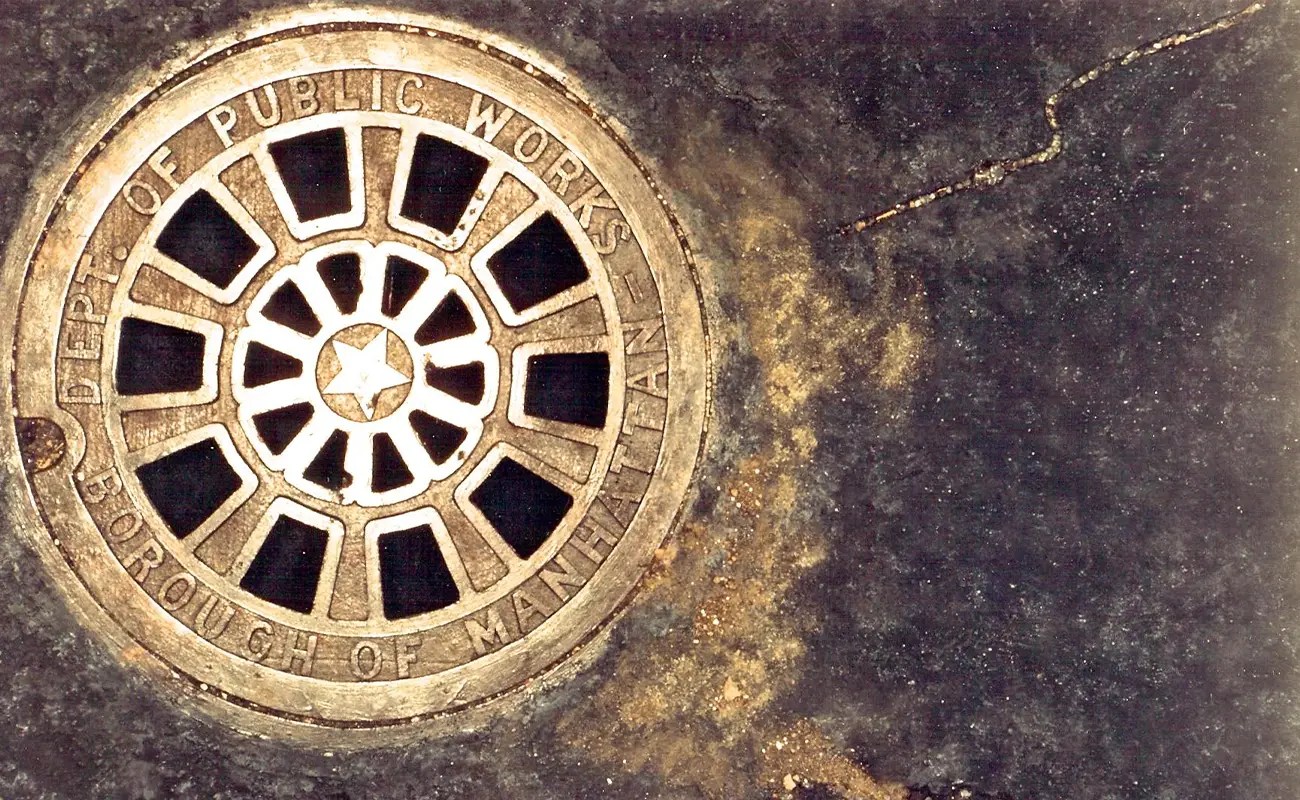
The subject also connected Mastrangelo with the legacy of Andy Warhol, Jasper Johns, and American Pop Art, particularly its ability to shift familiar objects into new cultural and visual contexts. Manhole covers were almost aggressively ordinary, embedded into sidewalks and roads and encountered countless times without sustained attention. Mastrangelo recognized that this familiarity was precisely what made them compelling. “Borough of Manhattan,” one of her successful early manhole cover sculptures, demonstrated how municipal infrastructure could become an artistic subject while retaining its recognizable identity. Her commitment extended beyond reproducing circular designs. She became increasingly attentive to the surroundings of the covers, studying cracks, crevices, sidewalk surfaces, signs of age, and the physical evidence left by weather and use. Municipal and public works employees also became unexpected contributors to her education. Friends and relatives sent photographs and rubbings, while workers offered information about sewer construction and maintenance. Through this exchange, a subject chosen for its visual potential also became an acknowledgment of largely unseen civic labor.

Water?
Bobbi Mastrangelo: Making the Ordinary Unmistakable
No instructor taught Mastrangelo how to construct the sculptural reliefs that became central to her practice. She developed her own methods, carving lightweight polystyrene sheets with a snap off knife and building surfaces capable of suggesting the density, damage, and age of streets. The challenge was not simply to reproduce a recognizable manhole cover. She wanted surrounding materials and props to appear convincingly weathered, which required close observation and practical experimentation. That inventive spirit could turn studio preparation into family theater. While creating an installation for the “City Views” exhibition at the Staller Center for the Arts, she enlisted her daughter Anne to help age a freshly painted orange and white barricade. Mastrangelo mixed muddy water with a small amount of black paint, and mother and daughter threw cups of the mixture over the object until its newness disappeared. The laughter accompanying the process reveals an important dimension of her work: technical problem solving, humor, curiosity, and family participation frequently occupied the same creative space.
Printmaking offered Mastrangelo another way to investigate the forms she found in public infrastructure. After purchasing a Dickerson Printing Press in 1980, she created deeply embossed prints on handmade paper, translating the physical character of utility covers into impressions that emphasized surface and pressure. Her husband, Al, encouraged her to give environmental concerns a stronger role within the work, an idea she embraced. Prints including “Water?” and “When the People Care” addressed ecological questions, while the sculpture “Save Water” carried the message into three dimensional form and later became part of the permanent display at Toast Coffee House. Water infrastructure was therefore more than a source of circles, lettering, and industrial patterns. It offered a way to consider the resource moving beneath those covers and the responsibilities surrounding its protection. Mastrangelo could preserve the immediate visual recognition associated with street hardware while redirecting attention toward environmental consequences, allowing a familiar civic object to function simultaneously as subject, symbol, and warning.

Save Water
Water Drops at Toho
Her assemblage “Precious Water” pushed that environmental concern into an interactive experience. Two water covers presented viewers with sharply contrasting possibilities. Lifting one activated Mastrangelo’s recording about pure water, accompanied by flowing water sounds, musical chords, and free verse poetry. Opening the other produced a far more unsettling encounter, combining ominous audio, murky green liquid, and predictions concerning the collective future. Her eldest son, Michael, created the sound effects, continuing the pattern of family members contributing ideas and practical support to her work. He also proposed the possibility of water covers transforming into enlarged drops of water, and the Toho Water Authority eventually acquired some of those pieces. Another intervention came when a print on handmade paper became badly wrinkled against its support. Rather than discarding it, Michael suggested interpreting the damage as an earthquake scene. Mastrangelo adopted the concept, added supports and a deep shadow box frame, and “Earthquake” subsequently received an exhibition award. Accidents, suggestions, and environmental concerns could all become productive artistic material.

Toast Coffee House, in Patchogue, NY, permanent display of Bobbi Mastrangelo’s “Grate Works of Art. “
Where Family, Chance, and Material Meet
Collaboration within the Mastrangelo family was less a formal artistic program than an ongoing source of encouragement, labor, invention, and companionship. Al helped establish her studio whenever the family moved and frequently took the family out for meals, freeing time that Mastrangelo could devote to art instead of kitchen responsibilities. Her children contributed in equally distinctive ways. Peter was hired to transport her Con Ed installation, assemblages, and prints to the Staller Center for “City Views,” but his involvement went beyond delivery. During July 1992, while working part time at Seven Eleven, he brought home buckets of discarded coffee filters and grounds for an experiment in papermaking. Mastrangelo composted the grounds, rinsed the filters, tore them into pieces, and blended them with water, Elmer’s Glue, and calcium carbonate. She poured and pressed the mixture onto large screens, eventually producing two dozen sheets of mottled, mocha colored handmade paper measuring nine by twelve inches. Those reclaimed materials became surfaces for monotypes including “We’re All Connected” and “Polluted Waters.”

When the People Care
Inside 52GA-R
Peter also influenced “Precious Waters” shortly before the opening of “City Views.” After examining the assemblage, he suggested adding greenery to its simulated wrought iron fence. Mastrangelo liked the idea and went to the beach searching for vines. Anne declined the invitation to accompany her because she was absorbed in a book, a decision that proved unexpectedly fortunate. Mastrangelo collected an attractive vine without gloves and brought it home, only to wake the following day with an itching and burning rash across her upper body. A dermatologist identified the plant as poison oak. The episode captures both the enthusiasm and occasional unpredictability surrounding her approach to making art. Anne nevertheless participated in many other adventures. From childhood, she acted as an enthusiastic supporter, bringing her mother snacks and leaving encouraging notes. Later, the two traveled by train to New York City, visiting museums while photographing and making rubbings of urban manhole covers. Art became intertwined with family excursions, shared discoveries, practical mishaps, and memories accumulated over decades.
One of Anne’s photographs ultimately connected Mastrangelo’s visual art with another major project: her autobiography, “It’s A Grate Life.” The original photograph used for the book cover came from a playful staging in which Mastrangelo and Anne dug a hole large enough to accommodate the base of a manhole sculpture. Mastrangelo stepped into the opening and held the cover above her head, transforming the object that had defined her artistic career into a humorous image of personal identity. Greg Deibert later used AI to create a watercolor rendering based on Anne’s photograph. The book itself emerged after a profound change in Mastrangelo’s life. She survived a hemorrhagic stroke in 2017 at the age of eighty, which affected her entire left side. During recovery, she had extensive time to reflect on her experiences. Between the ages of eighty six and eighty eight, she wrote her life story by pressing out the letters with only her right hand, eventually assembling a narrative spanning childhood, artistic life, and retirement in Florida, accompanied by more than 140 photographs.

Buckeye
Bobbi Mastrangelo: Preserving a Grate Life
The physical consequences of the stroke eventually changed Mastrangelo’s relationship with art making. Her left hand tightened into a fist, while movements in her left arm became shaky and difficult to control. Family members and friends assisted with her creative work for a period, but the limitations became increasingly significant. By age eighty six, she had already begun writing her autobiography, creating another means of preserving the experiences that had shaped her life. Al encouraged her to retire from art, and at eighty seven she agreed. Retirement from active production, however, did not erase the emotional force of the objects she had made. Among them, “Metropolitan Cover” remains the piece with the greatest personal significance. Based on a sidewalk scene near the Metropolitan Museum of Art, the sculptural relief consists of several carved layers of polystyrene, accompanied by nine Belgian Blocks individually formed from styrofoam. Hanging in the den of her Florida home, it remains within daily view and recalls treasured trips to New York City and its museums.

Authors’s autobiography, It’s A Grate Life
Metropolitan Cover
Other works preserve equally specific geographical associations. “Buckeye,” a favorite that represents many of Mastrangelo’s smaller water cover works, originated from a sidewalk scene on Lake Avenue in her hometown of St. James, New York. “City of Orlando” carries a different emotional connection, reflecting the happiness of retirement in Central Florida. Such pieces show how her chosen subject accumulated meaning over time. What began as a solution to the artistic question of what to do with circles gradually became a record of places, journeys, family experiences, environmental concerns, and personal milestones. Her works also entered institutional and public collections. Before her move to Florida, the Islip Art Museum in New York State and the former Baltimore Public Works Museum held substantial groups of her art. “Borough of Manhattan” entered a National Association of Women Artists collection at the Zimmerli Art Museum. Toast Coffee House in Patchogue, New York, now hosts a permanent display featuring examples from her early “Grate Works of Art” collection.
Mastrangelo’s attention has consequently shifted toward securing the future of that artistic legacy. She hopes to donate one sewer wall relief to the Tokyo Rainbow Sewerage Museum and believes the remainder of her collection belongs in a Florida art museum, although she anticipates needing assistance with the arrangements. Japan holds particular interest for her because of its colorful municipal manhole covers, which commemorate local landmarks, folklore, and popular culture. She believes this widespread appreciation of manhole design could exert a positive influence on art history and help create a broader context for understanding her own long commitment to the subject. Once the future of the collection is addressed, she plans to devote more time to writing and to helping young people pursue their aspirations. Looking across the decades, her decision in 1979 to make overlooked infrastructure the foundation of an artistic career appears remarkably consequential. Manhole art brought exhibitions, experiments, awards, museum connections, family adventures, environmental messages, and memories that continue to shape what she calls “A Grate Life.”

Con-Ed Installation
City of Orlando