“I am an artist — I feel it this way.”

Making the Invisible Tangible
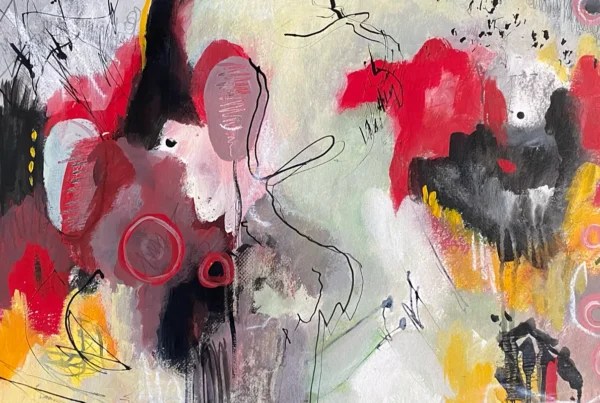
Olga Nekrasova builds her practice around a deceptively simple proposition: what cannot be directly seen can still acquire form. Working across abstract painting, textile, photography, video, and sculptural objects, she turns attention toward inner states, memory, energy, and the relationships connecting human beings to natural systems. Her materials range from ink, wax, resin, and yarn to metallic pigments and reflective leaf. Rather than treating these media as separate disciplines, she uses them as different instruments for a continuing investigation into perception, protection, and the conditions that allow life to endure.
That investigation grows from a long engagement with space. Nekrasova studied Design at Udmurt State University and later completed professional training in HO.RE.CA. Design at Politecnico di Milano. In 2008, she founded the Olga Nekrasova Workshop, developing architecture and interior projects for private and public environments. More than two decades of professional work sharpened her sensitivity to the way bodies occupy spaces and how surroundings influence experience. Her artistic practice redirected that architectural attention inward, from the organization of physical environments toward less tangible structures of feeling, memory, and psychological balance.
Nekrasova describes energy as something she has sensed since childhood rather than as a scientific claim. In her work, it operates as a language for experiences suspended between sensation and matter. Reflective gold and silver leaf, pearlescent pigments, and surfaces altered by changing light give this idea a physical presence. The viewer never encounters a wholly stable image because position and illumination continually modify what appears. Material therefore becomes active: it registers shifts, withholds certainty, and suggests that perception itself is part of the work.

Olga Nekrasova: Immersion, Chance, and Inner Depth
Water is central to Nekrasova’s visual thinking. Underwater space does not represent a particular location so much as a psychological condition, one in which familiar coordinates weaken and attention turns inward. Depth becomes associated with memory and the unconscious, while clouds and mist offer an airborne counterpart, mutable forms suspended between presence and disappearance. Both allow Nekrasova to address states that resist being fixed. They also support the meditative quality of her practice, where slowing perception is not simply an aesthetic effect but part of the artistic method.
Her materials reinforce that resistance to absolute control. Water, ink, wax, resin, thread, fabric, and natural substances each behave according to their own physical logic. Nekrasova allows fluidity, absorption, transparency, tension, and accident to participate in the work rather than forcing every element toward a predetermined result. This makes creation a process of observation as much as construction. She initiates conditions, watches forms emerge, and responds to the material event. The resulting image carries evidence of an encounter between intention and forces that remain partly independent of the artist.
Light Presence, made in 2019 with ink and plastic, connects this method to Nekrasova’s recurring image of submerged consciousness. She describes the subconscious through the metaphor of silent ocean depths where memories, emotions, and creative impulses remain before surfacing into awareness. Forms rising from those depths suggest meanings gradually crystallizing from what is initially inaccessible. Her 2026 series Sinking Deeper and Deeper continues the association between immersion and interior experience, using ink on paper to pursue a visual language in which emergence matters as much as the final form.

From Human Resilience to Living Systems
The focus on psychological states gradually opened Nekrasova’s practice toward ecology. Her question became broader: could natural mechanisms of protection and adaptation offer models for thinking about human resilience? This shift does not abandon her earlier concerns with interiority. Instead, it places them within systems of interdependence. Nature becomes more than visual inspiration. It becomes a source of structures and strategies through which protection, coexistence, vulnerability, and renewal can be reconsidered. Biomimicry consequently enters her work as both research method and conceptual framework.
This direction is explicit in the long term Laboratory for the Restoration of Biological Resources, an interdisciplinary project imagining a future after the depletion of familiar planetary resources. Nekrasova positions herself as an archivist and engineer of speculative life cycles. At the project’s center are “Energy Clusters,” abstract visual formulas conceived as metaphorical seeds capable of restoring damaged environments. Works including Biologically Active Cells and New Neural Connections, both from 2025, extend the language of cells, networks, and regeneration through glass prints, while the New Cells series uses ink on paper to consider the assembly of living structures from fragments of technological decay.
The project joins ecological fragility with a recurring concern for connection. Nekrasova’s 2026 video Tea Drinking approaches the same issue from an interpersonal angle. A ritual usually associated with togetherness becomes a study of the gap between self-perception and another person’s gaze. Gestures, words, and pauses pass through individual interpretation, leaving each participant partly enclosed within a personal “vessel.” Presented in the context of Beauty: Archived, the work treats beauty as projection rather than fixed property. The possibility of genuine encounter remains precious precisely because shared space does not guarantee shared perception.

Olga Nekrasova: Coral Skin and the Architecture of Care
Coral offers Nekrasova a particularly concentrated model for these questions. She is drawn to the plate coral Turbinaria mesenterina and its capacity to combine structure, protection, and living space. Its spiral organization becomes a prompt for asking how a form might simultaneously shelter, unite, and sustain an organism. Through this research, sculpture moves beyond representation. An object can instead be approached as shell, organ, protective skin, or hypothetical biological species, modeling principles of survival rather than merely depicting a natural form.
Inside Soft Memories: Coral Skin, begun in 2026 and ongoing, translates this research into textile structures. Wall works, sculptural objects, and wearable corals use yarn and tactile surfaces to connect embodied memory with feelings of safety. Here softness is functional and conceptual. It becomes a strategy of preservation, a form of support capable of holding vulnerability without denying it. Works such as Soft Armor, Soft Reef, Structuring, Development of the Organism, and Sprouting develop a vocabulary in which the body can be understood as a home and textile as a flexible architecture of care. Wood and stone enter selected works, placing softness in direct conversation with harder materials.
Textile also carries a personal continuity within Nekrasova’s practice because she has sewn and knitted since childhood. Fabric brings associations with clothing, domestic space, inheritance, and bodily presence, while tearing, joining, layering, and pulling threads provide concrete actions for thinking about identity and memory. Across her wider practice, the same question repeatedly changes material without losing its focus: how can invisible processes become perceptible? From atmospheric ink and shifting reflective surfaces to speculative cells and coral inspired forms, Nekrasova constructs an art of connections in which inner experience and natural structure continually test, mirror, and reshape one another.