“I try to shake the thoughts of the observer but at the same time give a little comfort with the colors and a feel of complicity.”
Bright Color, Darker Undercurrents
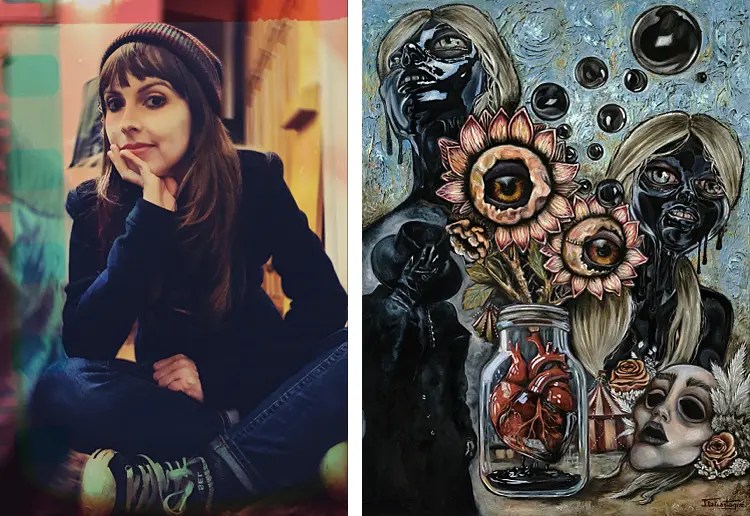
Julia Dalcastagné builds paintings from a tension she has carried since childhood: an attraction to dark subjects alongside a love of vivid color, illustration, and humor. The Brazilian artist describes her visual language through the pairing “ugly/beautiful,” a phrase that captures the push and pull at the center of her work. Bright hues invite the eye in, while areas of black add weight and discomfort. Exaggerated faces, especially enlarged or emphasized eyes, intensify the encounter. Rather than choosing between unease and reassurance, Dalcastagné allows both sensations to occupy the same image.
Much of that sensibility formed during the 1990s. Cartoons, anime, superheroes, comics from different periods, and illustrated books all fed an early fascination with images that could communicate quickly while carrying distinct emotional worlds. At 12, she spent a year in London with her parents and encountered a British humor shaped by harshness and sarcasm, where something tragic could also be comic. That combination appealed to an instinct already present in her interests, giving humor a sharper place within the darker material that attracted her.
Literature later strengthened this interest in uncomfortable aspects of ordinary life. During her teenage years, Dalcastagné became especially drawn to realism and its willingness to address subjects people might dismiss or avoid because they appear ugly. That literary attraction continues to inform how she approaches human experience. Her paintings focus on introspection, self awareness, individuality, and memories of childhood, often beginning with thoughts that seem simple but become unsettling when examined closely. The intention is not simply to disturb. She wants viewers to leave familiar emotional ground while still finding enough color, recognition, and complicity to remain with the image.
Julia Dalcastagné: Finding a Voice Through Drawing
Drawing was part of Dalcastagné’s life long before she considered art a profession. The shift came when she began developing ideas that felt distinctly her own and recognized an aesthetic through which she could speak to others. Encouraged by her parents, she went to college to develop her abilities. She says the experience did not radically change the aesthetic or poetic direction of her work. Instead, it made that direction more conscious and refined, helping her understand and strengthen choices that had already begun to define her practice.
A year in Italy studying illustration and comics gave her additional technical skills and dedicated time to sharpen that language. The influence of illustration remains visible in the way she constructs forms. Expressive outlines clearly delineate figures, giving the paintings a graphic force while preserving the physical presence of paint. Faces are frequently distorted or exaggerated, with the eyes taking a central role in the composition. These decisions are not decorative additions. They help turn the figure into a site where emotional states, visual illusion, and questions about being human can meet.
Her references cross painting, illustration, cinema, comics, and literature. Tim Burton, Ayami Kojima, Goya, and Yoshitomo Nara are among the strongest visual influences she identifies, each contributing something different through color, humor, shape, or technique. What connects them for Dalcastagné is their capacity to heighten seemingly simple human feelings until they become dramatic. Writers including Eça de Queiroz, Charlotte Brontë, Emily Brontë, Edgar Allan Poe, Hermann Hesse, and Milton Hatoum offer another model. She values how their work can unsettle readers through examinations of human nature while presenting those difficult observations with a sense of naturalness.

Individuality Inside a Shared Body
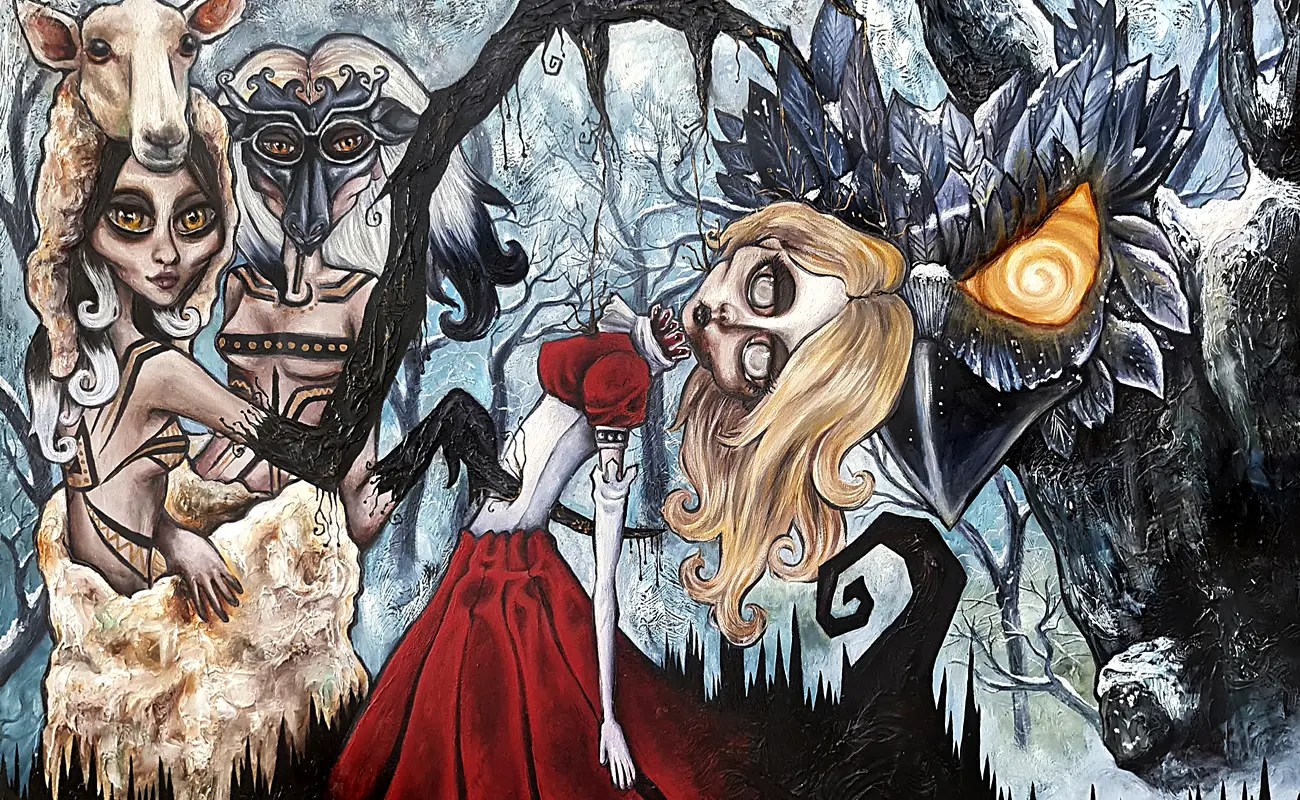
The oil painting “Dovunque Al Mondo” brings Dalcastagné’s interest in individuality into a specifically familial context. The work reflects on what happens when one family member resembles another so strongly, particularly a parent, that resemblance begins to carry expectations. Following a different path can then appear inadequate to others, complicating the process of forming an independent identity. Dalcastagné translates that pressure into a symbolic figure rather than treating it as an abstract idea, giving the conflict a body that is simultaneously shared and divided.
At the center is a single body with two heads, accompanied by distinct flowers that signal two different personalities. One is firm and combative; the other is delicate and traditional. Lantern shaped leaves appear in balanced numbers, suggesting that difference does not necessarily require separation and that two identities can coexist. Candles reinforce the distinction by giving each presence its own light even within the same body. A lion introduces another emotional register, representing the strength required to claim individuality when family resemblance and expectation threaten to define it in advance.
The painting concentrates several recurring concerns in Dalcastagné’s practice: identity, inner conflict, symbolic imagery, and the uneasy space between belonging and self definition. Its imagery also shows how her illustrative instincts support psychological subjects. The viewer is given recognizable signs, yet their arrangement resists a single literal reading. Flowers, leaves, candles, the lion, and the doubled head operate together as a visual argument about difference within closeness. The work does not reject family connection. Instead, it asks how a person can remain connected while protecting the particular light, temperament, and direction that belong to them.

Julia Dalcastagné: From Obsession to the Final Title
Dalcastagné usually begins her working day by researching images that captivate or inspire her. An idea may already have arrived through reading, lived experience, or a film, but she gives it time to become more concrete and visually persuasive. The themes that stay with her tend to be personally close, sometimes lingering with the persistence of an obsession. Sketching follows, often through several attempts. She prefers to develop options before committing to a painting because the chosen composition may occupy her attention for weeks, and she wants to feel genuine excitement about carrying it forward.
Once a sketch feels promising, she searches for reference images that can help her imagine tonal relationships and possible ways of portraying the subject. Even then, the drawing is not a fixed contract. Painting can expose weaknesses in the initial composition or provoke a new idea that changes the image. Dalcastagné welcomes that instability. Planning gives her a structure, but the work remains open enough for unexpected decisions to enter. The contrast is important to her process: careful preparation makes the painting possible, while revision and surprise prevent the original concept from becoming a restriction.
Music adds another layer to the making of each work. While painting, Dalcastagné listens to a particular album, sometimes more than one, so that its sound becomes attached to her memory and sensation of the piece. When the connection feels right, she may identify a specific song that illustrates the work. The title comes last, after research, sketches, tonal exploration, weeks of painting, revisions, and music have had time to shape the final image. That sequence mirrors the larger logic of her practice. Meaning is initiated by an idea, but it is allowed to change through making until image, mood, and language finally meet.