“The canvas ceases to be a passive surface and becomes an arena where my entire body participates in the gesture.”
Where Gesture Becomes Structure
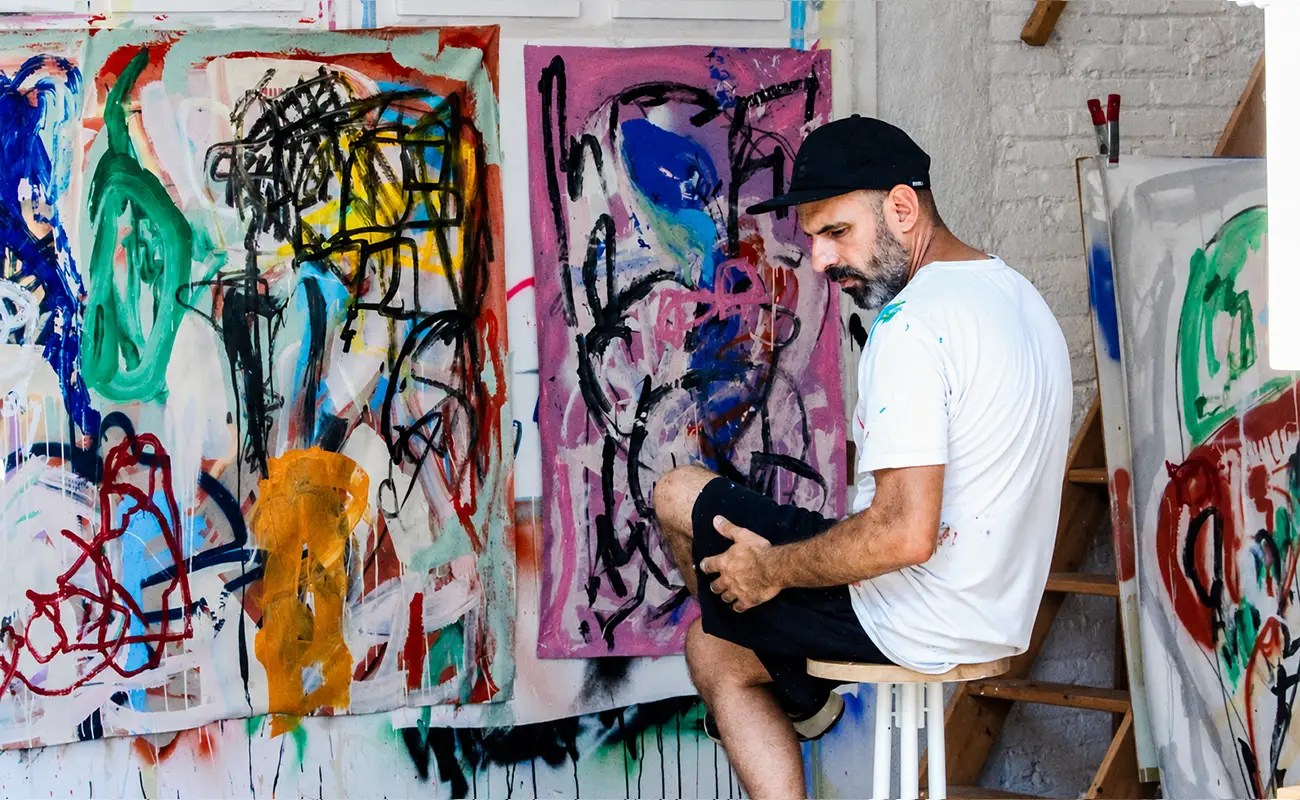
Pink Morro (Raúl) works from the Barcelona coast with a practice shaped by physical movement, material experimentation, and an enduring sensitivity to space. His paintings bring together the immediacy of graffiti, the compositional discipline of graphic design, and the spatial thinking developed through art direction and set design. Across canvases and sculptures, these experiences converge in an abstract language driven by color, rhythm, gesture, and the tension between instinctive action and deliberate construction. Rather than representing the visible world, Morro concentrates on forces that are harder to name but physically felt.
His work is anchored in gestural abstraction and what he describes as controlled chaos. Acrylic, oil pastel, spray paint, graphite, raw linen, and dense applications of pigment give him a broad vocabulary through which movement can accumulate. Each mark carries evidence of the body that produced it. Quick calligraphic lines coexist with heavier surfaces, atmospheric washes, interruptions, and concentrations of color. The image develops through this friction between freedom and balance, with intuitive decisions gradually finding a visual structure without losing the immediacy that initiated them.
Central to Morro’s practice is the idea of frequency. He is interested in dynamic energy, organic growth, and what he calls the physical memory of the gesture. Color is not simply decorative or descriptive. It becomes a carrier of intensity, while marks operate like traces of movement passing through the surface. He approaches painting as a way of registering unseen rhythms, particularly the vibration he associates with matter and the moment when rational control recedes enough for the body to respond intuitively. The resulting works preserve both the action of making and the equilibrium discovered through it.

Pink Morro: From Graffiti to the Studio
Morro’s relationship with scale and material began on the street. During his youth, graffiti introduced him to speed, risk, large surfaces, and the direct relationship between gesture and bodily movement. Painting in that context developed an instinct for immediate decisions and an attraction to the adrenaline of execution. Those early experiences remain present in his studio practice, not through conventional graffiti imagery but through its physical logic. Broad movements, spontaneous marks, aerosol, and an awareness of how the body occupies space continue to inform the way he approaches a canvas.
Alongside graffiti, Morro studied Graphic Design at university and later founded his own creative studio. Years working in art direction and set design strengthened a different set of instincts. Graphic design brought attention to composition, proportion, and visual organization, while set design required him to think spatially and understand how elements behave within constructed environments. These disciplines did not disappear when his focus shifted toward fine art. Instead, their methods became embedded within his paintings, offering an underlying framework against which the more impulsive aspects of his practice could operate.
The decisive transition came from a desire to move away from screens and reconnect with physical materials. Wood, pigment, surface, and three dimensional form offered the tactile resistance he was missing. Around seven years ago, that need developed naturally into a full time studio painting practice. Morro describes the change less as a calculated professional decision than an organic surrender to something physically necessary. His background now functions cumulatively: graffiti contributes urgency, graphic design contributes structure, and set design contributes spatial awareness. Their intersection gives his abstractions an energy that can feel spontaneous while remaining attentive to balance.

Scaling the Body Into the Canvas
Nature provides another foundation for Morro’s visual thinking. The Mediterranean light near his studio, conscious breathwork, and the physics of organic vortices inform his sensitivity to rhythm and movement. He is also interested in subtle energy fields and sacred geometry, approaching matter as something active rather than fixed. These concerns connect physical observation with less tangible perceptions of energy, allowing structure and intuition to meet within the same work. His paintings do not illustrate these subjects literally. Instead, they translate their sensations into shifts of density, direction, color, repetition, and open space.
His artistic references reinforce this attraction to physical presence. Morro points to Abstract Expressionism and Informalism, particularly Cy Twombly’s raw calligraphy, Antoni Tàpies’ tactile engagement with matter, Jean Michel Basquiat’s urgency, and Willem de Kooning’s chromatic freedom. What connects these influences is not a single visual formula but an insistence that painting can register action directly. Morro responds to that immediacy while bringing it into his own vocabulary, where marks move between spontaneous notation and organized relationships. The surface becomes a record of pressure, speed, interruption, accumulation, and release.
That physical approach reaches a pivotal point in his Maniobra series. Large canvases including M011 and M012, both measuring 200 by 200 centimeters, require Morro to work at a scale where the whole body becomes involved. The monumental Andrómeda, at 300 by 200 centimeters, pushes that relationship further. For Morro, the canvas is no longer a passive support at this size. It becomes an arena in which movement, distance, strength, and spatial judgment operate together. Andrómeda is particularly significant because it unites his street roots, spatial experience, and continuing investigation of energy fields and cosmic balance.

Pink Morro: From Raw Linen to Architectural Space
The construction of these large works begins directly on raw linen. Morro first uses diluted acrylic washes and aerosol to create atmospheric depth while establishing an underlying tension across the surface. He then builds physical density with heavy body impasto applied by palette knife. Manual applications of pigment add another degree of immediacy, allowing the material itself to become part of the gesture. Oil sticks and graphite introduce rapid lines and spontaneous calligraphic movements that cross, disrupt, or connect the denser painted areas. The process depends on layering without erasing the evidence of how each stage was made.
For Morro, the Maniobra works matter because they occupy a threshold between exertion and order. Painting begins with a highly physical engagement, yet the goal is not uncontrolled accumulation. He watches for the point at which apparently chaotic gestures establish structural harmony and visual resonance. This balance reflects the central tension running through his practice. Instinct needs enough freedom to remain alive, but composition gives that energy coherence. Large scale intensifies the challenge because every decision must be negotiated through both vision and bodily movement, linking the architecture of the image directly to the act of producing it.
That discipline extends into Morro’s daily routine. After taking his children to school, he travels to his studio, located roughly 300 meters from the sea, and begins a focused cycle of building stretchers, preparing canvases, mixing pigments, painting, and cataloging finished work. His next ambitions expand beyond the conventional canvas. He wants to develop his organic sculptures and immersive installations for monumental architectural settings and international boutique hotels, allowing his interest in matter and spatial experience to operate at a larger scale. Japan is another important objective, with Osaka and Tokyo offering a spatial sensibility he hopes to engage through future exhibitions.