“How can something extremely delicate become powerful? How can fragility itself become a form of strength?”
Building Strength from Fragile Materials
Laurent Guez creates ceramic sculptures in which organic growth, structural thinking and personal ideas of resilience converge. A French Canadian artist living in Mansonville, Quebec, he works primarily with porcelain, stoneware and paper clay, building forms that occupy an expressive space between nature and construction. Flowers, cacti and other living structures provide starting points, yet his work does not attempt to reproduce them faithfully. Instead, Guez studies how natural forms adapt, endure and transform, translating those principles into carefully constructed volumes, rhythmic surfaces and tactile ceramic bodies. The resulting sculptures hold opposing qualities in balance: vulnerability and resistance, delicacy and presence, freedom and technical constraint.
The foundations of this practice reach back to childhood, when Guez built imaginary cities from LEGO and discovered an early fascination with construction, aesthetics and invention. Architecture initially seemed like the natural path, but he ultimately studied industrial design at the École Nationale des Arts Appliqués et des Métiers d’Arts in Paris, where he lived from 1975 to 2000. His education encouraged him to think simultaneously about structure and use, while the Bauhaus shaped his attention to nature, the human body, movement, articulation, colour and the relationship between form and function. Gaudí offered another important model, showing how architecture could absorb organic structures and movement without losing its underlying logic.
Guez carried those interests into a professional career spanning design, interior environments and scenography. His projects ranged from department store installations to stand alone shops, and as co head of Tux Creative Agency he worked with international clients, particularly within the cosmetics and pharmaceutical sectors. Commercial design demanded both imagination and precision. A concept had to be conceived, structured, technically resolved and made physical. Those habits remain embedded in his ceramic work today, but the purpose has changed. In the studio, structure no longer answers primarily to a client or commercial brief. It becomes a framework through which Guez can investigate questions that are entirely his own.

Laurent Guez: From Design Logic to Ceramic Freedom
A decisive shift came in 2014, when Guez began searching for a form of creative expression free from commercial constraints. He started studying ceramics and initially worked with functional objects before gradually moving toward sculpture. By 2022, he had committed to working as a full time artist. Clay, and porcelain in particular, proved especially suited to the transition. It allowed him to retain the constructive intelligence developed through industrial design while making room for intuition, uncertainty and experimentation. He could determine the subject, method and direction himself, effectively becoming both the maker and the person setting the creative brief.
That freedom, however, is never absolute. Ceramic materials impose conditions that cannot simply be designed away. Gravity affects construction, clay shrinks, fragile elements can break, firing temperatures alter the material, and glaze reactions introduce their own unpredictability. Guez values this negotiation between intention and material behaviour. Technical problem solving is part of the pleasure, particularly when a difficult construction finally makes an imagined form possible. Yet the kiln always retains a degree of authority. This combination of control and uncertainty distinguishes ceramics from his previous design practice and gives the work its particular tension.
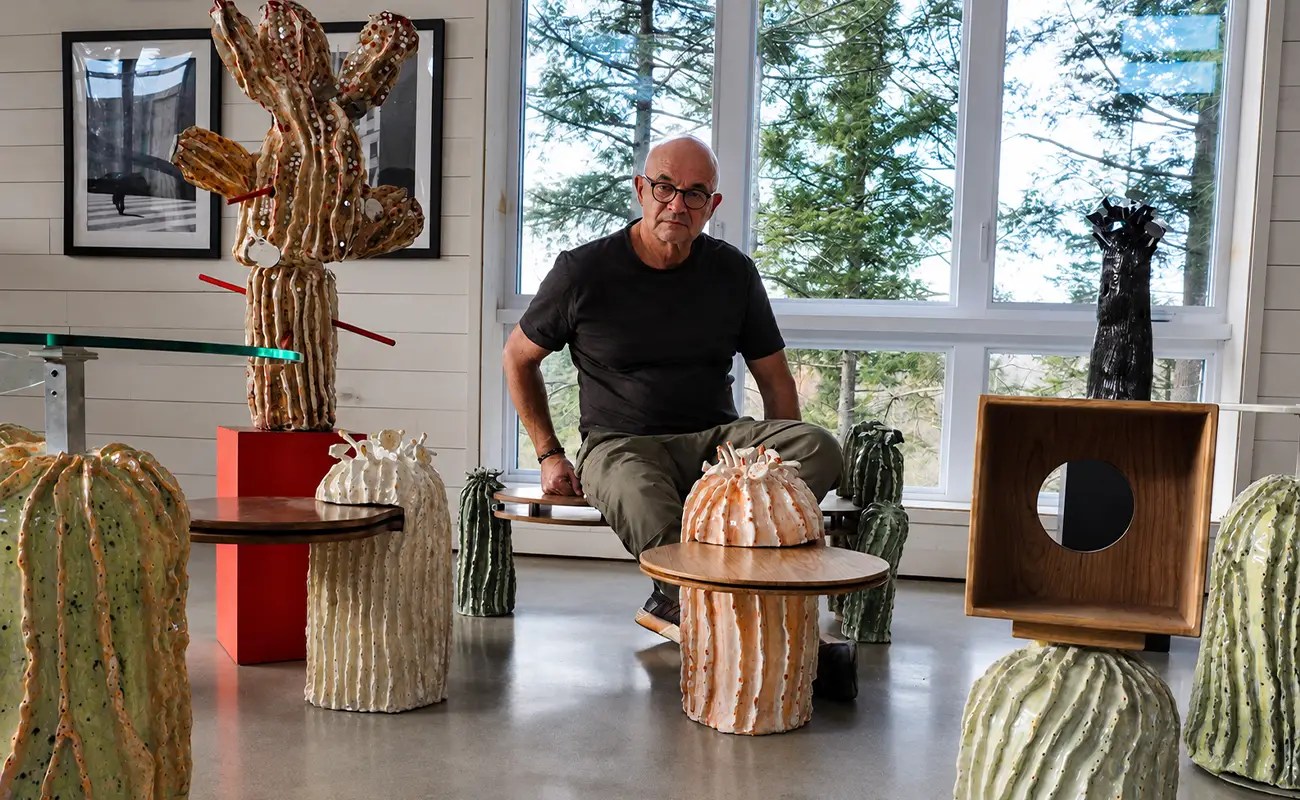
Resilience eventually emerged as the central idea connecting these formal and technical concerns with Guez’s own experience. Periods of turbulence in his personal and professional life led him to consider how living systems survive adverse circumstances without remaining unchanged. His cactus series became the first sustained investigation of the subject. Rather than treating the cactus simply as an attractive botanical motif, he approached it as evidence of adaptation. Its unusual structures are responses to difficult conditions, making the plant a compelling metaphor for survival and transformation. Through ceramic sculpture, its capacity to persist becomes both a physical form and a wider question about how strength is constructed.

The Hibiscus and the Power of Delicacy
More recently, Guez has shifted his attention from the cactus to the hibiscus, introducing a contrasting vocabulary into his exploration of resilience. Where the cactus suggests protection and endurance through physical adaptation, the hibiscus proposes strength through flexibility, renewal and apparent delicacy. Its petals allow him to investigate movement, colour and vulnerability while asking whether power must always be associated with hardness. The flower extends his research rather than replacing what came before, offering another model for understanding how living structures respond to change.
This research developed substantially during a one month residency in Chengdu, China, undertaken as part of the 20th edition of the NY20+ programme after an international selection process coordinated by Arte Laguna. There, Guez created a new body of work inspired by the hibiscus. He continued the project in Faenza, Italy, while developing ceramic pieces for Argillà Italia 2026. Working mainly with porcelain and paper clay, he combines hand building, sculptural construction, mould making and spray glazing. These processes allow him to interpret the flower through its movement and chromatic qualities while maintaining resilience as the conceptual focus.
Scale has become especially important within this body of work. For sculptures reaching approximately 120 centimetres, Guez uses paper clay to preserve the visual delicacy of petals while extending them into a more architectural presence. Enlargement changes the viewer’s physical relationship to forms normally associated with softness and ephemerality. Fragility acquires weight without being disguised as solidity. This contradiction sits at the centre of his current thinking: how can something extremely delicate become powerful, and how might fragility itself operate as strength? Rather than resolving the question through a fixed statement, the sculptures make its opposing forces physically visible.

Laurent Guez: Where the Designer and Artist Meet
Residencies in China and Italy have also expanded the collaborative and technical conditions surrounding Guez’s practice. In Faenza, he has worked in a shared studio with ceramic artists from Italy and Chile, where different approaches, techniques and perspectives circulate through everyday studio life. The setting has encouraged further experimentation while reconnecting him with the problem solving instincts of his earlier career. One important direction has emerged through what he calls creative mould making, a process developed from technical training in complex plaster mould construction and from his previous investigations of the cactus.
Instead of treating a mould as a neutral device for reproducing an already resolved object, Guez constructs moulds from multiple components and makes their assembly part of the creative process. This approach is now carrying the cactus into unfamiliar territory. He is revisiting the motif at the boundary between sculpture and functional design, developing it as a usable object and as the potential starting point for a collection of small ceramic furniture. The shift does not signal a return to conventional product design. Rather, it allows function to enter his artistic vocabulary on different terms, with experimentation and personal inquiry guiding decisions that were once shaped by commercial requirements.
The project reconnects questions that have followed Guez since his earliest imaginary cities: how volume is organized, how structures hold together, how an object addresses the human body and how usefulness interacts with aesthetic form. His ambition is to develop the research into a small collection that could eventually be presented at Maison&Objet in Paris, subject to selection. The possibility carries a particular resonance after decades spent moving between design and ceramics. Instead of treating those identities as separate stages, Guez is allowing them to intersect. Construction, function, organic growth and resilience now operate within the same practice, giving the instincts of the designer and the freedom of the artist a shared material language.