Between Wild Memory and the Painted Surface
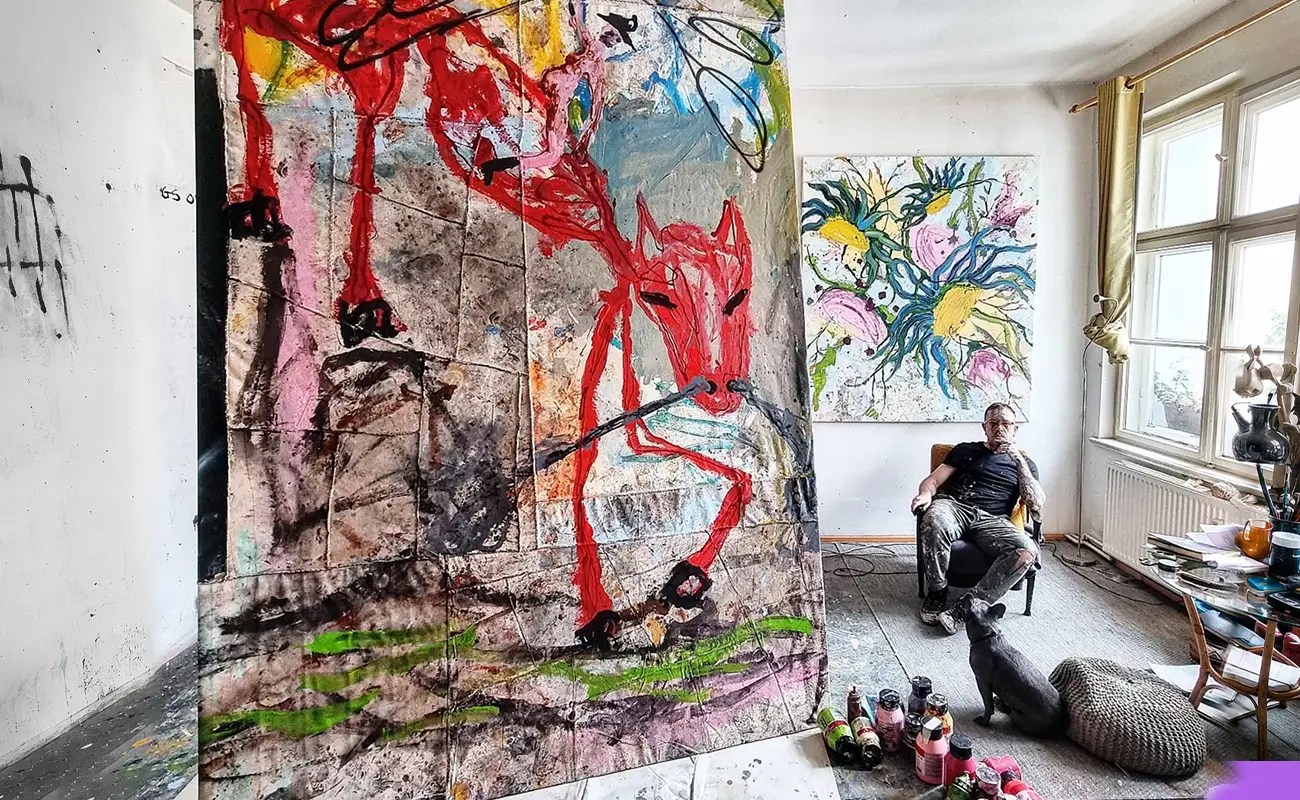
Kyte Tatt creates paintings in which experience refuses to settle into a straightforward story. The American painter and mixed media artist, now based in Berlin, works at the shifting boundary between abstraction and recognizable imagery, building compositions from urgent gestures, layered textures, fragments of biological form, and recurring symbols. Painting, drawing, collage, and constructed surfaces become interconnected parts of a practice shaped by memory rather than literal autobiography. Instead of illustrating particular episodes from his life, Tatt allows their emotional residue to reappear through color, line, texture, flora, fauna, human forms, and personal mythology. This openness is central to the character of his work. Forceful passages can encounter quieter areas, disorder can press against structure, and physical immediacy can coexist with contemplation. Nature provides an especially important framework for these encounters because its cycles allow Tatt to consider transformation without reducing it to a simple narrative. Growth, decay, vulnerability, resilience, destruction, and renewal can consequently occupy the same painted space.
Long before Berlin became the center of his painting practice, the landscapes of rural Pennsylvania gave Tatt an intimate relationship with the natural world. Much of his childhood unfolded outdoors, where bicycles, forests, countryside, frogs, and snakes formed part of everyday experience. Drawing developed alongside this fascination. He won several art contests during grade school and continued to draw as he grew older, although his creative direction remained deliberately broad. Rather than immediately identifying himself exclusively with painting, Tatt explored stencil work, leatherwork, and clothing design. Found, dismantled, and repurposed materials became resources from which new objects could emerge. That instinct also informed his involvement with community theater, where he created changing stage sets during an eight week production run, frequently turning discarded objects and scrap metal into theatrical environments. These early activities established habits that remain visible in his current work: adaptation, physical construction, improvisation, and an ability to recognize creative possibility in materials that have already lived another life.
Travel expanded that sensibility beyond the environments of his childhood. For roughly a decade, Tatt lived nomadically across the United States in vans, buses, and recreational vehicles, moving through landscapes and temporary communities while taking seasonal jobs that included farm work. During periods away from those jobs, his travels sometimes extended into Asia and Central America. He also became involved with artistic projects and communities on the American West Coast and received a grant to install his own work at Burning Man. The significance of those years lies not only in geographic movement but in the repeated experience of transition itself. Temporary homes, changing landscapes, unconventional working conditions, and encounters with different communities created a life in which permanence could rarely be assumed. That history helps illuminate why transformation occupies such a persistent place in his later paintings. His visual language does not seek stability by eliminating contradiction. Instead, it accommodates uncertainty, allowing memory and imagination to shift alongside the organic imagery, layered marks, and changing relationships that develop across each surface.

Kyte Tatt: Painting Without a Predetermined Destination
A dramatic change arrived in 2015 when Tatt relocated to Berlin and began focusing seriously on painting. The contrast could hardly have been sharper. He moved from a caravan on an Oregon farm surrounded by mountains into Berlin’s dense urban environment, exchanging an immediate relationship with open landscape for concrete and metropolitan intensity. That geographical displacement produced longing, but it also created the conditions through which his earlier experiences could be reconsidered. Distance heightened his awareness of what had previously surrounded him. Rural environments, animals, plants, journeys, and changing landscapes returned through memory and became raw material for painting rather than subjects to be reproduced literally. Berlin therefore represented more than a new address. It provided the context in which creative impulses that had previously moved through clothing, construction, travel, found materials, and temporary projects could become increasingly concentrated within a sustained painting practice. Separation from one life ultimately gave Tatt another perspective from which to reconstruct its emotional and visual traces.
That reconstruction begins through intuition rather than a fixed compositional plan. Tatt has developed enough structure within his working method to establish a point of entry, yet he rarely starts with a predetermined final image. An initial mark prompts another decision, and the painting gradually develops through a continuous exchange between action and observation. Thoughts become entangled with gestures, textures, shapes, and lines until conscious analysis gives way to a more instinctive form of attention. Tatt has spoken of needing to “coax” a painting into existence, an idea that captures the unusual balance between agency and receptivity within his process. He does not simply surrender control, nor does he force the image toward a conclusion conceived in advance. Instead, he watches for indications already emerging from the composition and responds to them. A form can be strengthened, interrupted, obscured, or released according to what the developing surface demands. Painting becomes a negotiation in which discovery carries as much weight as intention.
Speed is essential to preserving that responsiveness. Once Tatt enters the concentrated phase of making a painting, he generally works with urgency and prefers carrying the composition forward rather than repeatedly returning to reconsider every decision. Excessive revision could weaken the immediacy he seeks, so addition and removal depend on an instinctive awareness of when an element has achieved its purpose. Yet the visible energy of his paintings should not be mistaken for constant activity. Before the accelerated physical work begins, periods of waiting and reflection can occupy an important place in the studio. Tatt may sit, think, or sketch when tension develops or a creative block interrupts momentum. He has compared this receptive period to fishing, with thoughts passing through consciousness until one unexpectedly catches. What emerges may differ substantially from what he anticipated. Stillness and speed are therefore not opposing working habits. One prepares the conditions for the other, allowing loosely connected thoughts to gather before physical action transforms them into a concentrated visual event.

Materials Carry Their Own Histories
Tatt’s approach to materials reflects the same preference for flexibility, responsiveness, and accumulated experience. Acrylic occupies an important position because its quick drying time supports the velocity of his painting process, but it is only one component within a much wider vocabulary. Oil stick, oil pastel, spray paint, charcoal, graphite, house paint, collage, found materials, and varied surfaces can all enter his compositions. These combinations prevent medium from becoming a rigid boundary around the work. A painting may operate simultaneously as image, object, drawing, and constructed surface, with each material contributing a different physical character. Fast marks can meet resistant textures, while smooth painted passages can encounter interruptions created by paper, fabric, or other incorporated elements. The resulting surfaces register decisions not only through imagery but through their physical assembly. Material diversity becomes especially meaningful because it extends practices that Tatt developed long before painting became his principal focus, connecting his current studio work to years spent altering, salvaging, constructing, and repurposing objects.
Reclaimed paper and books make this continuity particularly visible, while hand stitched combinations of raw and primed fabric turn the support itself into an active component of the composition. These methods recall his earlier clothing designs made from found and deconstructed materials as well as his experience creating stage environments from discarded objects and scrap metal. Reuse, however, functions as more than a reference to the past. It gives his paintings a material logic based on transformation. Something carrying an earlier purpose can be reorganized and allowed to participate in another visual context. Pieces that might otherwise remain separate are joined, layered, covered, or exposed, creating surfaces whose construction mirrors the conceptual tensions within the imagery. The physical object can consequently embody the same processes of change that appear through natural symbols and expressive gestures. Construction and painting become inseparable, with seams, fragments, and accumulated layers demonstrating how difference can be held together without being made uniform.
That principle extends into Tatt’s ongoing fascination with opposing forces. He positions his work between representation and abstraction, seeking a precarious relationship between chaos and order rather than committing completely to either. Expansive gestures may be countered by restrained passages, while biological observation can intersect with mystical suggestion. Human figures, plants, and animals sometimes become recognizable within fields that otherwise resist straightforward description. Folklore and personal mythology provide additional symbolic resources, some inherited or borrowed and others invented within his own developing vocabulary. Importantly, these elements are not arranged to produce a single code that viewers must decipher correctly. Their meanings remain porous. A biological form can simultaneously evoke something observed in nature, something remembered, and something emotionally charged without being confined to one interpretation. By maintaining this ambiguity, Tatt allows the painting to remain active after it leaves the studio, giving symbols enough openness to gather associations beyond the circumstances that first brought them into existence.

Kyte Tatt: Finding Poetry Inside Collision
Nature supplies Tatt with a language for considering experiences that resist direct explanation. His interest is not limited to representing plants, animals, or landscapes as recognizable subjects. Instead, he approaches living systems as models through which larger questions about human existence can be considered. Natural cycles contain apparent contradictions that his paintings repeatedly embrace: life accompanies death, destruction can precede renewal, fragility exists beside extraordinary endurance, and individual organisms remain dependent upon wider systems. Flowers, animals, and biological forms can therefore operate on several levels at once. They are traces of an observable world, but they can also hold memory, emotion, symbolism, and imagined meaning. The contrast between vulnerability and strength in nature parallels Tatt’s desire to bring force and delicacy together on the painted surface. Aggressive gestures need not eliminate sensitivity. In his language, the challenge involves “discovering poetry within apparently violent brushwork,” allowing intensity itself to contain moments of unexpected grace.
One of Tatt’s most resonant metaphors develops this idea through the image of diamonds forming under sustained pressure on decaying matter. Within his thinking, the pressures generated by a troubled, changing world can pass through artistic experience and become something capable of containing beauty without denying loss. The metaphor avoids treating transformation as effortless or purely optimistic. Pressure, decomposition, and difficulty remain integral to what eventually emerges. Painting offers Tatt a process through which those conditions can be converted into color, gesture, line, texture, and recurring symbols, bringing imagination into contact with lived experience. Resilience consequently appears not as the opposite of vulnerability but as something formed alongside it. His compositions preserve this tension by refusing tidy explanations. Symbols function as vessels rather than fixed statements, and personal mythology remains open enough for viewers to approach it through their own associations. What begins in autobiography can thus move beyond biography without abandoning the emotional experiences from which it originated.
Across Tatt’s development, movement has remained a constant even as the form of his practice has changed. Childhood drawing, outdoor exploration in Pennsylvania, years of nomadic travel, seasonal farm work, creative communities, found material experiments, stage construction, and the major transition to Berlin all contribute to an artistic outlook founded on adaptation. His paintings have since appeared in solo and group exhibitions throughout Europe and at international art fairs, while works have entered private collections across Europe, North America, Asia, and Australia. Those milestones accompany a practice whose defining character remains grounded in a particular way of transforming experience. Memory passes through the structures of nature, while nature is translated through instinct, material experimentation, and gesture. Roughness does not cancel delicacy, and disorder does not eliminate structure. Destruction and growth can occupy the same composition because Tatt treats contradiction not as a problem to solve but as a condition to inhabit, giving painting enough freedom to hold what ordinary narratives often separate.