“I learned that I could look at anything and find art, a lesson that changed my life.”
Seeing Beyond Recognition
Judy Herman has spent a lifetime exploring the possibilities hidden within ordinary visual experience. Based in Los Angeles County, she moves fluidly between painting, photography, collage, and writing, building a creative practice that resists easy categorization. While extensive travels have taken her from Patagonia to West Papua, the deserts, mountains, shorelines, and canyons of Southern California remain a continual source of inspiration. Alongside her artistic work, she has established herself as a respected freelance writer whose features, profiles, and reviews have appeared in publications such as the Los Angeles Times, Slate, and Afterimage. Across these varied pursuits, a common thread emerges: a deep curiosity about perception, language, and the ways images shape understanding. However, rather than focusing on straightforward representation, Herman consistently seeks opportunities to transform what is seen into something more evocative, layered, and open to interpretation.
The foundation of this outlook can be traced back to childhood art lessons at the Pasadena Art Museum. At just nine years old, she studied with Lucille Krasne, whose unconventional exercises encouraged students to focus on relationships between color, shape, texture, and composition rather than on naming objects. Random collections of chairs, scarves, baskets, and fabrics became opportunities to discover visual harmony from each student’s chosen viewpoint. This early training fostered a habit of looking beyond literal appearances and taught Herman that artistic potential exists everywhere for those willing to observe carefully. The experience became formative, shaping an approach that continues to guide her work decades later. Instead of asking what an object is, she became interested in how it functions visually, an idea that remains central to both her paintings and photographic compositions.
That philosophy extends into every stage of her artistic process. Whether working with a camera, constructing a collage, or creating a painting, Herman prioritizes formal qualities over recognizable subject matter. Color relationships, surface textures, rhythmic patterns, lines, and shapes become the true protagonists of her compositions. Even when a photograph begins with a clearly identifiable scene, extensive manipulation and layering may gradually dissolve the original reference point. Through this process, images become less about documentation and more about visual discovery. The result is work that invites viewers to engage with sensation, structure, and emotion rather than relying on familiar narratives or locations. Her practice consistently demonstrates that abstraction can emerge from the everyday world when perception is allowed to move beyond literal description.

Judy Herman: Transforming Landscapes Through Imagination
Landscape imagery occupies a significant place within Herman’s creative output, yet her treatment of place differs dramatically from traditional approaches. Rather than attempting to preserve a location exactly as it appeared, she seeks to communicate what drew her attention in the first place. A revealing example emerged during a drive through California’s Kern River Valley. Looking through the passenger-side window, she became captivated by the powerful geological formations and dynamic arrangement of canyon rocks.
However, the midday conditions flattened the scene into muted beige tones, obscuring the structural energy she perceived. Once back in her studio, digital tools allowed her to intensify and reshape the color palette, introducing rust and teal hues that emphasized the underlying architecture of the landscape.
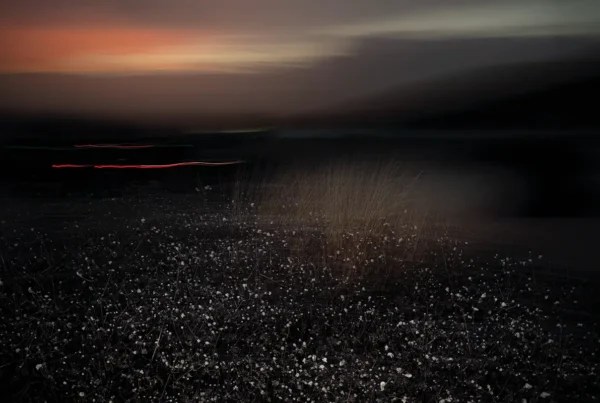
This intervention reflects a broader commitment to expressive interpretation rather than strict realism. Familiar locations often become nearly unrecognizable after Herman has reworked them, leading some viewers to mistake photographs for paintings. Such responses do not concern her. The objective is not geographical accuracy but visual vitality. Through adjustments of color, contrast, and composition, she amplifies the qualities that initially captured her imagination. The resulting works retain traces of real places while transcending conventional photographic expectations. In altering photographs she challenges assumptions about their documentary nature and shows that, like paintings, photographs can be an expression of an artist’s imagination.
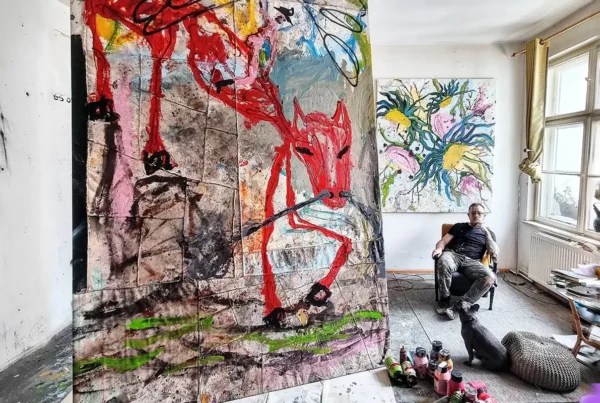
Large-scale painting offers another avenue for experimentation. Herman has increasingly moved beyond the limitations of traditional stretched canvases, choosing instead to work on unconventional surfaces including window screens, shower curtains, and packing materials. This willingness to experiment reflects her broader creative temperament and her desire to allow materials to influence outcomes. Among her most ambitious achievements is a monumental landscape depicting rock formations near Costa Rica’s Osa Peninsula. Measuring approximately 100 by 90 inches and painted on a sheet of packing material, the work exemplifies both her fascination with natural forms and her eagerness to challenge established artistic conventions. Through scale, material innovation, and expressive color, the piece demonstrates how familiar subjects can be reimagined through fresh visual strategies.

Fragments, Layers, and the Language of Collage
Experimentation remains one of the defining characteristics of Herman’s artistic identity. Collage, in particular, has provided a fertile framework for exploration because of its inherent flexibility and openness. She values the ability to rearrange elements repeatedly, discovering unexpected relationships through trial and revision. This process mirrors her broader interest in chance, intuition, and discovery. Rather than beginning with a fixed outcome, she often allows compositions to evolve organically as pieces are added, removed, layered, and transformed. The resulting works reveal a dynamic dialogue between control and spontaneity, producing visual environments that encourage multiple interpretations rather than singular readings.
Her engagement with collage naturally expanded into layered photography and digital art following the rise of digital imaging technologies. While photography once served primarily as a means of documenting travels, digital tools unlocked new creative possibilities. Images could be stacked, repositioned, stretched, recolored, and blended into increasingly complex compositions. The flexibility of software offered a freedom that aligned perfectly with her exploratory mindset. Equally important, digital processes allowed her to revise decisions at any stage, encouraging risk-taking without fear of permanent mistakes. This capacity for continual transformation reinforced her belief that artistic creation thrives when experimentation remains central to the process.
Many of Herman’s mixed media works move so far from their origins that subject matter becomes secondary or disappears entirely. At other times, fragments of her own photographs or reproductions of well-known artworks enter the composition, creating layered visual conversations across different sources and histories. She embraces the idea that viewers contribute meaning through their own experiences, constructing narratives from unexpected juxtapositions. Sometimes image selection is guided purely by formal considerations such as color harmony or compositional balance rather than symbolic content. This openness allows each work to function as a site of discovery, where memory, association, and perception intersect in ways that remain fluid and deeply personal.

Judy Herman: Art, Language, and Lifelong Exploration
The relationship between visual communication and language has played an important role throughout Herman’s life. Her academic background includes studies in Spanish literature, library science, and linguistics, disciplines that emphasize interpretation, structure, and meaning. Before focusing more fully on artistic pursuits, she worked as a reference librarian at the Los Angeles Central Library.
Although her formal education was not centered on studio art, creative interests remained constant. She continued taking classes whenever opportunities arose, steadily expanding her understanding of visual expression while developing a parallel career as a writer.
This combination of literary and visual engagement has given her work a distinctive intellectual dimension, shaped by an enduring fascination with how people construct and communicate ideas.
Retirement marked the beginning of an especially active period of artistic growth. Freed to dedicate more time to creative pursuits, Herman immersed herself in workshops, classes, and sustained engagement with the Southern California art community. A weekly gallery-visiting group, which she has attended for more than two decades, became an important source of inspiration and dialogue.
Her involvement with the Palos Verdes Art Center also proved significant, including service as a founding member and past president of the Photographic and Digital Artists affiliate. These experiences strengthened her connection to contemporary artistic developments while fostering an environment of continual learning and exchange.
New directions continue to emerge from her ongoing curiosity. Recently, Herman has begun creating shaped and sculptural photographs that integrate poetry inspired by her own imagery, bringing together visual and written forms in innovative ways. At the same time, she remains willing to address specific subjects when they demand attention. Travel photography, such as her “Faces of Cuba” and “Women of Vietnam” series, often focuses on people within their everyday surroundings, while politically engaged projects such as her climate crisis series “Mother Nature Strikes Back” communicate a more explicit message. Whether producing abstract compositions, experimental photographic constructions, large-scale landscapes, or text-based works, Herman consistently demonstrates a commitment to exploration. Her career stands as an example of how artistic practice can remain vibrant and evolving when driven by curiosity, observation, and an enduring willingness to embrace the unknown.