The Discipline of Curiosity and Constructed Nature
Andrew Kudless has built a career around a compelling proposition: materials are never passive, and design becomes richer when matter is allowed to participate in shaping outcomes. Based in Houston, Texas, he is recognized internationally as a designer, architect, artist, and educator whose practice moves between architecture, engineering, biology, and computation. That cross-disciplinary position has made his work especially influential in contemporary design culture, where the boundaries between craft, research, and fabrication continue to shift. Kudless serves as the Bill Kendall Memorial Endowed Professor at the University of Houston’s Hines College of Architecture & Design, while also leading advanced research environments dedicated to emerging technologies. These academic roles mirror the wider ambitions of his studio work, which consistently treats making as a form of inquiry. Rather than separating aesthetics from performance, his projects often combine structural logic, sensory experience, and fabrication intelligence into a single language. The result is work that feels both analytical and alive, combining precision with surprise in ways that continue to attract attention from museums, institutions, and designers around the world.
His educational path helps explain the depth of that perspective. Kudless earned a Master of Architecture from Tulane University, where he graduated with honors, then completed a Master of Arts in Emergent Technologies and Design at the Architectural Association in London, receiving distinction. Those studies placed him within two very different but complementary traditions: one grounded in architecture’s civic and spatial responsibilities, the other focused on experimentation, digital systems, and future-oriented methods. Earlier in his career, he also received a Fulbright Fellowship to study architectural design and urbanism in Japan’s Kansai region, an experience that broadened his engagement with urban culture, fabrication traditions, and alternative spatial thinking. Before establishing his own studio, he worked with Allied Works Architecture in Portland and New York, contributing to major commissions including the Museum of Arts and Design in New York City. He also worked with Expedition Engineering in London as a consultant in digital design, modeling, and fabrication, experiences that strengthened his fluency between design intent and technical execution.
These foundations eventually converged into a practice distinguished by synthesis rather than specialization. Kudless’s work is not confined to buildings, furniture, installations, or teaching alone. Instead, he moves across scales, using each project type to test ideas that can inform the next. That flexibility has helped him maintain relevance during periods when architecture has been transformed by computational tools, robotic fabrication, and new expectations around sustainability and material performance. Yet technology in his practice is never presented as spectacle for its own sake. It functions as a means to understand growth, force, geometry, and behavior. His projects frequently appear organic, but their forms emerge from disciplined processes rather than imitation of nature. This balance between intuition and method has made him a distinctive voice among designers who expanded digital practice beyond surface effects. Through teaching, publishing, and making, Kudless has demonstrated that advanced tools can still produce work with tactility, warmth, and emotional charge, qualities too often absent in technologically driven design.

Andrew Kudless: Matsys and the Intelligence of Material Systems
In 2004, Andrew Kudless founded Matsys, a studio whose name compresses the phrase “material systems” into a memorable identity. The title is more than branding. It summarizes a philosophy that understands architecture and design as active systems shaped by matter, energy, force, and environment. Matsys investigates the relationships between form, growth, and behavior, bringing together biological, geological, and synthetic references without treating them as separate categories. Within this framework, a wall, pavilion, object, or landscape can be studied through similar questions: How does it respond to pressure? How does it gather loads? How does surface become structure? How do fabrication methods alter appearance and performance? Such inquiries have allowed the studio to operate across scales while maintaining conceptual continuity. Matsys became widely known for translating these questions into visually striking outcomes, but the deeper significance of the work lies in how it repositions design as collaboration with material tendencies rather than domination over them. That stance has influenced students, professionals, and institutions interested in more integrated ways of making.
Craft occupies a central role within this philosophy. For Kudless, craftsmanship is not limited to handwork or nostalgic notions of making. It exists where material knowledge meets tool expertise, whether the tool is a chisel, a mold, a robotic arm, or a custom script. Digital fabrication gave architects more direct control over production, yet it also increased responsibility for quality, precision, and decision-making. Matsys embraced that challenge by using projects as laboratories for emerging methods such as generative modeling, code-based workflows, and fabrication experimentation. In this context, software is not detached from physical reality. It becomes another instrument through which designers can understand resistance, tolerance, texture, and assembly. Kudless has repeatedly argued through practice that technology should reconnect designers with production rather than distance them from it. This viewpoint explains why many Matsys works feel carefully made despite their complexity. Their sophistication comes not from visual excess, but from a close dialogue between process, toolpath, and final material presence.
The studio’s process often reverses conventional architectural sequencing. Instead of beginning with fixed programs and applying materials later, Matsys frequently starts with experiments in matter and code. Through repeated iterations, patterns emerge, limits become visible, and new opportunities appear. Only then are site conditions, use requirements, and larger constraints introduced to reshape the evolving system. This method grants the tactile and physical world a leading role from the outset. It also permits unexpected discoveries that more linear workflows can suppress. Such experimentation helps explain the playful yet disciplined character of Kudless’s projects, many of which appear to grow rather than merely be assembled. The forms can seem uncanny, animated, or strangely familiar because they echo the logics of natural organization without directly copying any one source. Across installations, architectural components, and sculptural objects, Matsys has shown that innovation often emerges when designers listen closely to what materials are already inclined to do.

Structures That Perform Like Landscapes
Among Andrew Kudless’s most celebrated works is Confluence Park in San Antonio, developed in collaboration with Lake|Flato and partners. The project is widely admired because it merges civic architecture, environmental education, and structural invention into a coherent public experience. Its pavilion canopy uses form-finding principles to create a network of concrete petals that gather and direct rainwater while producing shade below. Rather than treating engineering as hidden support and architecture as visible expression, the project unites both functions. Visitors encounter a space that feels sculptural and welcoming, yet every curve also participates in environmental performance. This integration earned the project major honors, including a 2019 AIA National Honor Award for Architecture and later recognition through sustainability-focused awards. Confluence Park demonstrates Kudless’s larger belief that efficiency and beauty need not compete. When systems are thoughtfully resolved, they can reinforce one another. The pavilion therefore stands not only as a destination, but also as a public lesson in water, climate, and the elegance of responsive design.
Another recurring thread in his career is the exploration of shell geometries and lightweight structural intelligence, seen in projects such as Shellstar Pavilion. These works investigate how surfaces can span, bend, and organize space through geometry rather than brute force. Shell structures have long fascinated architects because they achieve strength through shape, and Kudless has continued that tradition using contemporary tools and fabrication methods. Instead of repeating historical precedents, he examines how digital analysis and advanced production can generate new shell possibilities suited to present conditions. The resulting forms often appear fluid, but they are grounded in rational performance. Curvature channels loads, openings calibrate light, and surfaces become both enclosure and support. This union of expressive form with measurable behavior is a hallmark of his practice. It also reveals why his work resonates across disciplines. Engineers appreciate the logic, designers admire the composition, and the public responds to the sensory richness of inhabiting spaces that feel simultaneously natural and engineered.
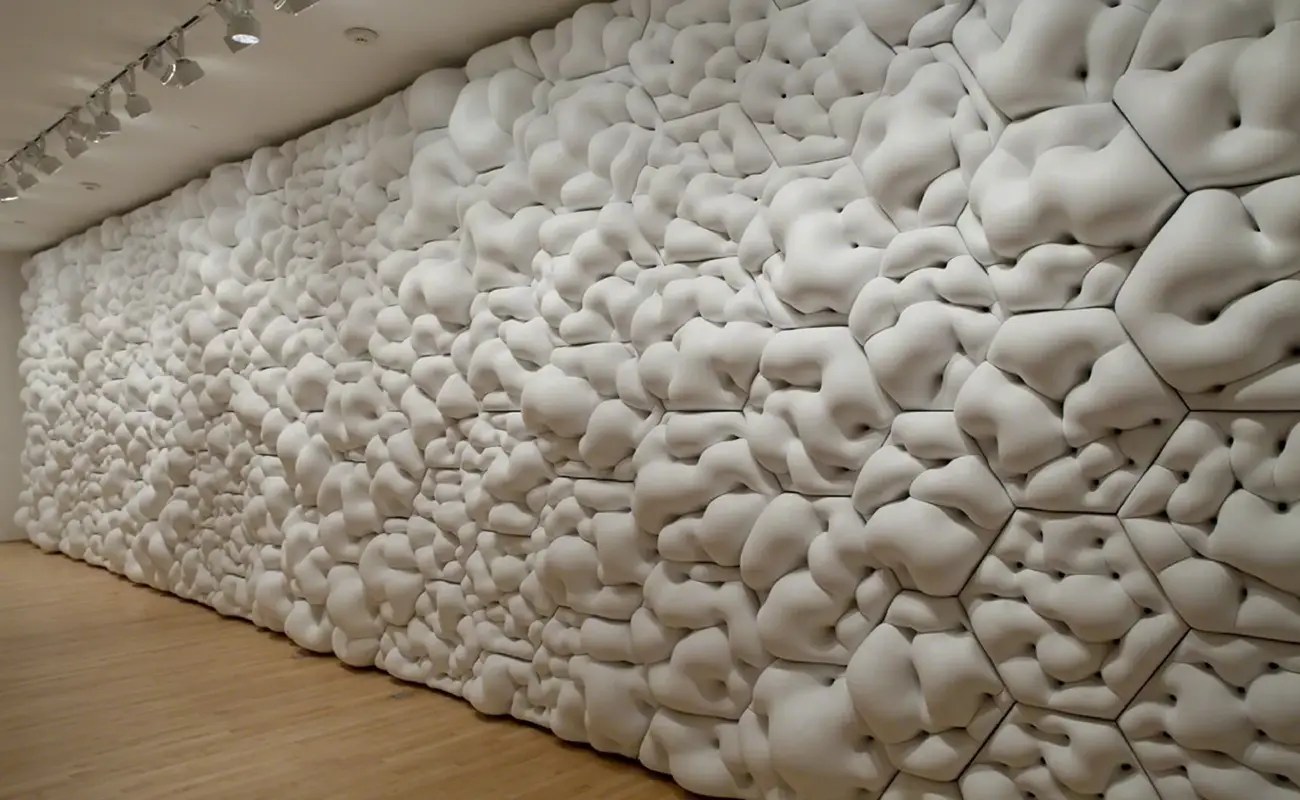
Equally important is the long-running P Wall series, begun in 2006 and continuing through multiple iterations. These investigations use flexible fabric formwork to cast precast concrete or plaster façade panels with richly contoured surfaces. Instead of rigid molds that impose uniformity, fabric responds to gravity, pressure, and support conditions, producing forms shaped by controlled variation. One notable version, P_Wall from 2009, extended forty-five feet through a sequence of swelling and flowing volumes. The work captured a key aspect of Kudless’s approach: beauty can emerge from calibrated forces rather than decorative application. In the P Wall series, texture is not added after the fact. It is generated through the behavior of the casting system itself. This gives each panel a sense of movement and material honesty. The series also challenged assumptions about façade production by showing that complexity need not be prohibitively expensive or wasteful when process and material behavior are intelligently aligned from the beginning.

Andrew Kudless: Influence Beyond the Studio Floor
The reach of Andrew Kudless’s work extends well beyond built commissions. Matsys projects have been exhibited internationally and entered the permanent collections of institutions such as the San Francisco Museum of Modern Art, the Centre Pompidou in Paris, and the FRAC Centre in Orléans, France. Inclusion in these collections signals more than visual appeal. It recognizes the cultural importance of work that expands how design can be conceived and fabricated. Museums often collect projects that capture turning points in practice, and Kudless’s output reflects a period when architecture and design were being transformed by computational methods and new material thinking. Yet his contribution remains distinctive because he pairs technical experimentation with sensual form. Many digitally generated works of the era appeared detached or purely formal. Kudless’s pieces, by contrast, retain bodily presence, texture, and a sense of physical consequence. This has made them legible to broad audiences while still rewarding specialist scrutiny from curators, architects, and scholars.
His influence is equally visible in education. Kudless has taught at the Architectural Association, Yale University, The Ohio State University, Rice University, and the California College of the Arts, in addition to his leadership at the University of Houston. Across these roles, he has helped shape generations of designers who now work in architecture, fabrication, product design, and research. Teaching has never been secondary to his practice. It operates as another site of experimentation where methods can be tested, challenged, and refined through dialogue. At Houston, his involvement in advanced technology labs reflects a commitment to preparing students for changing professional realities that include robotics, coding, simulation, and interdisciplinary collaboration. At the same time, his long emphasis on craft ensures those tools remain tied to material understanding. Students influenced by Kudless often inherit a broader definition of design expertise, one that values making, analysis, ethics, and curiosity in equal measure.
Recognition from luxury and commercial collaborators further illustrates the breadth of his appeal. In 2019, Kudless became the first American designer invited to contribute to Louis Vuitton’s Objets Nomades collection, a high-profile platform for limited-edition furniture and objects. The invitation suggested that his language of structure, softness, and complexity could translate from architecture into collectible design without losing rigor. He has also worked with clients and collaborators including Autodesk, Kreysler & Associates, Maison Perrier Jouët, Vivid Sydney, Fletcher Studio, Better Places Forest, and others. Such partnerships reveal a designer comfortable moving between public infrastructure, cultural commissions, experimental installations, and finely crafted objects. What unifies these varied engagements is a consistent search for intelligence embedded in form. Kudless has shown that contemporary design can be technically advanced without becoming sterile, and expressive without sacrificing performance. That balance secures his place as one of the most thoughtful figures working across art, architecture, and fabrication today.