“I don’t want the photograph to solve the mystery. I want it to leave the door open.”
The Quiet Threshold Between Recognition and Mystery
Justin Pumfrey approaches photography as an encounter rather than a hunt. A photographer and poet living between Richmond, on the edge of London, and Somerset, he has built a practice around solitary walking, close attention, and moments when familiar surroundings briefly lose their familiar names. Trees obscured by fog, dark water, plants, frost, weather, and elusive fragments of light become points of entry into questions that have occupied him for decades. His photographs do not seek to make those subjects more legible. Instead, they preserve the instant when recognition becomes unstable and ordinary perception gives way to something harder to define. This approach places openness at the center of his work. Rather than imposing a predetermined idea upon a landscape, Pumfrey waits for something within his surroundings to interrupt his habitual way of seeing. The resulting images carry a restrained sense of mystery, inviting the viewer into a quality of attention in which the familiar can become unexpectedly alive.
That sensitivity has roots in Pumfrey’s childhood. At eight, he was sent to boarding school in North Yorkshire, an experience he remembers as cold and frightening. Yet the surrounding countryside offered a powerful counterpoint to the institution itself. Nature became somewhere he could retreat, and within it he experienced a feeling that things could somehow return to their proper order. The emotional significance of that refuge remained with him and continues to inform the way he moves through landscapes today. Three years later, another formative experience arrived through his father, who gave him a Pentax Spotmatic, explained how it worked, and handed him a roll of FP4 film. Pumfrey immediately became absorbed by photography. His father subsequently constructed a darkroom inside an old meat safe at their home. Windowless and still fitted with ceiling hooks, it possessed an eerie atmosphere, yet under its red light Pumfrey discovered the fascination of watching photographic images slowly materialize in developing trays.
His education expanded the relationship between image and language. Pumfrey studied English Literature at Oxford, and poetry gradually entered his photographic thinking in a way that would prove permanent. He later spent many years working professionally as a photographer, travelling extensively and learning to produce images under a wide variety of circumstances. That period gave him a strong technical foundation and an adaptable understanding of photographic craft. At the same time, another form of education was unfolding beyond professional practice. During his twenties, he began reading Christian mystics before turning toward Zen and Advaita Vedanta. The writings of Bashō and Chuang Tzu, alongside T.S. Eliot’s Four Quartets, became particularly important. Each seemed to approach an experience that Pumfrey recognized without being able to define completely. Photography gradually became a way of remaining near that elusive territory, joining technical knowledge, poetic awareness, landscape, and spiritual inquiry within a single practice of sustained attention.

Justin Pumfrey: Waiting for the World to Become Unfamiliar
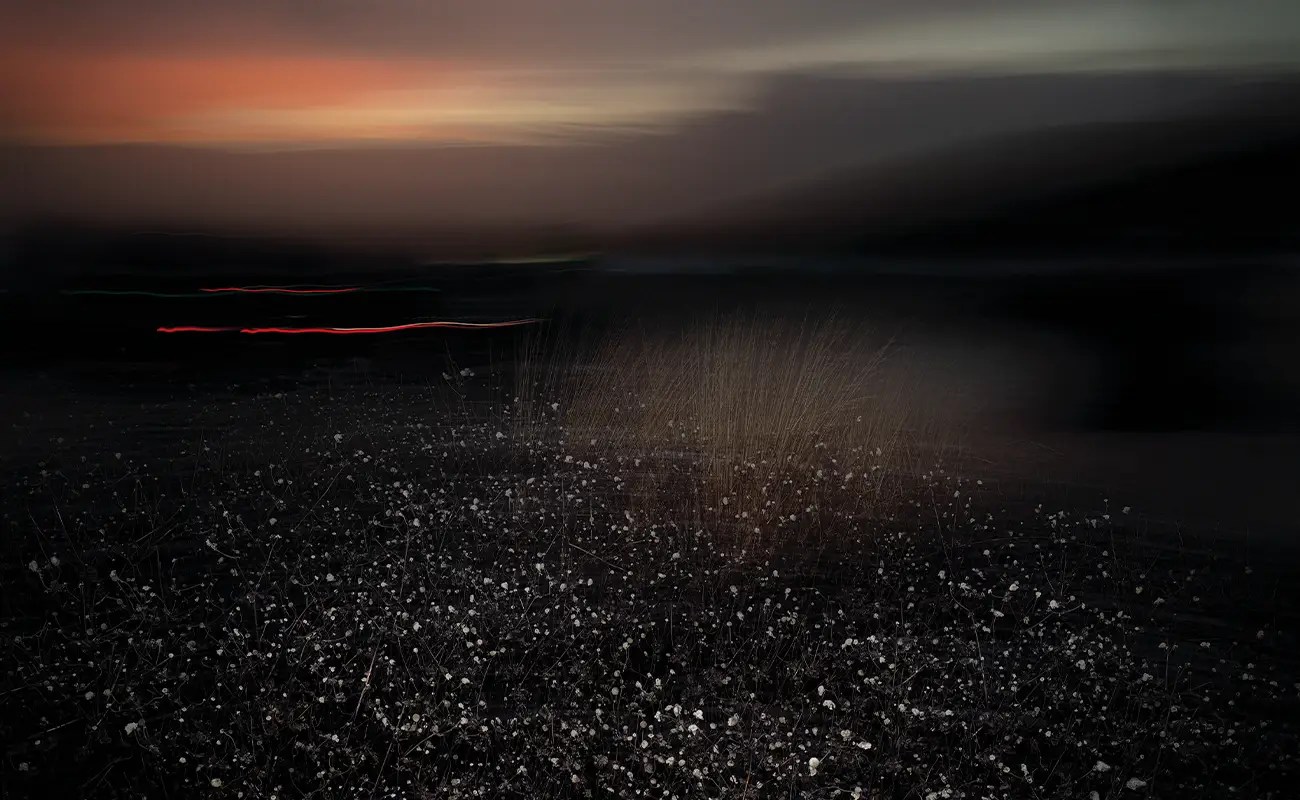
Walking is fundamental to Pumfrey’s process, yet he does not treat a walk as a conventional photographic expedition. He may know where he is heading, or he may move without a destination, carrying his camera while attempting to leave excessive intention behind. An hour can pass without producing a photograph, and he accepts that possibility as part of the practice. Then an apparently unremarkable sight can abruptly change in significance. A tree emerging through mist, illumination held within a dead leaf, or the surface of black water may stop him. The physical subject has not necessarily altered, but his relationship to it has. For a brief interval, habitual recognition falls away and there is simply the encounter, immediate, alive and prior to explanation. Pumfrey values precisely this interruption. To him, not knowing is not a failure of perception or an expression of indecision. It resembles an opening through which the world can be encountered before the mind organizes it according to familiar concepts, expectations, and categories.
This distinction explains why Pumfrey resists deciding too much before making an image. Searching for a predetermined subject risks confirming what he already understands, while receptivity allows something unexpected to claim his attention. He has described this condition as waiting to be solicited by what wants to see us, a formulation that reverses the usual assumption that the photographer acts upon a passive world. Something first catches him at a level that precedes explanation, and only then does the camera enter the process. His attraction to night, mist, vegetation, water, shifting weather, and scenes that resist immediate recognition follows naturally from this position. These subjects can hover between clarity and obscurity, allowing the photograph to retain what he calls a degree of secrecy. He does not want an image to settle every question or convert ambiguity into an easily consumed meaning. Its purpose is closer to maintaining an opening, giving the viewer enough visual information to enter while withholding the final certainty that would close the experience.
Early photographic influences helped shape Pumfrey’s visual awareness. Bill Brandt made a profound impression when he was young, particularly through a distorted nude photographed on a beach, an image Pumfrey remembers finding mesmerizing. Henri Cartier Bresson also became significant. Years later, encountering Cartier Bresson’s photographs at the Metropolitan Museum in New York produced an intensely transporting response. Yet Pumfrey now finds it increasingly difficult to isolate artistic influence from the broader currents of his life. Poetry, meditation, Bashō, the English landscape, and roughly thirty years of spiritual practice have all contributed to his understanding of what it means to see. Technique remains important, but his mature practice is less concerned with demonstrating mastery than with becoming receptive. The photographer who once learned to work effectively under almost any professional circumstance has gradually turned toward a quieter challenge: recognizing when knowledge itself recedes enough for perception to become fresh, immediate, and unexpectedly alive.

Before the Mind Gives the World a Name
Across the spiritual traditions Pumfrey has explored, he repeatedly encountered an idea for which he eventually adopted a simple term: the Nameless. In his understanding, it points toward experience before the mind separates what appears into named objects and individual identities. Before perception announces tree, moon, self, or other, there is simply an appearance and an awareness of that appearance. Pumfrey is interested in the possibility that these may not be two entirely separate things. His spiritual practice has gradually encouraged him to become more available to such experiences, and photography offers a parallel method. Standing somewhere with a camera, growing quiet, and allowing habitual labels to loosen can alter the character of even an ordinary place. Once names become less dominant, the familiar world can appear surprisingly strange. His images emerge from this threshold, where the viewer recognizes enough to remain oriented but encounters sufficient ambiguity to question whether recognition truly amounts to seeing.
The same concern appears in the distinction Pumfrey makes between looking, seeing, and knowing. He is increasingly interested in the gaps separating those states, particularly a form of knowing that does not depend on accumulated information. Sometimes an image seems to register in the body before the analytical mind has reached it. His editing process demonstrates this delayed recognition. A photograph can remain on his computer for months while provoking little response, only to become compelling when he returns to it much later. The file has not changed, but Pumfrey acknowledges that perhaps he has. This willingness to let meaning arrive slowly protects his work from premature decisions. It also mirrors his experience outdoors, where he attempts what he calls “waiting without waiting.” Nothing specific is expected, and nothing needs to occur. Yet availability remains active. A tree encountered in mist can suddenly feel, for reasons beyond immediate explanation, like the most important thing in the world, and that shift is enough to make him raise the camera.
Such an approach depends on accepting periods when no image announces itself. Pumfrey does not consider an uneventful walk unsuccessful, because productivity is not the sole measure of attention. The process instead asks him to remain receptive without converting receptivity into another form of expectation. That subtle distinction connects his photographic life with his long engagement with meditation and poetry. It also helps explain why landscapes in Richmond and Somerset can sustain an ongoing practice without requiring spectacular subjects. What matters is not geographic novelty but the possibility that perception can change within a place already known. Night, seasonal weather, reflected surfaces, fog, plants, and passing light can interrupt the certainty of recognition. Pumfrey follows those interruptions rather than attempting to manufacture them. His photographs consequently resist the role of visual explanations. They function more like invitations to inhabit the interval before interpretation settles, allowing a tree to remain a tree while simultaneously becoming something that cannot be exhausted by its name.

Justin Pumfrey: Making the Moon and Leaving Space for the Unknown
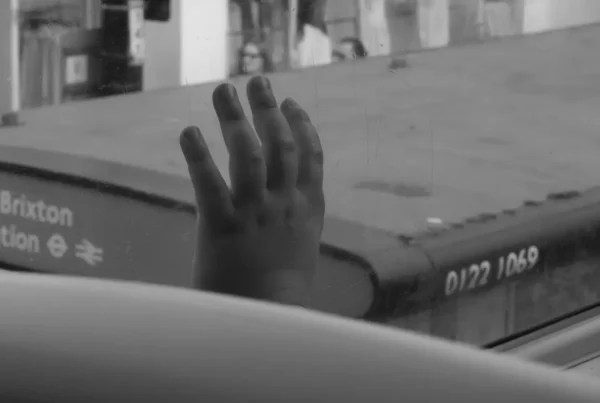
Making the Moon, a book of photographs and poems created between 2019 and 2026, is the work that currently carries the greatest significance for Pumfrey. It was not conceived through a fixed plan. Images accumulated gradually across the years: nocturnal landscapes, plants, frost, water, peculiar fragments of illumination, views through glass, and moments when ordinary things seemed to step outside their familiar identities. Some photographs remained untouched on his computer for years because he could not yet understand what place they occupied. Instead of forcing them into an immediate structure, he allowed them to wait. Eventually, relationships began to surface. A photograph made during a Somerset winter could suddenly seem inseparable from another created miles away in Richmond. A poem might find an image with which it could coexist, while another photograph resisted language and required silence. The book emerged through these affinities rather than through a thesis imposed in advance, echoing the receptive process through which Pumfrey makes individual photographs.
The title expresses that philosophy through a productive paradox. Human beings do not literally create the moon, since it exists independently of anyone looking at it, yet Pumfrey suggests that in another sense the moon is made anew each time it is genuinely seen. This tension between existence and perception sits close to the central concerns of his practice. The poems included in Making the Moon are therefore not captions or explanations for the photographs. He deliberately wanted space between word and image so that another kind of experience might arise in the interval. The physical construction of the book is equally significant. Designed with Phil Cleaver and edited with Lawrence Pumfrey, it treats paper, sequencing, empty space, and the unexpected encounter between facing photographs as active elements. Pumfrey thinks of the finished publication less as a declaration to decode than as somewhere a reader can enter. Complete intellectual comprehension is unnecessary and, in some respects, he would prefer that the book continue to resist it.
That principle of openness is also shaping what may come next. Pumfrey has begun reconsidering the possibility of physically painting and working directly onto photographs, an approach he explored previously. He is attracted to the idea that a photograph might become a unique object with a tangible existence rather than remaining solely a reproducible image. At the same time, he hopes Making the Moon will travel, with Japan holding particular interest. His relationship with Zen and Bashō began many years before he considered exhibiting there, while Japanese ideas concerning transience, emptiness, season, and direct perception resonate with questions he has independently pursued throughout his work. He is careful not to overstate those connections or predetermine how the photographs should be received. His preference is simpler: send the images into another context and discover what occurs. If someone far away encounters one photograph, stops unexpectedly, and cannot quite explain why it has arrested their attention, that moment would fulfill something essential in Pumfrey’s conception of seeing.