The Material That Refuses to Stay Still
Johannes Steininger stands within contemporary Austrian art as a figure who consistently challenges expectations about what sculpture can be. Born in Linz in 1977, he has built a practice that joins visual art, sound, architecture, design, and spatial experience into a coherent language. Rather than treating these fields as separate disciplines, he uses each one to sharpen the others. His objects are not passive things placed in a room. They respond to the room, redirect attention, and change the way viewers sense proportion, surface, and atmosphere. International exhibitions have introduced audiences to work that appears light yet is grounded in rigorous thought. This combination of conceptual clarity and tactile invention gives his practice unusual depth. Many artists focus on one medium and refine it over decades. Steininger instead expands across mediums while maintaining a clear identity. His art asks viewers to consider how objects occupy space, how materials behave under pressure, and how perception changes when form is built from something as unstable and essential as air itself.
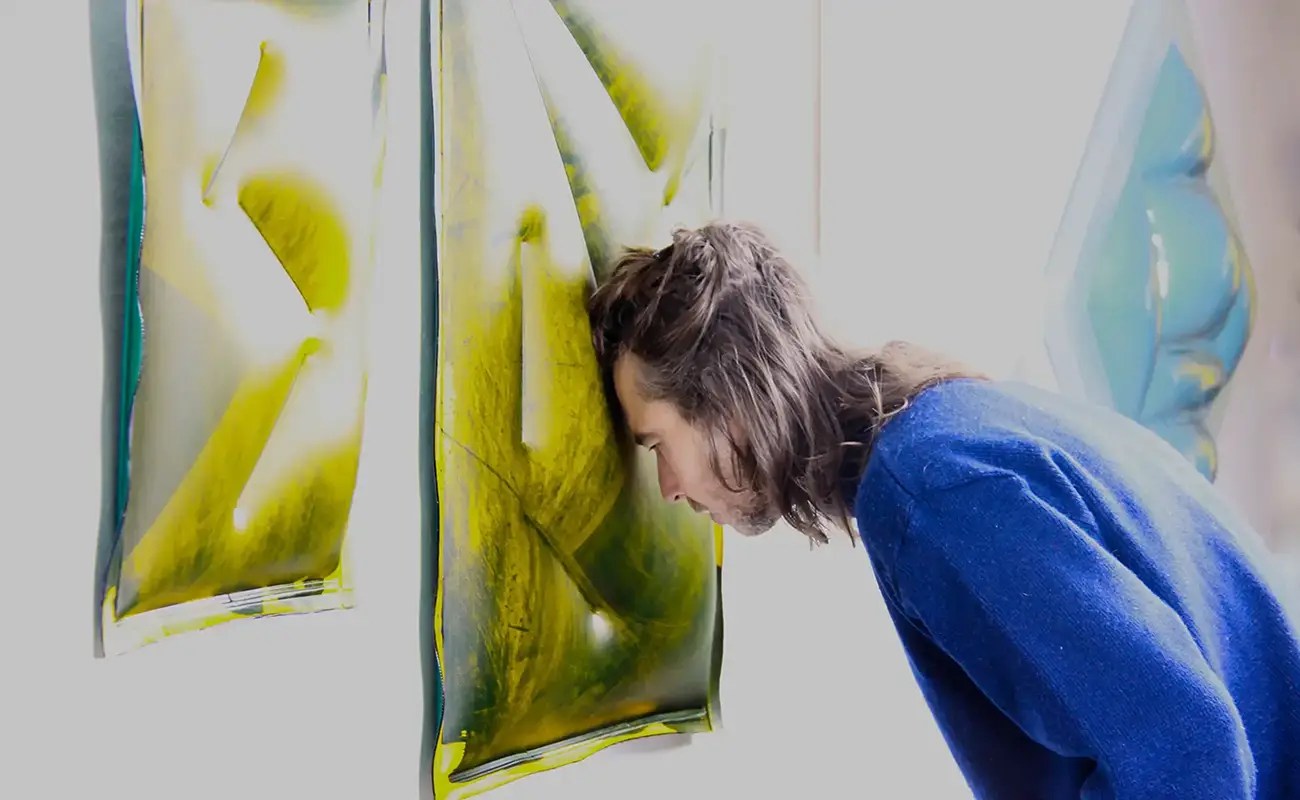
One of the most recognizable aspects of Steininger’s work is his use of industrial soft vinyl, especially PVC, which he transforms into inflated sculptural surfaces and hybrid wall pieces. These works often appear to hover between painting and sculpture. They possess color, composition, line, and frontal presence associated with painting, yet they project outward into physical space with the assertiveness of relief sculpture. Air functions as both support and idea. It fills the forms, gives them volume, and simultaneously reminds viewers that volume can be temporary. This tension between presence and fragility is central to the impact of the work. A firm contour may depend entirely on invisible pressure. Smooth membranes can bulge, bend, or soften with changing conditions. Through this method, Steininger turns a common industrial material into something unexpectedly lyrical. The surfaces carry traces of process, welding, embossing, and shaping, while the completed forms suggest movement even when still. They seem caught between expansion and restraint, between engineering logic and poetic uncertainty.
The visual force of these works is strengthened by Steininger’s sustained attention to line. He has described line as a language of art, and this idea is evident throughout his practice. Straight, curved, narrow, forceful, gentle, or abrupt lines organize the viewer’s eye and direct emotional tone. Because his chosen material can swell outward, lines do not merely sit on a flat plane. They travel across contours, wrap around bulges, or become tension points where the eye senses pressure beneath the skin of the object. This creates a sophisticated dialogue between drawing and volume. What begins as a graphic decision becomes a structural event. The result is neither conventional painting nor conventional sculpture, but a field where marks become bodies. In many contemporary discussions, digital images dominate visual culture. Steininger’s work offers another route by showing that line, surface, and pressure can still produce surprise when handled with intelligence. His objects remind viewers that abstraction can remain deeply physical and emotionally charged.

Johannes Steininger: An Unconventional Route to Precision
Steininger’s path into art did not follow a predictable academic sequence, and that unusual beginning remains important to understanding his mature practice. Before entering higher art education, he completed an apprenticeship as a machinist. Such training develops sensitivity to tools, tolerances, joins, surfaces, and the discipline required to make things function reliably. These qualities often separate artists who imagine materials from artists who truly understand them. In Steininger’s case, technical knowledge became a creative asset rather than a separate chapter left behind. Later works reveal confidence with fabrication processes and an instinctive respect for how materials react under stress. Inflated membranes, sealed seams, structural balance, and precise contours all benefit from a maker’s practical intelligence. The machinist’s mindset also encourages patience, iteration, and problem solving, qualities visible in work that may look effortless but depends on exact control. Many viewers encounter softness and playfulness first, yet beneath that visual ease lies disciplined construction. This dual identity, poetic surface joined to technical mastery, is one reason his sculptures carry unusual authority.
After those early formative years, Steininger moved through technical and creative positions in broadcasting, live sound, theater production, and cultural institutions. Each environment offered tools that later resurfaced in his art. Broadcasting sharpens awareness of signal, timing, and audience attention. Live sound develops sensitivity to acoustics, resonance, and how space shapes listening. Theater production teaches staging, movement, emotional atmosphere, and the dramatic potential of objects under changing light. Work inside cultural institutions provides familiarity with installation standards, curatorial contexts, and the practical life of artworks. Rather than existing as disconnected jobs, these experiences became an informal education in perception. They trained him to think not only about what an object looks like, but how it behaves within a complete setting. This broad practical background helps explain why his installations often feel composed rather than merely placed. The viewer senses that every distance, angle, and spatial relationship matters. Steininger understands rooms as active partners in meaning, not neutral containers for art.
Formal study later deepened and organized these experiences. At the University of Art and Design Linz, he studied Space and Design Strategies, earning a bachelor’s degree before continuing postgraduate development. He also studied Acoustic Communication and Sound Studies at the Berlin University of the Arts, with further focus on auditive architecture. Additional research at the Technical University of Berlin expanded his engagement with engineering acoustics. This educational trajectory is notable because it crosses artistic and scientific frameworks without reducing one to the other. Many artists borrow technical language loosely, while many engineers neglect poetic perception. Steininger’s background allows him to move between both worlds with credibility. His works therefore emerge from genuine inquiry rather than decorative references to science. Sound, structure, and perception are not themes attached after the fact. They are embedded in how the works are conceived. The combination of hands-on labor, institutional experience, and advanced study gives his practice a rare breadth that continues to distinguish him in contemporary art.

Rooms That Hear, Surfaces That Speak
A defining strength of Steininger’s practice is the way it treats sound as a sculptural concern. Sound is often discussed as something separate from visual art, yet his work suggests that every room already contains an acoustic character shaped by dimensions, surfaces, density, and absorption. By introducing inflatable wall structures and soft protruding forms, he can alter how a space responds to vibration and reflection. This does not mean the works function merely as acoustic equipment. Instead, they operate in two registers at once. They are visually compelling objects and active participants in the sonic life of their environment. Curved membranes, air-filled chambers, and varied surfaces can diffuse or soften reflections, subtly changing how speech, footsteps, or music are experienced. In this sense, viewers do not only look at the artwork. They inhabit changes created by it. Such an approach broadens the definition of sculpture from isolated object to environmental agent. Steininger’s installations can therefore be understood as proposals for more attentive relationships between seeing, hearing, and moving through architecture.
His interest in auditive architecture gives this approach conceptual weight. Architecture is usually judged by appearance, circulation, and function, while listening remains secondary. Steininger counters that hierarchy by emphasizing how buildings are heard as much as they are seen. Echoes in a corridor, muffled corners, sharp reflective walls, and intimate softened chambers all shape emotional experience. Through sculptural interventions, he reveals these hidden dimensions. A wall piece may appear decorative at first glance, yet it also modifies the acoustic temperament of the room. This creates a productive ambiguity. Is the object image, instrument, relief, barrier, or collaborator with architecture? The most compelling answer is all of these at once. Such complexity links him to broader contemporary concerns about multisensory art while preserving a distinctive voice rooted in material experimentation. He does not overwhelm viewers with technological spectacle. Instead, he uses humble means, membrane, pressure, contour, placement, to make people newly aware of phenomena they normally overlook.
The theater background mentioned in his biography also resonates strongly here. Theater trains practitioners to understand that atmosphere can be built through timing, scale, lighting, silence, and anticipation. Steininger carries this sensibility into gallery contexts. His works often possess a staged quality, not artificiality, but a sharpened awareness of encounter. Entering a room with one of his inflated forms can feel like meeting a presence already waiting there. The object may appear soft, but its occupation of space is decisive. Shadows become part of the composition, movement of viewers changes perspective, and even pauses in conversation can feel more pronounced. This sensitivity to emotional environment separates his installations from purely formal exercises. He understands that space can affect mood before any explicit interpretation begins. Consequently, the viewer’s body becomes central to meaning. One walks around, listens differently, notices distances, and senses tension between surface calm and internal pressure. In Steininger’s art, atmosphere is not decoration. It is structure.

Johannes Steininger: Expanding Sculpture for the Present Century
Steininger has described himself as committed to expanding the concept of sculpture for the twenty-first century, and his body of work supports that ambition. Traditional sculpture often relies on mass, permanence, and solid materials such as stone, bronze, or wood. Steininger chooses softness, inflation, synthetic film, and mutable volume. This reversal is not novelty for its own sake. It asks whether contemporary life, shaped by mobility, temporary systems, networks, and unstable environments, might require different sculptural metaphors. Air-filled forms can appear monumental while remaining lightweight. They command attention while acknowledging dependence on invisible support. Such conditions mirror modern realities in which power structures and identities may seem solid yet rest on fragile systems. By working with these tensions, Steininger updates sculpture’s vocabulary without abandoning its historical concerns with body, space, scale, and presence. His references to movements such as Spatialism and the Zero group indicate awareness of earlier attempts to break the flatness of images and rethink space. He continues that conversation through distinctly current materials and questions.
Another notable feature of his practice is the way objects can embody what they depict. His hybrid wall works often avoid the distance between image and thing. Instead of representing volume on a flat surface, they become volume. Instead of painting air through illusion, they are physically sustained by air. This directness gives the work conceptual elegance. Viewers are not asked to imagine hidden meaning detached from material fact. Meaning arises through the exact conditions of construction. Flexible films layered and welded into relief forms make pressure visible. Surface becomes evidence of internal forces. Such clarity is increasingly valuable in an art world where complexity can sometimes become obscurity. Steininger demonstrates that intellectually rich work can remain immediate and legible. One can appreciate the pieces through sensation first and reflection later. Their forms invite curiosity, while their methods reward sustained attention. This balance between accessibility and depth helps explain why his work resonates across varied audiences and exhibition contexts.
Alongside studio production, Steininger has also contributed to education and institutional art practice. Since 2021, he has taught Design and Technology within the Art & Education department at the University of Art and Design Linz. Teaching is significant because it extends an artist’s influence beyond exhibitions into future generations of makers and thinkers. His background makes him especially suited to this role, joining craftsmanship, conceptual inquiry, acoustic awareness, and interdisciplinary experimentation. He has also worked as an art handler for the regional art collection of Upper Austria, an experience that deepens understanding of how artworks are preserved, installed, and encountered publicly. These positions reflect a career engaged with art as ecosystem rather than isolated authorship. Steininger emerges not only as a producer of objects, but as a practitioner invested in knowledge, institutions, and practical exchange. In that broader sense, his contribution reaches further than any single sculpture. He helps shape how contemporary art can be made, taught, installed, and experienced today.