“Entertainment, to me, is almost a side effect of healing through art.”
Art as a Practice of Survival and Joy
Yoram Gal has spent nearly six decades treating creativity not as a profession that begins and ends with the studio, but as a way of staying alive, alert and emotionally engaged with the world. Painting entered his life at 12, during a period of intense psychological distress, and quickly became inseparable from writing. What began as relief developed into a lifelong practice spanning painting, theater, cinema, literature and animation. After years as an actor, playwright, screenwriter and director, Gal has devoted the past 24 years to painting full time, building a studio-gallery in Jaffa while continuing to write and develop film projects.
His earliest creative breakthrough arrived while he was undergoing intensive Freudian child therapy at the Anna Freud Clinic in London. Sent there to confront anger, fear, stress, nightmares and what he describes as “intense pain of the soul,” he worked for three years with Dr. Koch. “Almost immediately, I began to paint, and then to write,” Gal recalls. “For the next 59 years, this has been a source of healthy joy, relief and therapy that has kept me growing and growing. One small seed was sown when I was 12, and it is still growing every day.”
That origin also explains the unusual conviction behind his practice. Gal does not separate artistic ambition from emotional repair. “Since I began painting at the beginning of my teenage years, I felt my life had a mission: to heal the world,” he says. He later recognized that the same impulse was also directed inward. “I now understand that this motivation to heal ‘all the people on earth’ was also a determined striving to heal myself.” The scale of the ambition remains, even if its meaning has matured. He wants art to disturb emotional sediment, bring hidden fears and anxieties to the surface and make catharsis possible. As he puts it, “Entertainment, to me, is almost a side effect of healing through art.”

Yoram Gal: A Creative Life Built Around Catharsis
The audience response Gal values most is not applause or prestige, but evidence that a work continues to affect someone after the encounter has ended. “I feel enormous pride when people who bought a painting of mine tell me, sometimes many years later, how happy it makes them every morning to wake up and see that painting on the wall opposite their bed,” he says. His experiences as an actor produced a related form of confirmation. Spectators would approach him after performances with tears in their eyes, eager to describe the shock, joy or emotional release they had just experienced. Those moments reinforced his belief that art can create change through recognition and feeling.
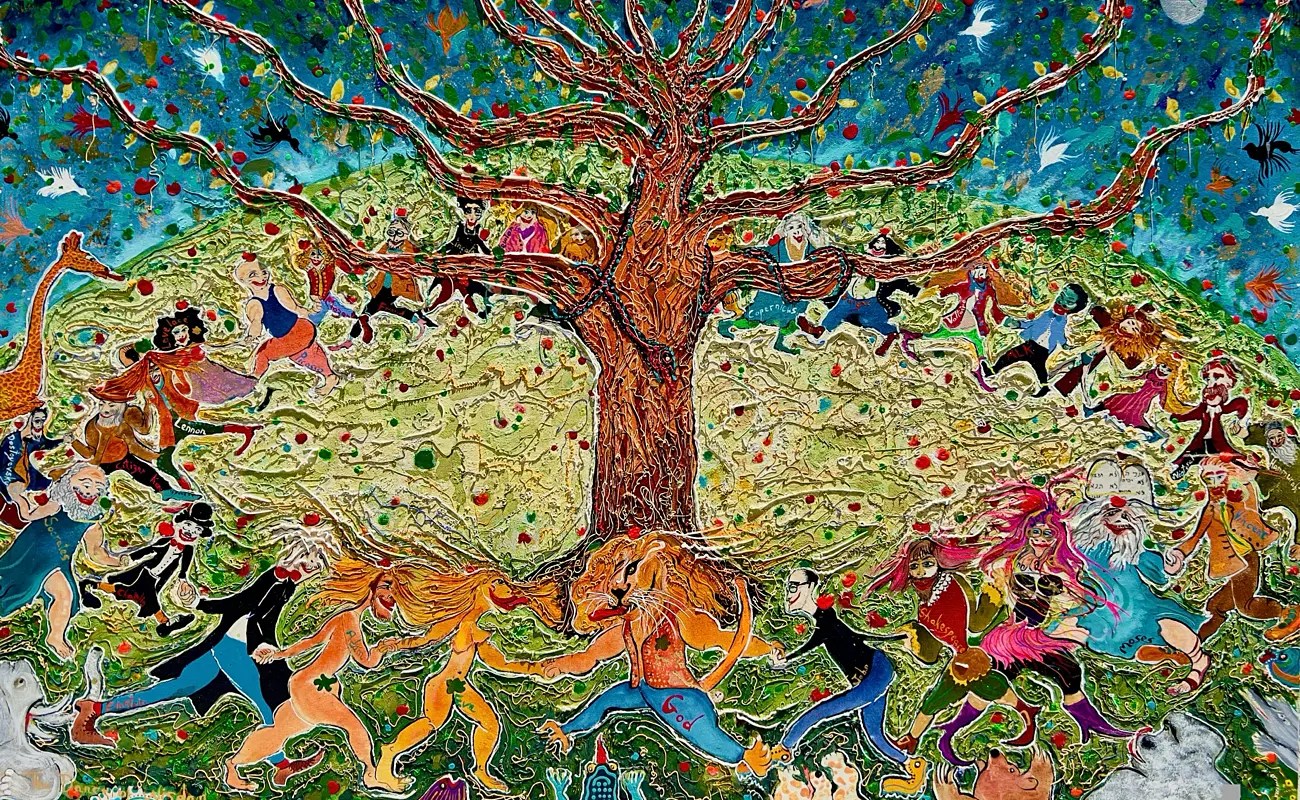
Gal’s influences are correspondingly broad because he treats the whole of life as material. “My life, every detail of it, is the greatest influence on my work,” he says. He names his traumatic childhood, therapy, army service, a suicide attempt at 24 and a half, three marriages, his son, lovers, family life and his complex Israeli and nonreligious Jewish identities as forces that have shaped his work. Alongside lived experience sits an enormous imagined circle of artistic and intellectual companions. Nietzsche, Dostoyevsky, Voltaire, Picasso, Van Gogh, Gauguin, Shakespeare, Molière, Mozart, The Beatles, Leonard Cohen, Chaplin, Orson Welles, Monty Python, Socrates and many others occupy what he jokingly calls his brainstorming team. “They are all, somehow, sitting around my imaginary brainstorming table.”
The list is eclectic because Gal’s creative identity has never fit neatly into one discipline. He studied theater and cinema rather than psychology, then moved across stage, television and film while continuing to paint and write. He has written more than 60 stage plays, screenplays and other works, acted in numerous productions and directed for stage, television and cinema. His feature film WILD, which he wrote and directed in 2000, became one of the major markers in that path. Rather than treating these shifts as separate careers, Gal sees them as connected methods for reaching the same objective: “to invent things I have never seen before,” and use them to stir people’s hearts and perhaps bring about “change for the better.”

Painting a Film One Watercolor at a Time
“The most meaningful piece is always the last one, the one I am working on now,” Gal says. At present, that work is YOGI & CAMI, his animated feature film and television project. The project began with a novel he completed around two years ago, then expanded after he took an intensive course in AI animation and started experimenting with moving images. Many attempts failed. Conversations with his son and his partner eventually led him toward a more demanding solution. “I followed their advice and finally dared to embark on something rather crazy,” he recalls. “I began painting the film by hand.”
Gal has now created more than 400 original watercolors on paper for the project. Each is photographed and animated, then combined with performances by real voice actors, while his filmmaker son edits the material. Roughly 40 minutes currently exist in rough cut. Gal estimates that another 500 to 600 paintings remain, bringing the eventual total to around 1,000 hand painted originals for a film of approximately 90 minutes. His goal is to complete it by summer 2027. The scale is formidable, but it also matches the total commitment that has characterized his creative life.
For Gal, YOGI & CAMI matters because it gathers nearly every skill he has developed into one work. “It is perhaps the most exciting project I have ever undertaken because it uses virtually everything I have learned during my life, as a writer, director, actor and painter,” he says. Writing the novel draws on decades of plays and screenplays. Directing connects to his stage, television and film experience. Voice performance and character interpretation reflect his years as an actor. Most visibly, the project depends on the painting practice that has been his full time vocation for 24 years.
He places it in a personal sequence of creative landmarks: writing and starring in EVERYMAN in 1978, writing and directing WILD in 2000, then transforming YOGI & CAMI from novel to animated feature between 2023 and 2027. “Every 25 years, a highlight,” he observes. Then comes the characteristically Gal-like conclusion: “I’m curious what will happen in another 25 years, when I turn 100 in 2052.”

Yoram Gal: Discipline, Reinvention and the Next Work
Gal’s days are organized around sustained output. He rises early, runs four kilometers, exercises for another 20 minutes and begins working. “Every night before I fall asleep, I need to decide what I am going to do the following day,” he explains. “I plan it in my head, and then I can sleep calmly.” The schedule usually combines very different kinds of activity: one painting or several at once, writing, work on YOGI & CAMI, commissions, preparations for exhibitions and the constant administrative demands of maintaining a creative career. “I’m almost a one-man band,” he says, although the structure around him is collaborative in key ways.
His filmmaker son, Nimrod Gal, collaborates with him on YOGI & CAMI and also handles social media and advertising, while Tzlila Hurvitz manages the studio-gallery in Jaffa. She transformed the studio into a public facing gallery in 2015, and the space has since become a point of contact for Israeli visitors and travelers from many countries. Gal says his paintings are now held in private collections across 44 countries. A short break and, when possible, a 20 or 30 minute nap divide the day before he resumes work until around 7 p.m. Even then, the process often continues from bed through writing, editing, notes or paper sketches that may become paintings the following day. “In other words, I have difficulty stopping until the last minute.”
He rejects the idea that this rhythm is simply workaholism. “It is simply a total way of life,” Gal says. “Nothing excites me more than growing, discovering and improving the next invention.” He describes it as “a life of joyful dedication,” comparing his sense of purpose to that of “a religious monk, a priest or a scientist: I have a mission. Nonstop.”
YOGI & CAMI remains the immediate mission, but it is not the only one. He is also producing new and commissioned paintings and writing a screenplay in which he intends to play the lead role. His attention to exercise and diet is tied to the same forward momentum. He wants the health and strength to keep making work for decades. His own description captures that urgency more vividly than any polished summary could: “There are endless things still inside my belly, bubbling nonstop, waiting to be made.”