Where the Ordinary Changes Scale
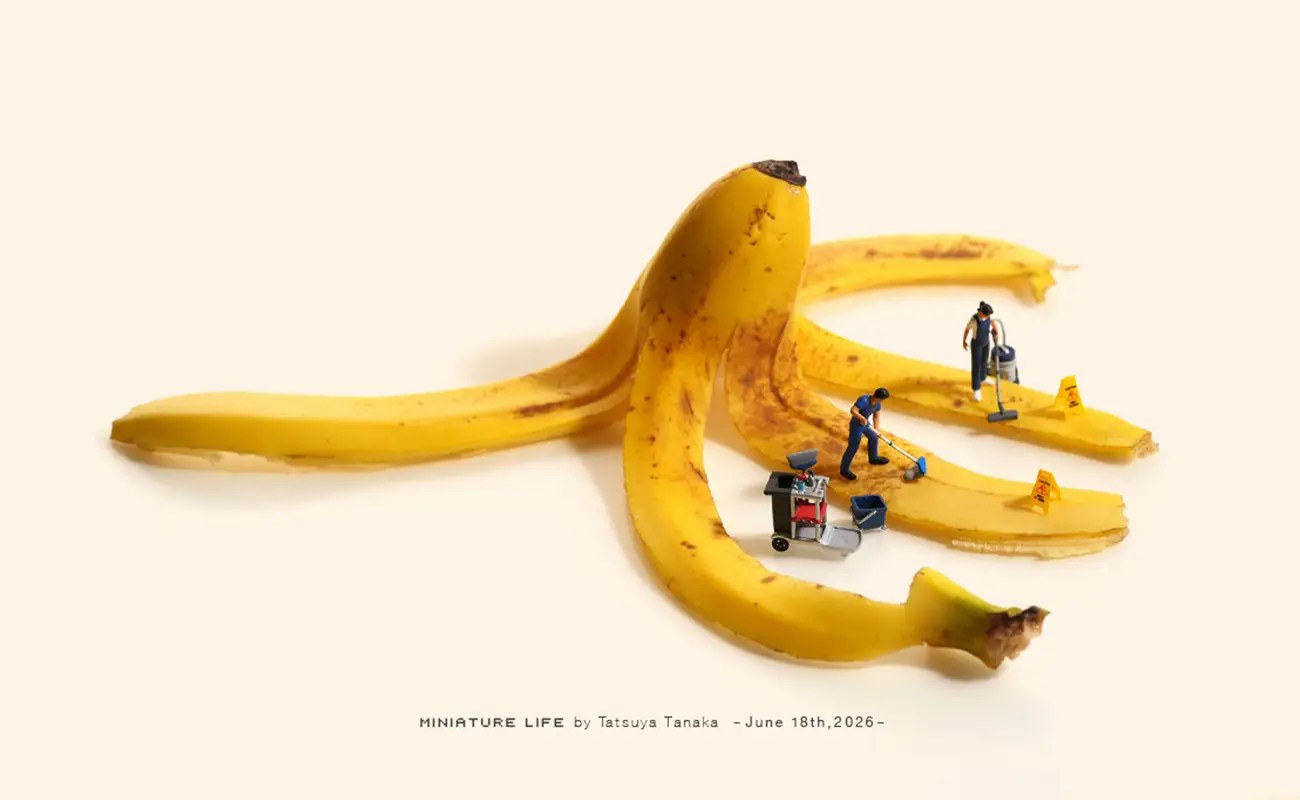
Tatsuya Tanaka has built an artistic practice around a deceptively simple proposition: familiar things can become entirely different when viewed from another perspective. The Japanese miniature photographer and mitate artist combines tiny figures with food, stationery, household goods, and other recognizable objects, transforming them into landscapes, architecture, vehicles, and stages for everyday activity. Broccoli becomes a towering tree, green straws resemble a bamboo grove, cake provides a ski slope, and bread takes on the aerodynamic profile of a bullet train. His photographs depend not on concealing reality but on making two interpretations visible at once.
Born in Kumamoto Prefecture in 1981 and educated at Kagoshima University, Tanaka worked at a design company before concentrating on miniature photography. His role as an art director involved planning magazine advertisements, while his personal collection of figures intended for plastic models and dioramas offered the material for another kind of visual experiment. Searching for photographic ideas to share, he began placing these figures alongside objects within easy reach. The resulting changes in scale attracted a strong response and encouraged him to continue testing what ordinary materials could become.
That exploration developed into MINIATURE CALENDAR in 2011. Tanaka conceived the project around the idea of publishing a new miniature work online every day, echoing the regular turning of a calendar page. Its premise grew from a familiar imaginative impulse: broccoli or parsley might resemble forests from the viewpoint of a tiny person, while a leaf floating on water might function as a boat. By constructing and photographing these associations, Tanaka gives temporary thoughts a physical setting and a carefully controlled point of view.

Tatsuya Tanaka: Learning to See One Thing as Another
At the center of Tanaka’s visual language is mitate, the Japanese concept of perceiving one thing as another through imaginative association. His materials generally remain recognizable rather than being physically disguised. Shape, color, texture, and structure supply clues from which a second identity can emerge. A brush may become a field while its bristles remain unmistakably bristles. The viewer understands the original object and its fictional function simultaneously, and the friction between those two readings produces much of the work’s wit.
Broccoli occupies a particularly important place in this development. Tanaka has identified it as the object that first led him to think seriously about alternative interpretations of commonplace things. Its resemblance to a tree is immediate, requiring little explanation and crossing linguistic or cultural boundaries with ease. That accessibility became an important principle within his practice. He aims for ideas simple enough for children to understand, using recognizable situations and familiar materials rather than requiring viewers to possess specialized knowledge before entering the image.
His interest gradually shifted from presenting miniature figures toward the broader possibilities of likening one thing to another. Photography and lighting were largely self-taught, developing alongside this conceptual change. The figures increasingly became actors rather than subjects in isolation, inhabiting settings made from objects whose original functions remained plainly visible. Tanaka’s miniature people accept these improbable environments without surprise. Their apparent normality makes the transformation more convincing, inviting viewers to temporarily accept a world in which the proportions of everyday life have been completely rewritten.

Building an Illusion in Millimeters
The apparent immediacy of a Tanaka photograph rests on a demanding construction process. Sometimes an object comes first. He examines its form and searches for a scene suggested by its physical characteristics. At other times, he begins with an imagined situation and looks for the materials and figures needed to create it. Composition, lighting, perspective, photography, editing, titles, and wordplay contribute to the final result. Each element must support the central visual association without obscuring the identity of the object that inspired it.
Scale is one of the most sensitive variables. Tanaka has accumulated miniature figures in numerous sizes, occupations, outfits, and poses, enabling him to choose a character suited to a particular environment. Figures that appear almost identical can function very differently when placed beside a vegetable, roll of paper, piece of stationery, or household item. At dimensions measured in millimeters, a slight mismatch in proportion can undermine the imagined relationship. The precision of the finished scene therefore depends on finding a balance between physical reality and the scale suggested by the photograph.
Food is particularly fertile material because color, shape, and texture can quickly evoke landscapes or built environments. Rice, noodles, sushi, fruit, vegetables, bread, sugar, and confectionery have become settings for miniature activity. Toilet paper, clothespins, cosmetics, folding fans, textiles, stationery, and packaging provide other possibilities. Tanaka does not seek precious materials. Familiarity is more useful because viewers already know what these objects are supposed to be. Recognition creates the foundation for surprise when a notebook becomes an island, sushi turns into traffic, or stationery assumes the presence of monumental sculpture.

Tatsuya Tanaka: A Daily Discipline of Imagination
Humor gives these transformations much of their momentum. Tanaka often builds photographs around visual puns and unexpected substitutions, sometimes extending the joke through titles and wordplay. Rather than simply reproducing full-size environments in miniature, he rearranges their underlying logic. Food can become terrain for travel, sports, leisure, or work, while domestic objects acquire architectural dimensions. The tiny figures respond to these strange surroundings as though nothing unusual has happened. That understated behavior strengthens the joke while giving viewers space to discover the association themselves.
Japanese landscapes and cultural references also recur throughout his work. Cherry blossoms, Mount Fuji, sushi restaurants, martial arts, handicrafts, festivals, tatami, bamboo groves, and trains have entered his miniature vocabulary. Some compositions employ materials strongly associated with Japan, while others use globally familiar objects to construct specifically Japanese subjects. This combination allows Tanaka to communicate cultural references through visual relationships that remain accessible beyond Japan. His principle of immediate recognition, first exemplified by the broccoli tree, continues to shape how the work reaches audiences with different backgrounds.
More than a decade of daily production through MINIATURE CALENDAR has turned repetition into a creative discipline. Tanaka regards the limited time available for each work as a means of testing and extending his abilities, compelling him to keep searching for associations in objects around him. The practice has since expanded into international exhibitions, commissions, books, and projects including the title sequence for NHK’s Hiyokko, an opening film for Nihonbashi Takashimaya S.C., and participation as an exhibition creator for the Japan Pavilion at Expo 2020 Dubai. Publications including MINIATURE LIFE, Small Wonders, and MINIATURE TRIP IN JAPAN have carried these worlds into print. Across photographs, physical installations, books, and commissioned work, the central proposition remains constant: changing the viewpoint can make even the most familiar object visible again.