“Creating allowed me to process all the pain, trauma and challenges I’d been facing.”
Emotion Held in Texture
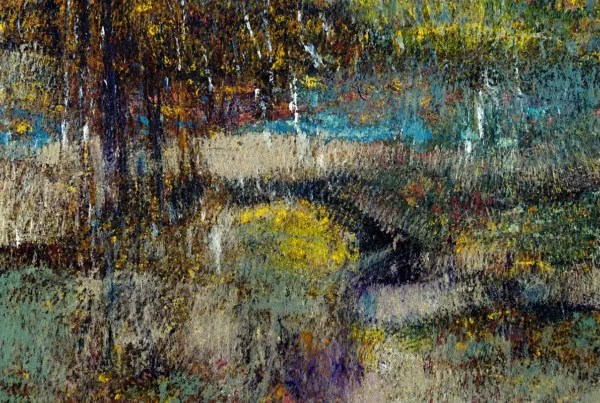
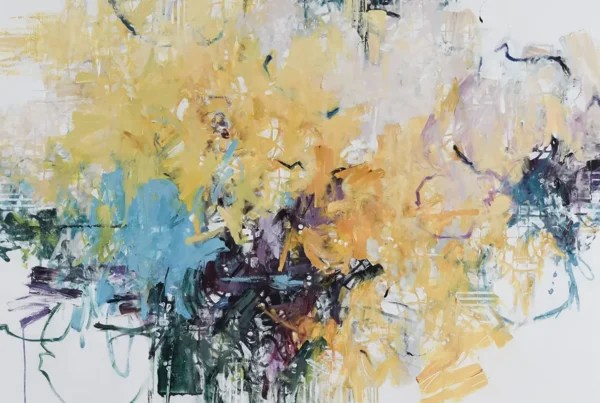
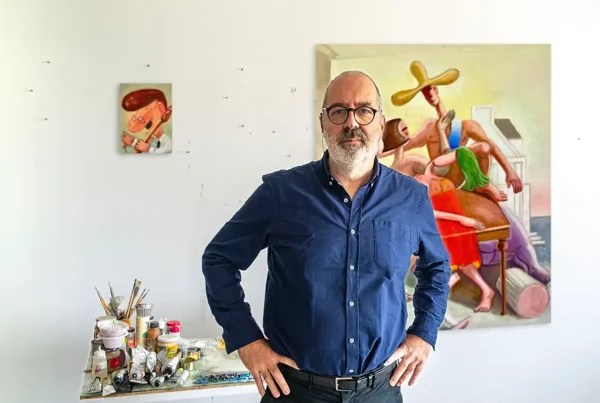
For Sydney-based abstract artist Irene Cabasa, painting is a physical and emotional language built through colour, texture and accumulated marks. Her surfaces explore resilience, identity, transformation and the complexities of lived experience, often allowing an idea to emerge gradually rather than forcing it toward a predetermined conclusion. Modelling paste, crackle paint, coarse texture mediums and acrylic colour give her paintings a dimensional presence, while brushes, palette knives, hands and unconventional tools introduce contrasting gestures. The result is an approach in which material and emotion develop together, each layer carrying evidence of the process that produced it.
Creativity entered Cabasa’s life early and through more than one discipline. She remembers singing from the time she could speak and drawing as soon as she could hold a crayon. Visual art remained part of her education through high school, while music later became the focus of formal study. In 2012, she completed a Bachelor’s degree in Performance and Popular Music at JMC Academy. That musical background continues to accompany her painting practice today. She regularly puts on headphones before beginning work, using music to focus and establish the conditions in which she can become absorbed in the canvas.
Her father provided another formative connection to creativity. He studied architecture before immigrating from the Philippines to Australia in 1985, bringing an appreciation for design, craftsmanship and creative thinking that strongly influenced his daughter. Architecture was his profession, but abstract painting was his passion. Cabasa grew up observing both sides of that practice: the precision and structure required by architectural work, and paintings animated by bold colour, energetic shapes and movement. The tension between control and freedom fascinated her, establishing an early model for an artistic life in which structure could coexist with instinct.

Irene Cabasa: Painting Through a Turning Point
Cabasa draws inspiration from sources that range from art history to the environment immediately around her. She cites Frida Kahlo, Salvador Dalí and Monet among the artists who have influenced her, alongside her father and the Australian landscape she calls home. Her perception of life and her own human experience are equally central. Rather than separating personal history from visual experimentation, she allows what she has lived through to inform the emotional character of the work. That relationship became particularly significant after she was diagnosed with breast cancer at the age of 33.
The diagnosis marked a profound shift in both Cabasa’s life and artistic practice. During one of the most difficult periods she had faced, painting became a means of continuing forward, supported by the constant presence of family and loved ones. Making art gave her somewhere to place experiences that could be difficult to articulate directly. Pain, trauma and uncertainty entered the creative process not simply as subjects to illustrate, but as emotional forces that could be worked through colour, pressure, texture and repeated physical action.
This experience deepened themes that were already important to her, particularly resilience and transformation. Her abstract language leaves space for complicated emotional states to exist together without requiring a single literal interpretation. Vulnerability can sit beside strength, darkness beside hope, and disruption beside renewal. The layered construction of her paintings is especially suited to those relationships. Surfaces are built, dried, revisited and altered, so transformation is not only something a finished work might suggest. It is embedded in the way the painting physically comes into existence.

The Many Selves of Sacred Feminine
One work brings these concerns into especially concentrated focus. Sacred Feminine, an acrylic painting on canvas measuring 30.5 by 30.5 centimetres, emerged from Cabasa’s reflections on the strength, softness, vulnerability and power she associates with women’s experience. She approached the painting without pursuing perfection, allowing emotion to determine the direction of the composition. Colour became a vocabulary for feelings she could not always express in words, turning the modestly scaled canvas into an exploration of identities and qualities that can coexist within one person.
Each colour carries particular significance. Rich reds evoke passion, life, courage and an enduring inner fire, while pink introduces tenderness and self-love, affirming Cabasa’s belief that softness does not signify weakness. Purple represents intuition, spirituality and the wisdom involved in trusting oneself. Black moves through the composition as an emblem of resilience and transformation, acknowledging what survives and changes through periods of darkness. Yellow supplies a counterpoint of hope, representing the light that can return even after difficult experiences. Together, these colours resist reducing femininity to any single emotional state.
Cabasa also gave the painting its character through the specific way she applied paint. Instead of relying on broad, sweeping strokes, she used both harsh and gentle dabs of the brush, letting the image accumulate through individual touches. The method mirrors the idea at the heart of the work: identity is layered rather than singular. For Cabasa, the sacred feminine can be wild and calm, broken and whole, fierce and nurturing at the same time. The painting invites viewers to reconnect with those seemingly contradictory energies, honour different versions of themselves, and approach their own experiences with compassion and strength.

Irene Cabasa: Letting the Surface Decide
Cabasa’s studio process begins with construction. After gathering inspiration and turning to music for concentration, she establishes the physical foundation using modelling paste, crackle paint, coarse mediums and other dimensional materials. These elements must dry before colour can be introduced, often requiring her to return the following day. Once painting begins, her tools expand beyond conventional brushes. Palette knives, her hands and found objects can all contribute marks, while dried acrylic paint skins left from earlier works are sometimes repurposed inside new compositions. What might otherwise become waste is given another visual and material function.
Time is an active part of this process. Cabasa may work for hours before stopping to let a layer dry or to see the composition again with greater distance. More complicated passages can lead to longer breaks, and she frequently keeps several works underway simultaneously. The fluid movement and layered water effects that recur in her paintings demand substantial drying periods, making patience inseparable from the technical process. A work can therefore develop over several weeks. Its concept may shift along the way, responding to what happens on the surface rather than remaining fixed to the idea with which she began.
That openness is now extending into Cabasa’s ambitions for scale and continuity. She is concentrating on larger paintings to discover how expanded surfaces alter her expression of movement, ideas and emotion. Greater scale requires a more physical encounter with the canvas, encouraging her to move around it and respond with her whole body. At the same time, she wants to create a cohesive series in which a concept, emotion or visual language can develop across multiple paintings. Instead of asking one work to resolve an idea completely, she is interested in connections between pieces and in how different perspectives might emerge when a subject is given room to evolve. Looking ahead, Cabasa also hopes to use her artwork as a platform to spread breast cancer awareness globally, drawing on her own experience to create meaningful connections and contribute to a broader conversation through her practice.