“The sea begins on land.”
A Language Forged Through Matter
Long before polished bronze became central to his artistic identity, Stéphane Pietrement discovered an emotional connection with clay that transformed his understanding of creation. In 1990, ceramics opened a path that allowed him to communicate through texture, density, and form rather than words. White clay, dark mineral-rich earth, and heavily grogged surfaces became tools for expressing instinctive reactions to the natural world. During these formative years, he experimented relentlessly with mineral pigments, building layered patinas that shifted from verdigris to anthracite and metallic black. The resulting sculptures appeared almost unearthed rather than constructed, resembling fragments of forgotten ecosystems or organisms suspended between plant, mineral, and animal states. Observers often struggled to define what they were seeing. Some compared the pieces to coral accumulations or meteorites, while others sensed traces of bark, marine colonies, or mysterious underwater formations. That uncertainty became central to Pietrement’s visual language and remains deeply embedded within his work today.
The atmosphere surrounding these early creations reflected an imagination nourished by science, exploration, and childhood fascination. Growing up in Touraine, within France’s historic Valley of the Kings, Pietrement absorbed a strong sensitivity toward nature and transformation. Television documentaries by Jacques Yves Cousteau and the underwater photography of Luis Marden expanded his perception of hidden ecosystems and awakened a lifelong fascination with marine environments. These influences did not emerge through literal representation. Instead, they shaped a biomorphic vocabulary built on movement, erosion, and organic tension. Even his earliest ceramic structures suggested submerged civilizations or living organisms adapting to invisible environmental forces. Their surfaces carried the memory of geological pressure and aquatic motion. Through this process, Pietrement gradually established a personal aesthetic where abstraction and ecology coexist, allowing sculpture to function simultaneously as emotional expression and environmental reflection.
A decisive moment arrived in 1996 while Pietrement was working as the private chef of renowned fashion designer Kenzo. After discovering the sculptor’s ceramic works, Kenzo encouraged him to exhibit publicly for the first time. That support marked the beginning of a professional artistic trajectory that would continue expanding over the following decades. Exhibitions in France, Switzerland, Japan, Belgium, and the United States soon followed, accompanied by recognition for both his ceramic sculptures and precious jewelry creations. Yet rather than remaining within a single discipline, Pietrement continued searching for new relationships between materials and form. His artistic path evolved through years of experimentation, eventually leading him toward freestyle bronze casting for his sculptures, combined with local centuries-old noble wood. That transition did not erase the spirit of his ceramic years. Instead, it extended the same fascination with organic transformation into a more physically demanding and technically ambitious practice.

Stéphane Pietrement: The Alchemy of Freestyle Bronze
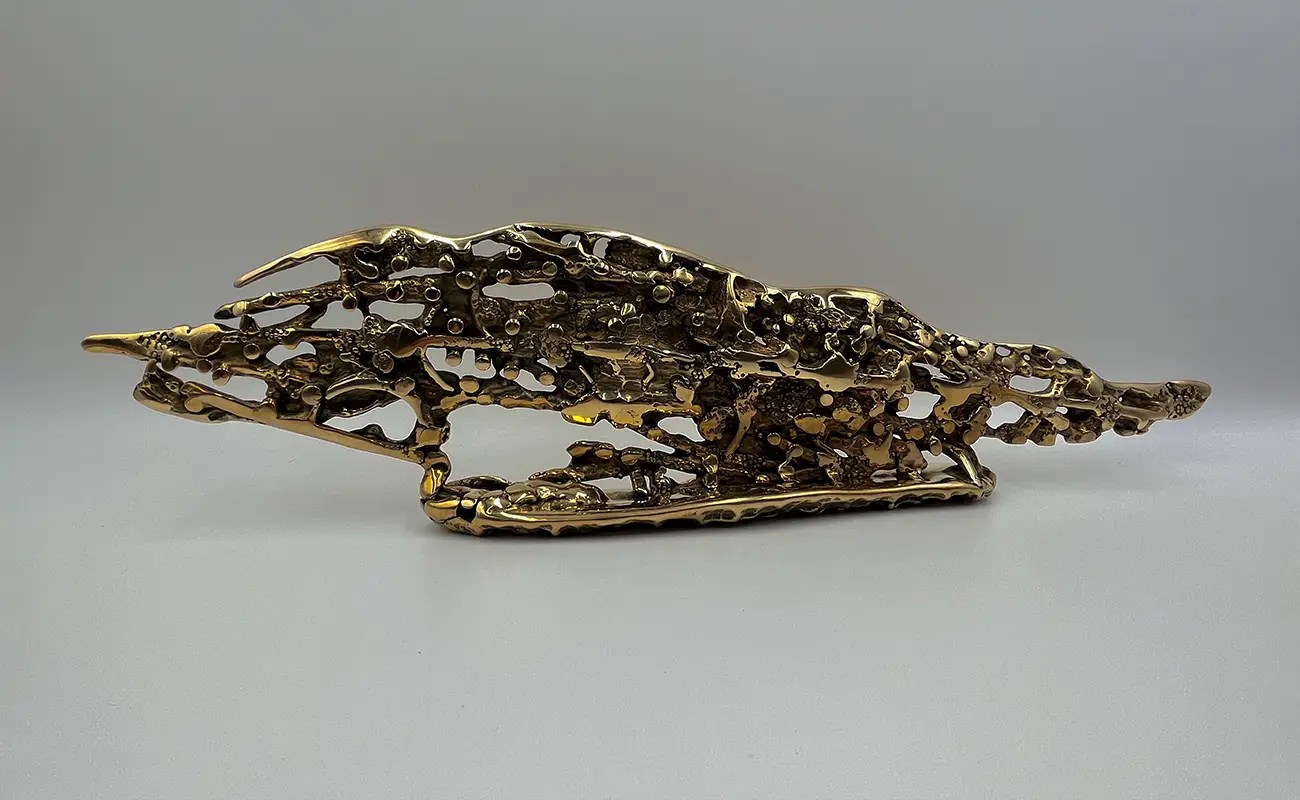
Today, Stéphane Pietrement works under the identity WOOD METAL SPIRIT, producing sculptures that merge polished golden freestyle bronze with centuries-old reclaimed wood. Every stage of production is executed personally, from casting and chiseling to assembly and final polishing. This complete control over the process allows his sculptures to retain an intensely personal physicality. Rather than relying on preparatory drawings or rigid technical plans, he approaches each piece through instinct and direct engagement with materials. Wood is treated not as passive support but as a living collaborator whose grain and imperfections influence the final composition. Bronze enters the process through fire and immediacy, reaching a temperature of 1100 degrees before being guided into shape during cooling. Pietrement rejects traditional lost wax methods, preferring an intuitive approach that embraces unpredictability. The resulting sculptures possess a fluid, almost spontaneous energy despite their technical sophistication. Their forms appear simultaneously ancient and futuristic, carrying the visual memory of marine organisms, fossil structures, and evolving biological systems.
The integration of reclaimed noble wood adds another dimension to this practice. Pietrement sources timber from old houses, castles, and farms throughout Nouvelle Aquitaine, often working with oak or walnut dating back centuries. These materials carry visible traces of time, weather, and human history, which he preserves rather than conceals. Some surfaces are treated using the Japanese Shou Sugi Ban technique, where controlled burning produces dramatic textures and deep black tones. Others are stained with Japanese or Chinese ink, creating subtle dialogues between darkness, reflection, and polished bronze. This combination of ancient wood and luminous metal produces striking visual contrasts while reinforcing the environmental themes that run throughout his work. Nature is not presented as decorative scenery. Instead, Pietrement treats natural materials as witnesses to transformation, survival, and fragility. His sculptures become encounters between permanence and decay, growth and erosion, terrestrial history and marine imagination.
One of the clearest expressions of this philosophy appears in the sculpture SEABED SPIRIT – ref. 110, a unique piece 1/1 centered on the relationship between environmental beauty and ecological destruction. Pietrement describes the piece as “a silent cry against the suffocation of our oceans.” Coral-like bronze structures emerge upward from a seventeenth-century oak base transformed through fire, while a translucent yellow plexiglass plinth symbolizes plastic pollution infiltrating marine ecosystems. The sculpture stages a confrontation between vitality and contamination without relying on literal storytelling. Instead, its emotional force emerges through material contrast and symbolic tension. Polished bronze suggests resilience and light, while the synthetic transparency beneath it introduces discomfort and vulnerability. Pietrement’s statement accompanying the piece, “The sea begins on land,” reinforces the idea that environmental damage originates far beyond coastlines. Through works like SEABED SPIRIT – ref. 110, he transforms abstract sculpture into a contemplative space where viewers confront both the magnificence and fragility of biodiversity.

Biomorphic Visions and Ecological Consciousness
Throughout Pietrement’s career, biomorphism has remained the foundation of his artistic vocabulary. His sculptures resist fixed interpretation, existing within shifting territories between coral structures, skeletal fragments, geological formations, and botanical growths. This ambiguity allows viewers to project their own associations while experiencing the emotional intensity of the forms. Rather than imitating nature directly, Pietrement studies its principles of mutation, adaptation, and interconnectedness. His works suggest living systems suspended in transformation, shaped by invisible environmental pressures and temporal cycles. The polished surfaces amplify this sensation by reflecting light dynamically, causing the sculptures to appear constantly in motion depending on the surrounding environment. Such visual fluidity contributes to the immersive quality of his exhibitions, where sculpture functions less as static object and more as evolving presence. This approach has attracted collectors, interior designers, galleries, and contemporary art fairs seeking works that combine technical refinement with conceptual depth.
Environmental awareness remains inseparable from this visual language. Pietrement’s fascination with marine biodiversity evolved gradually through travel, observation, and sustained reflection on ecological decline. His sculptures seek to rekindle curiosity toward ecosystems that many people rarely encounter directly. Instead of using explicit activism or documentary imagery, he encourages contemplation through beauty and tactile complexity. Bronze branches resembling coral colonies become reminders of vulnerable underwater habitats, while burned wood surfaces evoke environmental scars and regeneration simultaneously. This balance between seduction and unease gives his work emotional resonance. Viewers are first drawn toward luminous textures and elegant forms before recognizing the ecological tensions embedded within them. Pietrement understands sculpture as a way to slow perception and create sustained attention, allowing environmental themes to emerge through sensory experience rather than instruction.
Recognition for this approach has expanded significantly in recent years. Since establishing his WOOD METAL SPIRIT studio in the Basque Country in 2020, Pietrement has exhibited extensively through solo presentations, international contemporary art fairs, digital exhibitions, and permanent gallery collaborations. His sculptures have appeared in Monaco, Miami, Basel, Dubai, Berlin, Venice, Zurich, and New York, among many other locations. Awards from Artcertificate competitions and Salon d’Automne further reinforced his growing international profile. Critics and curators frequently emphasize the unusual balance within his work between craftsmanship, abstraction, and ecological reflection. Reviews have highlighted the fluid elegance of his polished bronze surfaces and the emotional impact created through combinations of reclaimed wood and luminous metal. Whether presented within galleries, design spaces, or luxury interiors, his sculptures maintain a strong conceptual focus centered on humanity’s relationship with natural systems.

Stéphane Pietrement: Toward Monumental Conversations
While Pietrement’s sculptures already possess a commanding physical presence, his ambitions increasingly extend toward monumental scale and public engagement. He envisions large biomorphic installations interacting directly with architecture and landscape, allowing his organic forms to inhabit museums, public environments, and cultural institutions. Such projects would expand the immersive qualities already present within his smaller works, creating spaces where audiences encounter sculpture as environmental experience rather than isolated object. The artist sees these future developments not simply as professional milestones but as opportunities to amplify ecological awareness through visual impact. By integrating biomorphic bronze forms into urban or architectural settings, he hopes to encourage reflection on humanity’s connection to marine and terrestrial ecosystems within everyday environments. This ambition reflects the broader evolution of his practice from intimate studio exploration toward public dialogue.
Collaboration also occupies an increasingly important position within his future direction. Pietrement seeks stronger relationships with interior designers, galleries, and foundations capable of integrating contemporary sculpture into meaningful spatial projects. His work already resonates strongly within architectural contexts because of its balance between refinement and organic unpredictability. Polished bronze surfaces interact dynamically with natural light, while reclaimed wood introduces warmth and historical memory into contemporary spaces. These qualities allow the sculptures to function both as conceptual artworks and as transformative spatial presences. Partnerships with institutions such as Sotheby’s International Realty and Roche Bobois have already demonstrated how effectively his sculptures engage luxury interiors while preserving their environmental and artistic integrity. Such collaborations reinforce the idea that ecological consciousness and sophisticated design can coexist without compromise.
Asia remains another deeply significant horizon within Pietrement’s artistic vision. Earlier exhibitions in Japan left a lasting impression on him, particularly through cultural sensitivities surrounding nature, purity, and material balance. His interest in returning to Asian audiences reflects more than professional expansion. It represents a desire to reconnect with environments where abstraction and organic minimalism hold strong philosophical resonance. Across all these ambitions, his central objective remains unchanged: transforming artistic wonder into awareness and responsibility. Through bronze, reclaimed wood, fire, and instinctive creation, Stéphane Pietrement continues building a sculptural language that celebrates biodiversity while confronting its fragility. His work exists at the intersection of elegance and urgency, offering viewers an experience where beauty becomes inseparable from reflection on the future of the natural world.