A Sculptor Who Turns Emotion Into Form
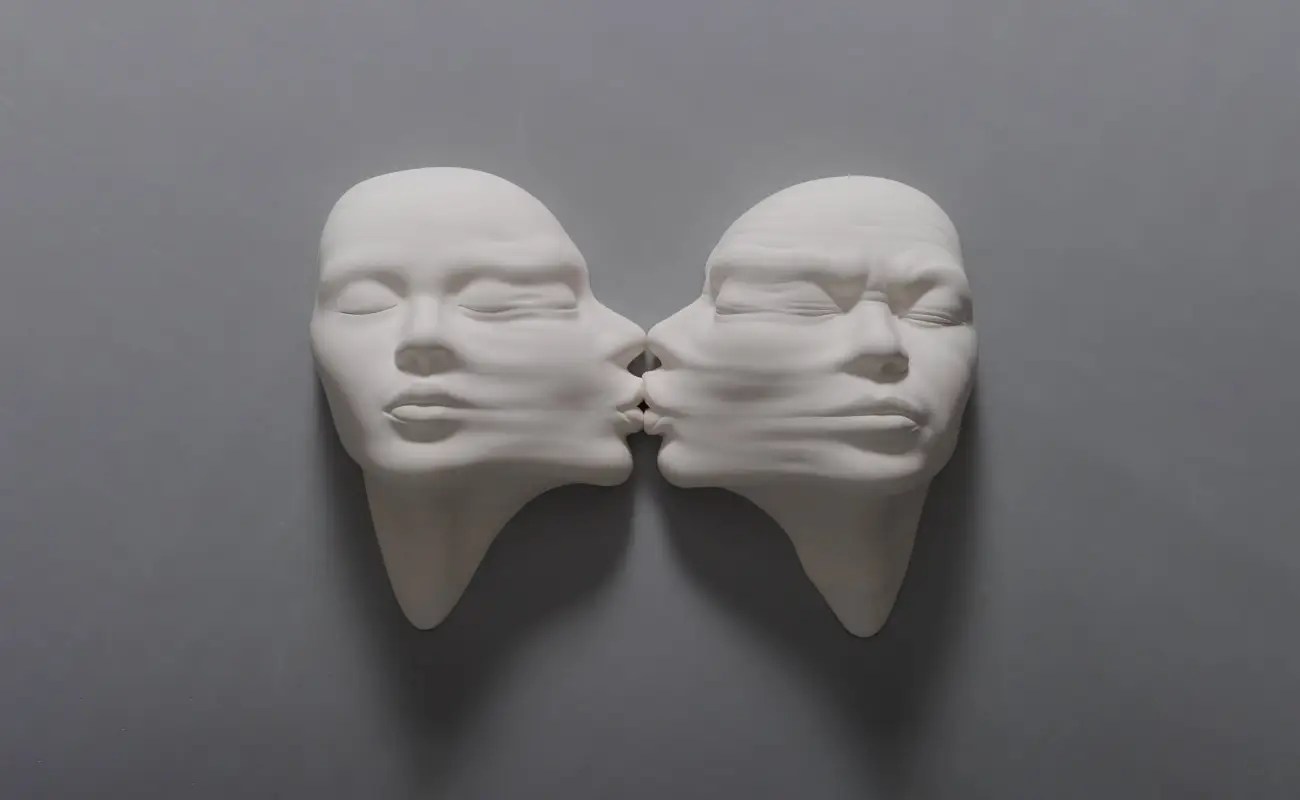
Johnson Tsang has earned international admiration for sculpture that fuses exacting realism with startling imagination. Born in Hong Kong, he has built a practice in which the human face and body are transformed into carriers of memory, tenderness, anxiety, wonder, and psychological tension. Working mainly with porcelain, while also producing works in stainless steel and mixed media, he creates forms that appear to bend the limits of matter itself. Faces stretch like fabric, surfaces burst open with inner force, and expressions seem to move between calmness and unrest. Through this language, he has become one of the most distinctive contemporary sculptors working today, especially within ceramics.
His route into art was far from conventional. Raised in modest circumstances, Tsang displayed creative impulses early, drawing constantly and turning everyday spaces into places of invention. Yet life initially led him through practical occupations rather than formal artistic training. He worked various trade jobs and later served for thirteen years as a policeman. A decisive turning point came in 1991, when he first encountered clay. That experience introduced a material that felt responsive, soothing, and deeply personal. What began as curiosity developed into a lifelong dedication, shaped by discipline, instinct, and a search for inner stillness.
Much of Tsang’s reputation rests on his ability to make difficult materials appear effortless. Porcelain is celebrated for beauty but feared for fragility, requiring patience, precision, and control. Tsang uses those demands to his advantage, pushing the medium toward extraordinary expressive power. Through techniques such as slab building and careful manipulation while clay remains pliable, he constructs forms that feel alive. His sculptures often present impossible visual events with convincing physical presence, allowing viewers to accept the unbelievable for a moment. That rare union of craft and imagination has become the foundation of his global standing.

Johnson Tsang: The Silent Power of White Porcelain
One of the defining decisions in Tsang’s mature practice is his devotion to white porcelain. For him, white carries associations of innocence, serenity, purity, and the gathering of all colors into one presence. This restrained palette removes distraction and places full emphasis on shape, texture, gesture, and psychological charge. Rather than relying on decorative color, he invites viewers to notice subtle shifts in surface and expression. The result is sculpture that feels concentrated and contemplative, where every curve or fracture gains emotional significance.
Earlier works at times used stronger color to communicate anger, conflict, or social unease. Over time, however, Tsang’s artistic language moved toward reflection, acceptance, and calm intensity. White porcelain became not a neutral absence, but a way of clarifying complex feeling. It allows his transformations to feel both dreamlike and believable. A face opening into a landscape or dissolving into liquid appears less theatrical and more poetic when rendered in this luminous material. The simplicity of color gives space for deeper interpretation.
This preference also highlights his technical command. White porcelain reveals imperfections easily, making precision essential at every stage. Tsang embraces that challenge, producing surfaces that can seem soft as skin or fluid as water. His long study of splash forms is especially significant. Beginning in 2002, he developed versatile ceramic splashes and launched the Yuanyang series, later collected by the Hong Kong Museum of Art and Taiwan’s Yingge Ceramics Museum. During the following decade, he refined methods for capturing the split-second energy of splashing motion in porcelain, turning stillness into apparent movement.

Dreams, Pressure, and the Elastic Human Mind
Among Tsang’s most admired creations are the Lucid Dream and Open Mind series, bodies of work that reveal his fascination with inner life. In these sculptures, heads become landscapes, pillows, battlegrounds, portals, or containers of hidden activity. Features are compressed, stretched, fractured, or opened to reveal miniature worlds. Such imagery suggests the pressures of modern existence, but it also points toward healing, resilience, and release. His sculptures frequently hold tension and humor together, creating works that are unsettling and playful at once.
He often transforms familiar anatomy into symbols of thought and feeling. A nose may buckle beneath the weight of sleep, a face may crack under unseen mental strain, or a profile may bloom with grass and water. These changes do not merely decorate the figure. They give visible shape to experiences that usually remain private and difficult to describe. Stress, affection, confusion, vulnerability, and hope become tangible through clay. This ability to translate emotion into matter is one reason audiences across cultures respond so strongly to his work.
Underlying these images is a philosophy rooted in intuition and emotional honesty. Tsang has spoken about ideas arriving when the busy mind becomes quiet. He views creativity not as a rare privilege, but as a natural human capacity available to anyone willing to listen inwardly. He also resists fixed interpretation, encouraging viewers to trust their own reactions. Meaning, in his view, is renewed each time a person encounters an artwork. That openness gives his sculptures unusual longevity, since every observer may discover something personal within them.

Johnson Tsang: Recognition, Public Presence, and Lasting Influence
Tsang’s achievements have been recognized through major international awards and institutional respect. In 2011, his work Bowls of Fantasy received the Special Prize at the Korea Gyeonggi International Ceramix Biennale International Competition. The following year, Splash of Wonder earned the Grand Prize at the Taiwan International Ceramics Biennale. These honors placed him in a rare historical position as the first Chinese artist to receive both prestigious ceramics distinctions. They also confirmed that his experiments in porcelain had expanded the possibilities of the medium on a global stage.
Recognition has extended beyond prizes into public service and civic honor. In 2009, he received The Secretary for Home Affairs’ Commendation from the Government of Hong Kong Special Administrative Region for outstanding achievements in international art events. Since 2014, he has served as Museum Expert Advisor for the Leisure and Cultural Services Department. These roles reflect confidence not only in his artistic talent, but also in his judgment, experience, and contribution to cultural life. His voice has therefore influenced both exhibition spaces and broader conversations around art.
His works are held in important public and private collections, including the Hong Kong Museum of Art, Hong Kong Heritage Museum, the Korea Ceramic Foundation, Yingge Ceramics Museum, and Dublin Castle. Since 2004, he has also produced stainless steel sculptures and public art commissions for numerous organizations. Yet the true significance of Johnson Tsang lies beyond lists of honors. He has shown that one of the most delicate materials can carry immense psychological force. Through porcelain, he has given shape to vulnerability, tenderness, pressure, and the extraordinary flexibility of the human spirit.