“Projects sometimes mature very quickly in my imagination, and at other times a bit more slowly.”
A Visual Language Shaped Across Continents
Pepponi Art occupies a distinctive position within contemporary painting, bringing together personal memory, cultural observation, and an instinctive command of color. Born in Germany as Birgit Kalkofen, she spent much of her early professional life working in tourism, a path that carried her through Europe, America, Asia, and Africa. More than a decade of living in Kenya became especially important to her visual development, while her experiences in Thailand, Spain, and other locations broadened her understanding of place, identity, and human expression. These encounters did not simply supply decorative references. They gradually formed the emotional and visual foundation of an artistic practice defined by vivid palettes, stylized figures, ornamental structures, and expressive faces. Working under the name Pepponi Art, Kalkofen transforms impressions gathered over decades into paintings that feel immediate yet layered. Her work demonstrates how travel can become more than biography, functioning instead as an enduring source of form, rhythm, atmosphere, and creative direction.
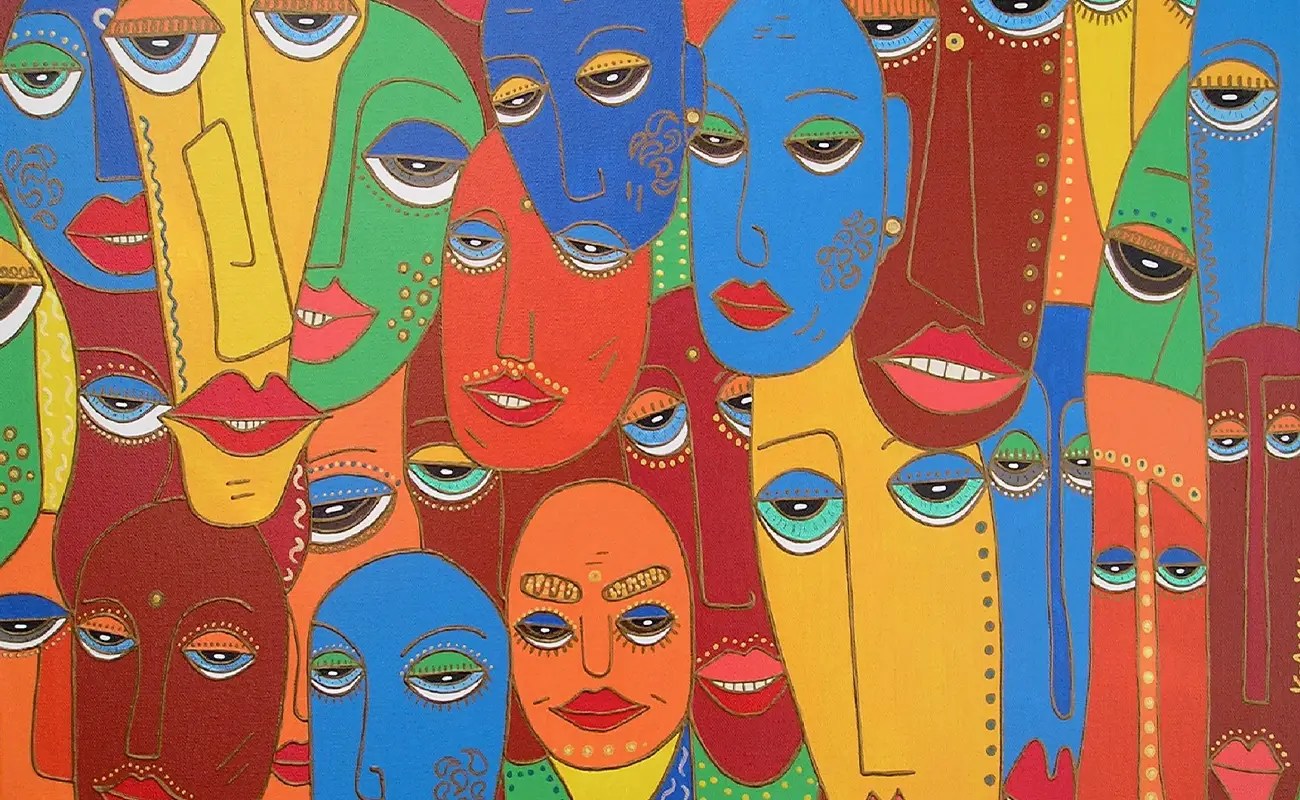
Although Kalkofen is self taught, her work reveals a confident and recognizable artistic vocabulary. Acrylic paint remains central to her practice, often combined with mixed media and applied to surfaces such as wood, which gives her compositions a physical presence beyond the conventional canvas. Her figures frequently approach abstraction without abandoning the human form. Faces, masks, elongated features, and strong outlines appear within arrangements of color and ornament, creating images that balance emotional accessibility with symbolic ambiguity. Viewers can identify a face or body, yet the meaning rarely settles into a single interpretation. This tension allows her paintings to remain open and psychologically engaging. Color is equally important. Rather than functioning as a secondary element, it directs the mood and structure of each composition. Intense reds, radiant blues, warm yellows, and contrasting tones create visual energy while supporting the emotional character of the subject. Through these choices, Pepponi Art has built a style that is expressive, personal, and immediately identifiable.
Her development has been guided less by formal instruction than by sustained observation, experimentation, and lived experience. The many environments she encountered offered different relationships to pattern, spirituality, nature, social life, and visual storytelling. African and Asian influences are particularly visible in the masks, facial structures, symbolic geometry, and ornamental details that recur throughout her work. At the same time, her paintings remain connected to European modernism through their flattened spaces, simplified anatomy, and expressive distortion. Comparisons may arise with the stylized portraits of Amedeo Modigliani or the geometric treatment of African inspired forms associated with Pablo Picasso, yet Kalkofen does not imitate these precedents. She absorbs broad visual histories into a language shaped by her own memories. The result is contemporary work that feels culturally expansive without losing its personal center. Every painting reflects a process of translation in which places, encounters, and emotions are reconfigured into color, shape, and human presence.

Pepponi Art: Between Recognition and Abstraction
The central strength of Pepponi Art lies in the way recognizable figures are pushed toward abstraction while remaining emotionally direct. Human faces often dominate her compositions, but they are rarely presented as conventional portraits. Features may be enlarged, simplified, shifted, or surrounded by rhythmic patterns that alter the viewer’s sense of identity. A face can appear intimate and distant at the same time, suggesting both a specific presence and a broader symbol of humanity. Masks introduce another layer of meaning. They can imply concealment, transformation, ceremony, protection, or the shifting roles people assume in different circumstances. Kalkofen leaves these possibilities unresolved, allowing viewers to bring their own experiences to the image. This openness gives the paintings their lasting force. Rather than explaining a subject through narrative detail, she creates an atmosphere in which expression, color, and form communicate before words can define what is being felt.
Ornamentation plays an active structural role throughout her practice. Repeated lines, geometric forms, patterned areas, and decorative accents help organize each surface while creating a sense of movement. These elements may recall objects, textiles, architecture, or visual traditions encountered during her travels, but they are not presented as documentary records. Kalkofen reorganizes them according to the internal demands of the painting. Pattern may frame a face, divide a background, emphasize a gesture, or establish a visual rhythm that carries the eye across the work. This approach allows the surface to feel both spontaneous and controlled. The compositions are energetic, yet their elements remain connected through carefully balanced relationships between color, shape, and scale. Even when the imagery appears playful or exuberant, the arrangement possesses a clear visual logic. Her paintings therefore reward immediate response while also encouraging slower attention to the interactions between figure, background, ornament, and emotional tone.
International exhibitions have helped introduce this visual language to audiences beyond Germany. Kalkofen has shown work at events and venues including Art Expo New York and Scope Miami, while galleries in Germany and Spain have also presented her paintings. Her inclusion in private collections across different countries reflects the broad appeal of images that communicate through fundamental human elements such as faces, gestures, colors, and symbols. The work does not depend on a single cultural reference or fixed explanation. Instead, it combines multiple influences within compositions that remain approachable. This accessibility does not reduce their complexity. Viewers may first respond to the brightness of the palette, then notice the ambiguity of the figures or the emotional tension within a particular expression. Such gradual discovery helps explain why the paintings resonate across varied settings. Pepponi Art offers an art of connection, inviting recognition while preserving enough mystery to make each encounter personal.

Memory, Movement, and the Beloved Monk
One of the most meaningful works in Kalkofen’s life grew from her time in Thailand during the 1970s. While working there, she became deeply impressed by Buddhism and by the presence of Buddhist monks. The experience remained with her for almost three decades before she attempted to translate it into a painting. Using acrylic paint on canvas, she created a visual depiction of a monk who carried the memory of that earlier period. The long interval between encounter and creation reveals how certain impressions can remain active beneath the surface of an artist’s life. Rather than producing an immediate record, Kalkofen allowed the memory to mature until it found a visual form. The resulting painting was not merely an image of a religious figure. It represented a sustained emotional connection to Thailand, to Buddhist spirituality, and to a formative chapter of her personal history. Its importance became evident in the way she protected it after its completion.
For nearly eighteen years, Kalkofen resisted repeated inquiries from people who wanted to purchase the monk painting. Her refusal suggests that the work occupied a place closer to a private companion than a commercial object. She referred to the figure affectionately as her beloved monk, language that conveys the intimacy of their long association. Eventually, however, she allowed the painting to leave, describing the moment as the monk moving on. That phrasing changes the meaning of the sale. Instead of presenting it as a simple exchange, she frames it as a departure, almost as though the figure had completed one stage of its journey and was ready to continue elsewhere. The story reveals the emotional relationships artists can form with their own creations, particularly when a work carries memories that predate its physical existence. It also shows how an artwork can hold personal history while gradually acquiring a life beyond the studio and beyond the person who made it.
Movement continues to shape Kalkofen’s imagery in both literal and symbolic ways. “Sailing to New Shores,” for example, emerged from her relocation from Mallorca, Spain, back to Germany. The title transforms a personal move into a broader image of transition, uncertainty, and renewal. A change of location becomes a passage between chapters, echoing the many journeys that have defined her life. Such works demonstrate that travel within Pepponi Art is not limited to geographical experience. It also describes emotional movement, changing perspectives, and the need to adapt when familiar circumstances shift. Her paintings draw power from this relationship between outer events and inner response. A place may inspire a palette, a cultural encounter may shape a figure, and a major decision may become the basis of a symbolic composition. Through this process, biography is not illustrated directly. It is recast as visual energy that allows personal experience to speak to more universal feelings of departure, memory, change, and belonging.

Pepponi Art: Painting in Response to an Unstable Present
Kalkofen’s creative process often begins long before paint reaches a surface. Some projects form rapidly in her imagination, while others develop at a slower pace and require time before their direction becomes clear. This flexible rhythm allows her to respond both to enduring memories and to urgent events. Her recent work demonstrates how political tension can provoke an immediate artistic reaction. During January and February, she became deeply troubled by the power struggles of certain political figures and by the absence of meaningful peace talks. Her frustration led her to create two related images. Soon afterward, conflict involving the United States, Israel, and Iran gave those concerns an even sharper relevance. The paintings were therefore born from a desire to answer political aggression through visual expression. Rather than claiming that art can resolve such conflicts, Kalkofen uses it to register emotional resistance, anxiety, and a longing for dialogue at moments when public events appear driven by confrontation.
Titles such as “Which Direction We Go” and “Change” reflect this engagement with political uncertainty. Both phrases are open enough to address collective conditions as well as individual choices. “Which Direction We Go” suggests a crossroads, raising questions about leadership, responsibility, and the consequences of decisions made under pressure. “Change” carries a similarly broad resonance, since transformation can represent hope, instability, progress, or loss depending on the circumstances surrounding it. Kalkofen does not separate these concerns from her established visual language. Figurative forms, symbolic arrangements, and forceful colors continue to guide the work, allowing political feeling to enter her practice without turning the paintings into literal illustrations. This method preserves their interpretive openness. A viewer may recognize the tension of the moment while also connecting the imagery to personal experiences of uncertainty. Through this balance, Pepponi Art converts current events into compositions that remain emotionally immediate without being limited to a single headline.
Environmental concern also enters her work through the “Nature 2.0” series, which arose in response to the continuing denial of global climate change. The title suggests a world being altered, revised, or forced into a new version of itself. It carries both technological and ecological associations, raising questions about what nature may become when human action reshapes its systems. This series extends Kalkofen’s broader interest in transformation while connecting personal expression to planetary conditions. Her bright colors may attract the eye, but beneath their visual intensity lies an awareness of instability and consequence. The same artist who paints faces, memories, masks, and journeys also responds to political conflict and environmental crisis, linking private perception with public concern. Across these subjects, her work remains grounded in sincerity rather than distance. Pepponi Art uses color not to escape difficult realities, but to confront them with clarity, emotional force, and an enduring belief in the communicative power of images.