“Control stops the flow.”
Painting What Survives the Moment
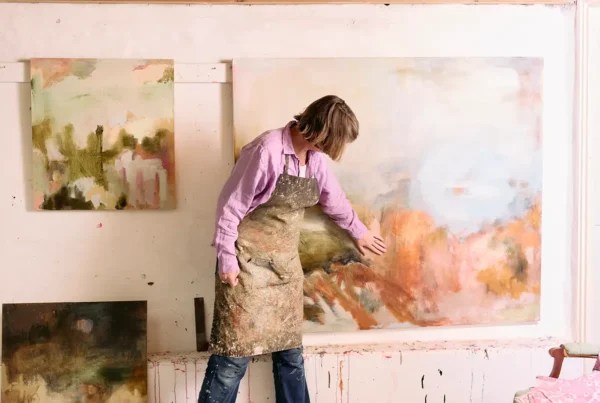
Öykü Akkoyunlu Davran builds paintings from what persists after direct experience has faded. Colour, movement, rhythm, spatial tension, and sensation become more important than faithful reconstruction, allowing memory to act as both subject and working method. Based in Ankara, Türkiye, the multidisciplinary artist, painter, illustrator, and designer works predominantly with acrylic and ink on paper, creating compositions whose immediacy reflects her interest in perception and observation. Her images often begin with places or experiences she has encountered, yet their final forms resist straightforward representation. Rather than reproducing what she saw, she asks what an image becomes after it has passed through memory.
Her path toward this approach has moved between fine art and visual communication. Drawing was present from childhood, although prescriptive art exercises at school initially frustrated her. Graphic design offered another entrance into visual culture. She studied the subject at Ankara Gaziosmanpaşa Anatolian Vocational High School, where regular drawing classes strengthened her abilities, before choosing Painting at Anadolu University in Eskişehir. During her undergraduate education, an Erasmus grant took her to the Universitat Politècnica de València in Spain for a semester. Even at art school, questions about how images should behave were already emerging. Some studio courses considered her painting too illustrative, reinforcing her discomfort with fixed expectations around image making.
After university, economic circumstances led Akkoyunlu Davran toward professional design. Across roughly twelve years in Istanbul and Ankara, she worked in advertising agencies and technology companies, taking on roles in graphic design, illustration, art direction, product design, and occasionally copywriting. The experience sharpened her understanding of how images are constructed to communicate and perform specific functions. Yet it also made her increasingly curious about what could happen when an image was released from those demands. In 2025, she returned to painting full time, carrying with her an unusually sustained awareness of both controlled visual communication and instinctive physical making.

Öykü Akkoyunlu Davran: Releasing the Designed Image
Stepping away from commercial creative work opened a period of intensive material experimentation. Akkoyunlu Davran financed six months of concentrated studio activity that she approached as a self funded residency. She worked with acrylic, watercolor, gouache, oil sticks and pastels, graphite, coloured pencil, chalk powder, finger paint, and other materials. During this period she produced six canvases and approximately 140 works on paper and other surfaces. Painting, drawing, cutting, and gluing became ways to recover physical and perceptual instincts that had been secondary to the problem solving structures of professional design.
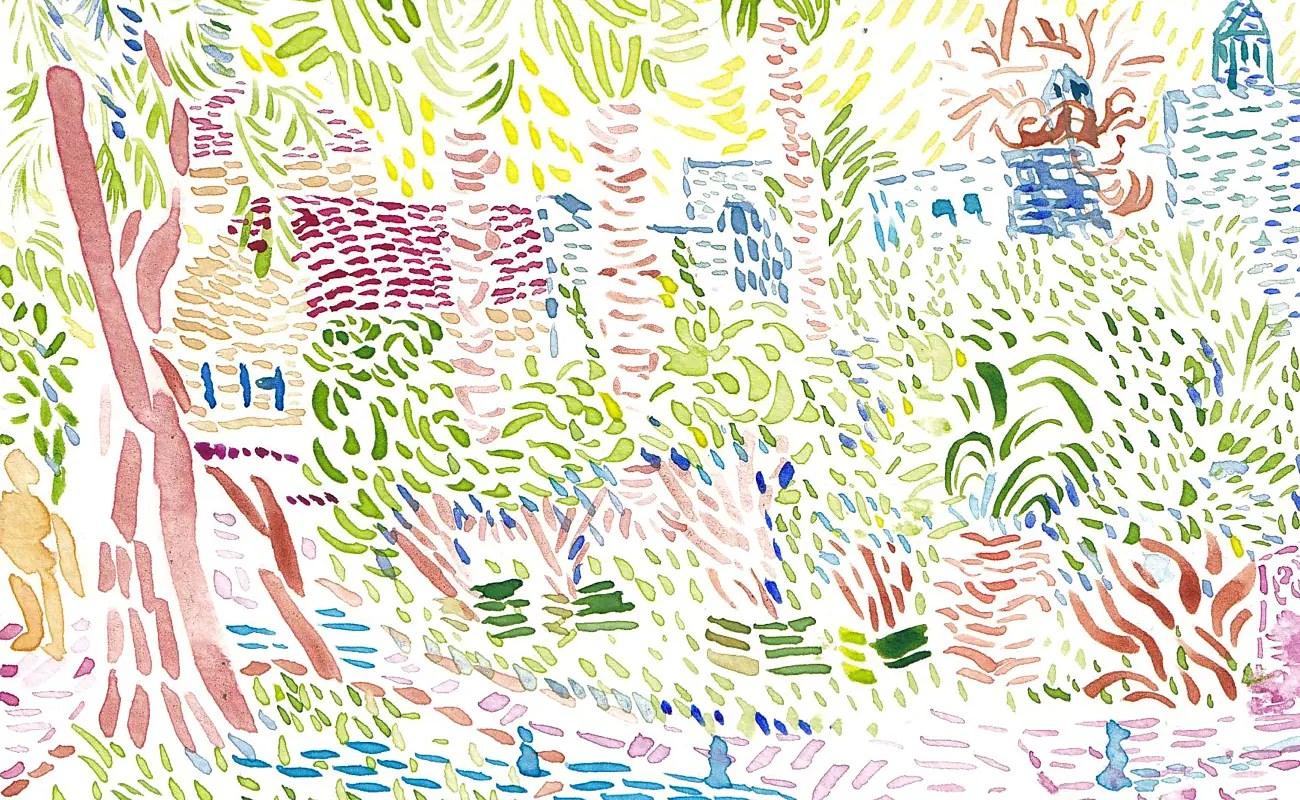
Watercolor proved especially useful in challenging habits developed through years of digital production. A mark made on a computer or tablet can function almost like a command, remaining responsive to revision and close control. Watercolor refuses that certainty. Water, pigment, gravity, and the support all influence its movement, giving the material a degree of agency within the image. For Akkoyunlu Davran, this uncertainty offered a productive release from feeling responsible for every visual decision. Her phrase “Control stops the flow” captures a central shift in her thinking, from directing each element toward a predetermined result to allowing the act of painting to generate discoveries of its own.
Those experiments contributed to her Abstractions series, in which she began applying paint directly with brushes, hands, and other applicators without starting from a fixed image. Representation did not disappear completely. Marks continued to suggest recognisable things even when she attempted to move away from depiction, and that tension became useful rather than something to eliminate. Memory gradually replaced the model or direct reference as an organizing force. Rapid marks made under intense concentration accumulated into forms that register thought and perception in motion, positioning the paintings between abstraction, observation, and the persistent human impulse to recognize images.

Nature, Memory, and the Space Between Colours
Nature is Akkoyunlu Davran’s strongest source of inspiration, particularly the sensations that remain after an encounter with a landscape has ended. She is interested in natural environments as well as moments of tension between organic and constructed forms. Rather than treating nature as scenery to reproduce, she retains fragments: a particular colour, the suggestion of movement, a rhythm, or a physical sensation. Nature therefore functions simultaneously as visual material and as a model for memory itself. Both leave traces, change with time, and resist being preserved in a completely stable form.
This relationship is especially clear in Road to Albufeira, a work made in 2025 following a trip to Portugal. Akkoyunlu Davran began with photographs, sketches, and visual impressions gathered during the journey, but did not attempt to reconstruct the landscape. The painting instead concentrated on what the experience had left in her memory. It was also her first work using acrylic on Yupo paper. The nonabsorbent surface appealed to her because it keeps paint and colour intensely present, supporting the chromatic directness that has become important to her current practice. More personally, the work marked the first moment when she felt her developing visual language had become distinctly her own.
Her interest in unstable memory predates these recent paintings. In 2011, while studying at the Universitat Politècnica de València, she created Liquid Memory using found footage painted directly on 8 mm and 16 mm film before transferring it to digital video. The work considered memory as fluid and temporary, capable of reproducing, erasing, and transforming information. That earlier concern now appears through different materials. Whether working with film or acrylic on paper, Akkoyunlu Davran repeatedly returns to the gap between an original experience and its later mental residue. The image becomes less an endpoint than evidence of transformation.

Öykü Akkoyunlu Davran: Speed, Friction, and Coexistence
Speed is central to Akkoyunlu Davran’s daily studio practice. She generally spends only a few hours on an individual piece, resisting prolonged refinement so that the raw energy of its making remains visible. Momentum accumulates across groups of works rather than through repeated adjustment of a single surface. This preference gives her practice a serial quality, with individual paintings contributing to a larger field of experimentation. Gesture, observational drawing, fragments, and spatial relationships can shift from one work to another while the act of making stays immediate. The studio becomes a place where repetition produces variation rather than polish.
Colour follows a similarly direct principle. Instead of blending hues into seamless transitions, Akkoyunlu Davran places colours beside one another so that individual forms and marks retain their autonomy. The spaces and tensions between these elements are as significant as the elements themselves. Separate visual units can coexist without surrendering their identities, creating compositions structured through friction, proximity, and balance. This approach connects formal decisions to a broader interest in how independent states can occupy the same space. Her paintings do not resolve those relationships into a single dominant reading; they allow contrasting impulses to remain active together.
That openness extends across a practice that has included photographic collage, direct animation, paper and three dimensional collage, digital media, drawing, painting, illustrated travel sketchbooks, portraits, still lifes, and monochrome works. Narrative also persists through her interest in science fiction, fantasy, writing, and illustrated travel journals. Rather than abandoning the communicative instincts developed through illustration and design, Akkoyunlu Davran places them in conversation with intuition, material unpredictability, and memory. Her next ambition is to carry this visual language into larger scale works, expanding a practice built around the charged interval between deliberate construction and the moment an image begins to escape control.