Making as a Form of Investigation
Pat Kim builds his practice around a simple but demanding proposition: materials can participate in deciding what an object becomes. Working across sculpture, furniture, objects, and printmaking, the Brooklyn-based artist and designer combines the discipline of industrial design with the responsiveness of traditional craft. Sculptural simplicity and enduring quality anchor his work, yet neither depends on rigid control. Kim moves between carefully resolved functional pieces and expressive material experiments, using each project to test how tools, processes, and substances can generate unexpected forms.
That instinct reaches back to his childhood in Arlington, Virginia. Kim was fascinated by mechanisms and construction, taking apart household objects to see how they worked and attempting to assemble them again. Another important influence was an inventive uncle who operated a deli beside the dry-cleaning business run by Kim’s mother. Drawing on practical skills acquired from growing up in the country, his uncle showed him how to improvise traps, slingshots, sleds, and other objects from whatever happened to be available. Making became inseparable from curiosity, resourcefulness, and direct physical experience.
Kim later studied industrial design at Pratt Institute in Brooklyn, including a short period at the Bauhaus-Universität Weimar, before graduating from Pratt in 2009. Entering the workforce during the financial crisis complicated the conventional product-design path he had imagined. He instead found employment with a furniture maker and began learning woodworking. What initially appeared to be a useful technical skill became a decisive change of direction. Working with tools and materials offered something increasingly important to him: the possibility of understanding an object through the process of physically constructing it.

Pat Kim: Letting the Lathe Lead
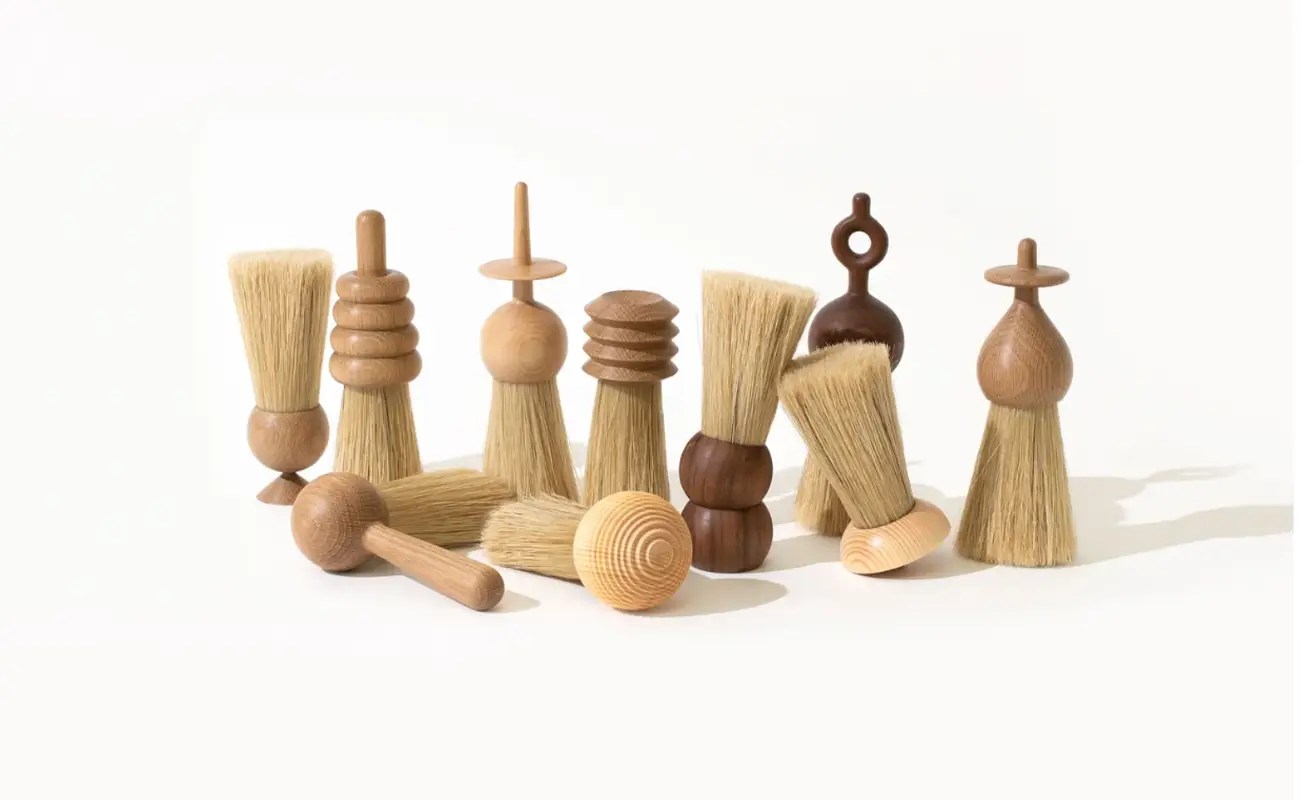
After developing his furniture-making skills, Kim joined like-minded colleagues to establish a cooperative woodshop in Red Hook, Brooklyn, where he continues to live and work. His attention increasingly shifted toward wood turning, first through smaller objects and eventually through larger sculptural furniture and independent forms. The move did not erase his industrial-design training. Instead, it placed that knowledge in conversation with the resistance, irregularity, and physical demands of wood. Function remained important, but it no longer had to determine every decision.
The lathe became particularly influential because it allowed Kim to work without knowing exactly where he would finish. He saves scraps left from other projects and returns to them as material for experiments. A fragment can be mounted on the lathe with no predetermined final object in mind. Cutting then becomes a way of discovering rather than executing. Shape develops through an exchange among the wood, the tool, movement, and Kim’s response to what appears. This approach stands in contrast to designing a complete form on paper and treating fabrication merely as the means of realizing it.
His studio consequently functions as both workshop and repository. Kim collects wood, stone, leather, shell, unusual hand tools, and other materials that might eventually prompt an experiment. Some tests remain unresolved for long periods before resurfacing in another context. Others generate tools, processes, or forms that redirect subsequent projects. Such accumulation supports a practice built on continuity rather than isolated breakthroughs. Failed attempts and leftover fragments can retain practical value because an experiment does not need to produce a finished object to influence what follows.

Where Natural Processes Meet Constructed Form
Nature provides another important source of formal thinking. During time spent in the Adirondacks, Kim became interested in places where living and nonliving substances appear to intersect: trees seeming to emerge directly from rock, stones rounded through erosion, decaying stumps, moss, and surfaces transformed slowly by weather and time. He does not simply reproduce these sights. Their relationships give him ways to consider growth, hardness, softness, erosion, decay, and the visual tension created when contrasting materials meet.
The Formations vase series makes this sensitivity particularly clear. Kim developed the works after noticing eroded wood remaining from a renovated pier and turned to untreated southern yellow pine as his material. Cutting both with and against the grain exposed different characteristics within the wood. Bleaching and staining brought further complexity to the surfaces, creating a marble-like appearance without disguising their origin. Existing cracks and splits remained visible rather than being corrected into uniformity. Leather bases were added to protect the surfaces on which the pieces rested, preserving a practical concern within an overtly sculptural investigation.
That balance between utility and formal exploration runs throughout Kim’s practice. Industrial design taught him to consider construction, purpose, and production, while woodworking intensified his awareness of grain, texture, touch, and resistance. Natural materials introduce conditions that cannot always be standardized, and Kim treats those variations as information rather than defects. His work can therefore shift between functional furniture and autonomous sculpture without requiring a hard division between the two. What matters is the quality of the encounter with the material and the integrity of the process that gives the finished object its character.

Pat Kim: Printing Through Invention
Kim’s experiments in wood eventually opened an unexpected route into printmaking. He first used scraps and offcuts for casual woodblock prints made as gifts for friends. A more distinctive process emerged from an abandoned turning experiment with a textured surface. Wondering what else the object might do, he applied ink and rolled it across paper. The test became the foundation for his moiré prints, carrying a technique associated with three-dimensional woodworking into a graphic language defined by repetition, interference, and movement.
The printing tools themselves preserve that connection to the lathe. Kim carves textures into turned wood or resin with a specialized tool, producing cylindrical rollers that differ in pattern, pitch, and scale. Once inked and rolled, their repeated marks interact to create moiré effects. Here, printmaking is not a departure from sculpture or furniture but another consequence of the same investigative habits. A tool developed through one process becomes useful in another, and a discarded experiment can unexpectedly supply the mechanism for an entirely new body of work.
Working with hanji, traditional Korean paper, pushed this approach further. Its thin, delicate character made it difficult to keep flat beneath moving rollers, so Kim treated the challenge as both an artistic and engineering problem. He built a vacuum table specifically for the process, testing methods for generating pressure, sealing sheets, and finding substrates that produced an appropriate impression. He was equally attracted to the paper itself, particularly its variations in texture and color, visible natural fibers, and evidence of hand production. Across these experiments, Kim’s practice remains unified less by a fixed aesthetic than by a persistent way of working: making tools when necessary, respecting the individuality of materials, and allowing physical investigation to reveal possibilities that planning alone could not predict.