“The paper itself became a mirror to my psyche.”
Painting the Mind Before Understanding Its Map
For Nathanail Evangelos Linardis (Linktree), painting began not as a passing childhood interest but as an early attempt to understand how an image could be made convincing. Born in Arta, Greece, in 1993, he was already absorbed by art at around five years old, testing how far markers and small sheets of paper could carry his ambition toward realism. The limitations of those simple materials became problems to solve rather than reasons to simplify his ideas. Teachers noticed that he devoted unusually long periods to painting, selected less common subjects, and pursued a degree of detail beyond what was typical for his age. Once he learned that studying fine art could become a professional path, he began telling people that this was what he intended to do when he grew up. That early certainty established a foundation for a practice that would eventually move between realism, symbolism, abstraction, poetry, music, and an ongoing investigation of perception, emotion, connection, and the unpredictable workings of his own mind.
His technical interests expanded quickly. By the age of ten, Linardis was creating portraits and religious paintings, and only a few years later he began working with oil paint. Before finishing high school, he had already participated in numerous national and international painting competitions and received awards for his work. Yet technical accomplishment did not confine him to straightforward representation. During his teenage years, extensive reading of university art books encouraged him toward surrealistic and symbolic imagery, providing visual languages capable of carrying ideas that realism alone could not necessarily express. Poetry developed alongside this transformation, following what he describes as a parallel course to his painting. Even his relationship with color changed through direct sensory experience. Although vivid hues initially fascinated him, their intensity could produce sensory overload. His palette consequently shifted over time toward earthier tones. The change illustrates a recurring principle within his practice: artistic decisions emerge through close observation of how materials, sensations, thoughts, and emotional responses interact rather than through allegiance to a predetermined style.
That relationship between artistic practice and self observation became more pronounced after 2011, when Linardis entered the Visual and Applied Arts program at the University of Western Macedonia in Florina, Greece, graduating in 2017. His university years coincided with sustained personal research into psychotherapy and neurology. His interests moved through subjects including autism, ADHD, human connection, cognitive therapy, and systemic therapy, turning the examination of his own mental processes into an important influence on his artwork. Rather than treating these areas as separate intellectual concerns, he allowed them to inform the way he considered image making itself. Painting increasingly became a surface on which internal movement could acquire physical structure. Thoughts, emotions, relationships, and interacting systems could be approached through marks, densities, rhythms, and spatial tensions. This shift did not erase the realistic skills developed during childhood. Instead, it opened another direction in which visual form could function less as an imitation of appearances and more as evidence of processes that normally remain invisible.

Nathanail Evangelos Linardis: Inventing a Tool for Unseen Movement
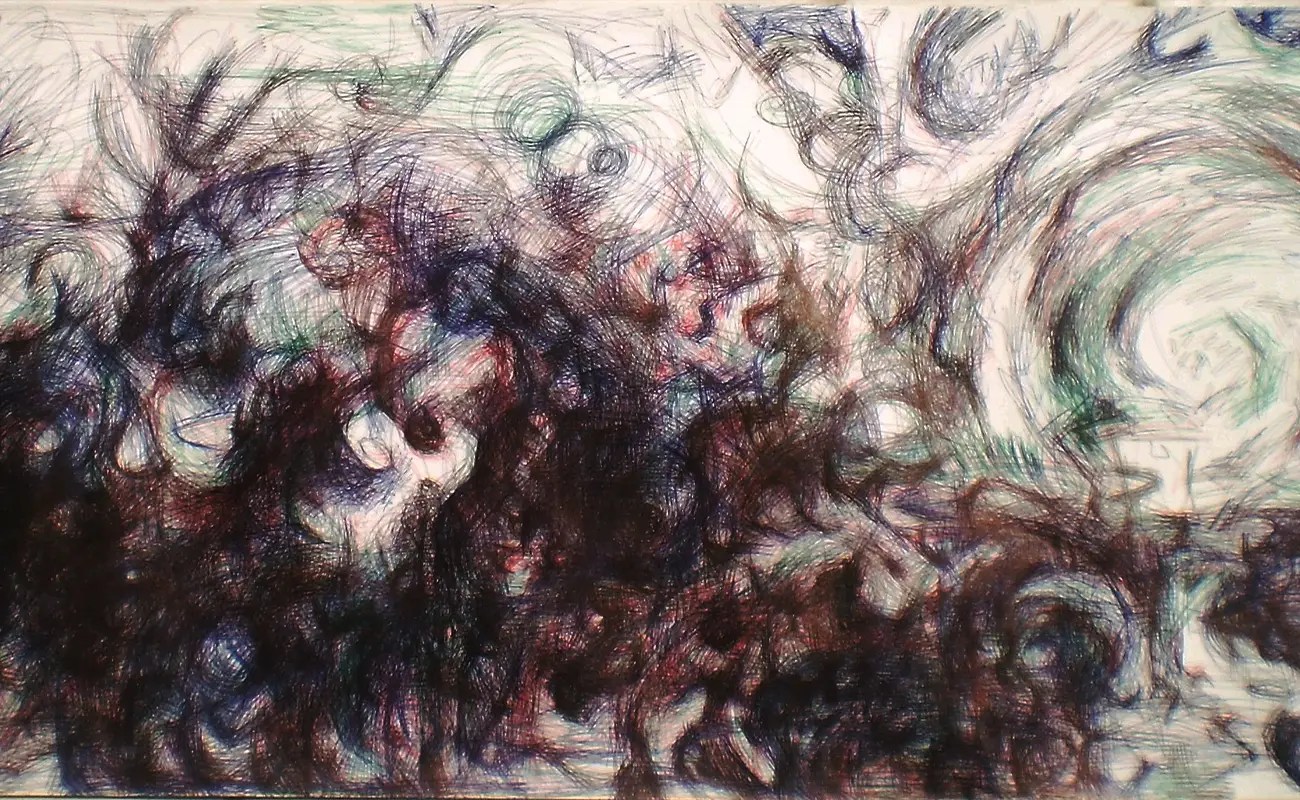
A decisive development emerged when Linardis began producing abstract drawings with a tool of his own invention. He gathered multiple ballpoint pen refills and bound them together with duct tape, arranging different color combinations for individual tools. The construction was simple, yet its behavior introduced possibilities that an ordinary pen could not offer. Because the exposed refills retained a degree of elasticity, they could bend during contact with the paper and produce smooth tonal variations. Instead of forcing the instrument to execute a fully predetermined image, Linardis allowed its physical characteristics to influence the direction of the work. Groups of parallel lines spread across the surface, moving nearer to one another and then separating again. Areas accumulated into darkness while others remained comparatively bright. Spiraling structures developed, interacted, and occasionally collided. Through this process, abstraction became inseparable from motion. The drawing was not merely an illustration of an internal condition. Its forms emerged through a negotiation among bodily movement, flexible materials, repetition, concentration, and the changing pressures of the creative act.
These line based works gradually became visual analogues for Linardis of complex psychological activity. He describes the paper as a mirror of his psyche, a place where numerous thoughts, emotions, internal dynamics, and social systems could appear to seek equilibrium. The repetitive marks gave physical form to movement he associated with neuronal activity, while the interaction of spirals suggested structures capable of coexistence, collision, and transformation. Such images resist a single fixed reading because their significance comes partly from relationships among their elements. Dense passages can appear forceful or concealed, while brighter openings provide contrast and spatial relief. Repetition generates order, yet the paths taken by the lines prevent that order from becoming static. The method also reflects his broader interest in allowing a creative process to reveal something before conscious interpretation takes control. Instead of beginning with a rigidly defined destination, he creates conditions in which the material, his concentration, and subconscious impulses can participate in determining what eventually appears on the page.
The origin of this technique came from a practical question. After completing a drawing with conventional ballpoint pens in seven hours, Linardis wondered how he could create a substantially larger work within the same amount of time. Using several pens simultaneously seemed like the answer, but ordinary pen barrels were too rigid. Their hardness restricted movement and kept individual lines farther apart than he wanted. Removing that structural limitation led to the bundled refill tool and, with it, an entirely new body of work. What began as an effort to increase scale without increasing time became an artistic system with its own visual logic. This transformation is central to understanding Linardis: a technical obstacle became an opportunity for invention, and invention then altered the conceptual possibilities of his practice. The resulting instrument could produce marks whose spacing, flexibility, and tonal accumulation were partly shaped by its construction, giving the material an active role rather than reducing it to a passive vehicle for an idea.

Chaos, Cosmos, and the Recurrence of Natural Forms
The first artwork created through this newly developed method also became the largest and most personally significant piece in the series. Titled “Chaos,” it occupies a foundational position for Linardis because it was simultaneously an experiment, a breakthrough, and what he considers the most enigmatic work produced through the technique. Its network of forms suggested an interior environment populated by multiple forces that seemed to interact harmoniously despite the density implied by its title. Darker areas appeared capable of concealing creatures, giving the abstract composition the strange spatial presence of a place that might continue beyond what the viewer can immediately perceive. The act of making it was equally important. Linardis describes an intense period of hyperfocus accompanied by a release of conscious control, allowing subconscious activity to participate strongly in the work. “Chaos” therefore represents more than the beginning of a series. It crystallized the relationship among invention, psychological observation, spontaneous action, and visual ambiguity that would continue to shape his abstraction.
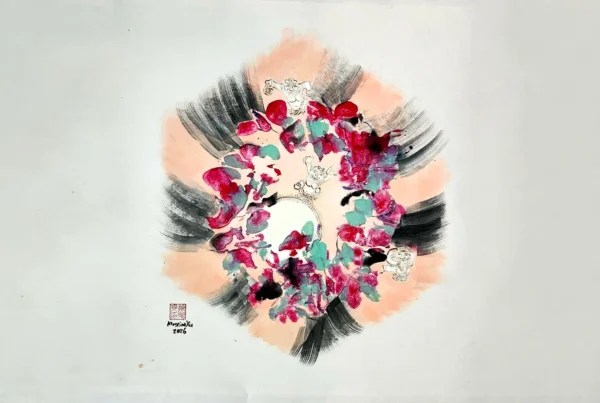
Linardis continues the series today, although its atmosphere has gradually moved toward imagery he associates with cosmogenesis. Alongside these pen based works, he has developed a substantial series of abstract oil paintings that carries a related internal process into a different material language. Oil paint changes the visual outcome because it does not depend upon the repeated linear structure created by bundled refills. Nevertheless, both bodies of work function for him as forms of an inner mirror. Dark and luminous areas, interacting forces, and shifting concentrations of visible matter can suggest expansive environments rather than identifiable scenes. Viewers may perceive galaxies, stars, caves, flames, water waves, or other natural phenomena within these paintings, even though the works remain abstract. Such associations allow interior experience and outward observation to approach one another. Psychological movement can resemble cosmic movement, while painted matter can suggest landscapes or elemental events without resolving into literal representations. The images occupy a productive threshold where recognition remains possible but never becomes compulsory.
Recurring patterns deepen this connection between inner experience and the structures Linardis observes in nature. A form that appeared in one abstract painting years earlier may unexpectedly return in a later composition, emerging again from his subconscious without being deliberately retrieved. These repetitions remind him of the way similar structures appear across radically different scales and forms of life, from plants and animals to microorganisms and outer space. The observation gives continuity to works made years apart without requiring a planned visual formula. It also helps explain why his abstractions can evoke both intimate mental states and enormous physical environments. A spiral, concentration, wave, or branching movement need not belong exclusively to psychology, biology, or astronomy. Similar visual rhythms can exist across each. Within Linardis’s practice, recurrence becomes a sign that creative intuition and natural pattern may intersect in unexpected ways. His paintings consequently remain open enough for forms to migrate between associations, allowing an image to feel simultaneously microscopic, bodily, geological, aquatic, or cosmic depending on how it is encountered.

Nathanail Evangelos Linardis: Creating Without Demanding the Destination
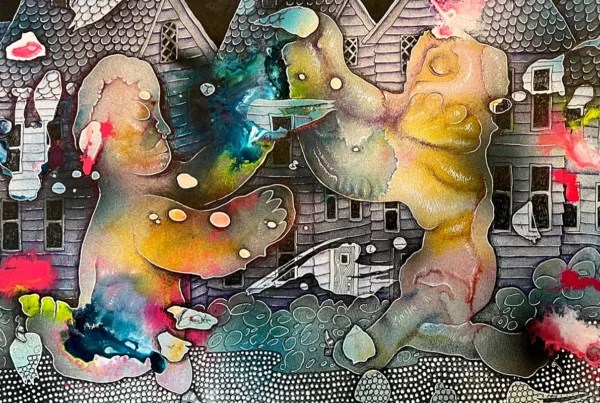
Abstraction has become central to Linardis, but it has never required him to abandon realism. He continues to create realistic work, maintaining a connection to the representational ambitions that first occupied him in childhood. Since 2019, he has also developed a series of erotic art in which figurative imagery can coexist with abstract passages, particularly within backgrounds. Here, abstraction serves a specific expressive purpose. Rather than functioning only as an independent investigation of psychological or cosmic space, it becomes a means of conveying the heightened emotions present within an erotic scene. This coexistence of recognizable bodies and nonrepresentational elements demonstrates how his different visual languages can operate together rather than compete for dominance. Realism provides one way of approaching visible experience, while abstraction can register emotional intensity that is harder to locate within a literal image. The combination also reinforces a larger characteristic of his practice: no single technique, genre, or material is expected to contain every aspect of what he wants art to communicate.
The same openness extends beyond painting. Poetry has accompanied Linardis since his younger years, developing in parallel with his visual work, while music forms another part of his creative activity. Across these forms, spontaneity remains important. He does not want to make a strictly logical decision about what he should create next or determine in advance which discipline deserves greater attention. Instead, he prefers to think only partially about where a work or creative period may be heading. This approach does not mean that his practice lacks continuity. On the contrary, earlier intentions sometimes surface much later, finally taking shape after years of apparent dormancy. At other moments, new directions arise because circumstances have changed. Life events, internal development, and the physical behavior of materials can all contribute to an outcome that could not have been fully predicted at the beginning. His creative history therefore unfolds through accumulation and return rather than according to a fixed progression from one style to another.
For Linardis, the future remains valuable precisely because it cannot be mapped with certainty. His work has already traveled from childhood realism and religious imagery toward symbolism, surrealistic thinking, experimental drawing, psychologically informed abstraction, oil painted cosmic associations, erotic art, poetry, and music. Yet he resists converting that history into a formula for what must follow. He prefers the position of an observer within his own creative process, attentive to what emerges when intention encounters growth, circumstance, subconscious activity, and physical material. That stance echoes the invention of his bundled pen tool, where relinquishing complete authority allowed the instrument itself to help shape the image. It also echoes “Chaos,” where concentrated action and subconscious release produced a work whose significance continued beyond its initial experiment. Rather than demanding that art confirm a destination already chosen, Nathanail Evangelos Linardis treats creation as a changing system, one in which past impulses can return, materials can redirect intention, and unexpected forms can become visible before their meaning is completely understood.