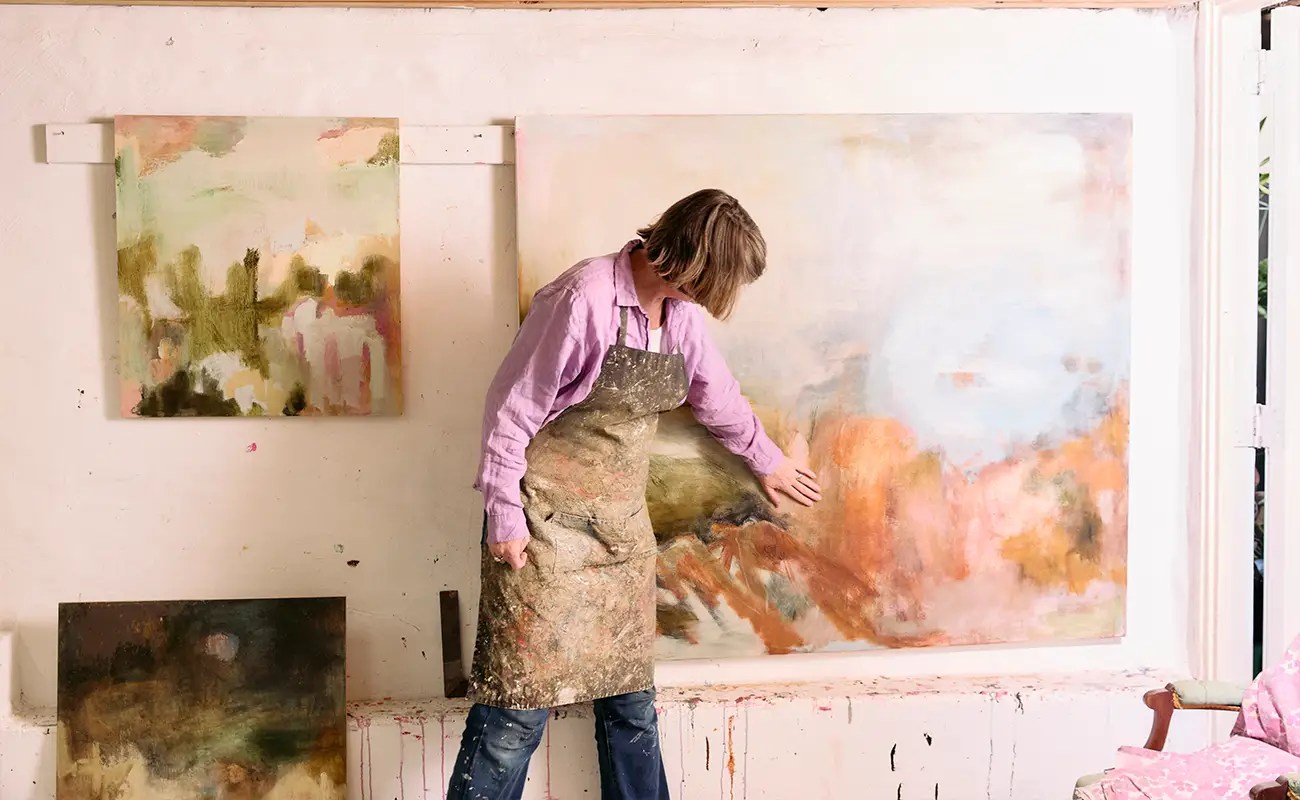
“The daily practice allows the paintings to ask questions of me, and I respond by adding, removing, covering and revealing.”
Painting What a Place Leaves Behind
For Sydney painter Louise Knowles, landscape begins long before paint reaches the surface. She wants to encounter a place physically, walking through it, swimming in it, watching how light moves across it and noticing the colours and textures that distinguish one environment from another. Her semi-abstract paintings emerge from this accumulated experience rather than from an ambition to reproduce a view. Ocean, sandstone, vegetation, open sky and distant terrain become starting points for compositions in which memory, observation and feeling remain closely connected.
Knowles has been making art for much of her life, although her path towards a sustained professional practice unfolded gradually. She began painting at school, initially captivated by mixing colour and influenced by the precise hard-edge realism of Jeffrey Smart. During the 1990s, classes with painter Sarah Mufford deepened her relationship with oils. The richness of the pigments, physical texture and possibilities offered by different mediums proved enduring. She held solo presentations in Sydney in 2006 and 2008, while other professional commitments and family life continued alongside her painting.
In 2021, Knowles was able to commit to art full time, a shift that changed not only the hours available to her but the nature of her relationship with painting. A dedicated studio established the conditions for daily experimentation, turning what had once been an activity into an ongoing exchange. She now works across multiple paintings simultaneously, partly because oils demand drying time and partly because moving between surfaces keeps decisions fluid. A colour, shape or unresolved passage in one painting can unexpectedly affect another, allowing the studio itself to become part of the creative process.

Louise Knowles: Building a Language Through Paint
Knowles works predominantly in oils across board, canvas and linen, sometimes beginning with an acrylic underpainting before introducing oil. Her surfaces are constructed incrementally through transparent and opaque passages, scraping, scoring, covering and rebuilding. Brushes, palette knives and other tools create shifts between broad areas of colour and concentrated marks. Earlier stages are not necessarily erased. Fragments can remain visible beneath subsequent layers, giving the finished painting physical depth while preserving evidence of the decisions that produced it.
This responsiveness is central to her method. Knowles rarely begins with a fixed image of what a painting should eventually become. Photographs and memories may reconnect her with a location, but reference material can be examined and then put aside before painting begins. Colour and sensation take precedence over literal description. Initial layers establish atmosphere, after which each alteration creates a new problem or possibility. Workshops with Australian painter Ross Laurie reinforced this questioning approach, encouraging her to treat every stage of a work as something capable of prompting the next decision.
Negative space is equally important. Knowles values quieter areas where the eye can settle before moving towards stronger concentrations of colour, texture and gesture. Composition can therefore emerge relatively late, once relationships within the surface begin to declare themselves. A work might be turned, scraped back or substantially altered when its balance feels unresolved. This openness has accompanied her gradual movement away from the more representational interiors, still lifes and built environments of earlier years. Architecture and design still interest her, particularly forms associated with the 1950s through the 1970s, but landscape has increasingly provided the framework through which abstraction can expand.

Colour, Coastlines and Distant Horizons
The Northern Beaches of Sydney offer Knowles a landscape that is both familiar and continually changing. Earlier series grew from routines close to home: swimming in the ocean, walking her dog and observing details that could easily pass unnoticed. Light, shadows, rock formations and subtle changes in colour became material for paintings rather than incidental scenery. In works connected with Ocean Pools, Ocean Sounds and Sand and Stone, water and sandstone are loosened from descriptive representation and reconstructed through colour relationships, atmosphere and layered surfaces.
Travel with her family has extended that visual vocabulary dramatically. Western Australia, particularly the Kimberley and Pilbara, left a powerful impression through their immense scale, intense colour and extraordinary expanses of space. Experiences of Broome, the Hamersley Range, Millstream Chichester and the Kimberley entered paintings without becoming conventional records of those locations. The New England landscape around Goonoo Goonoo Station has also informed her work. Whether responding to a beach near home or vast inland terrain, Knowles is interested in what remains after immediate observation gives way to memory.
Colour provides continuity between these environments. Knowles experiments constantly with combinations, tonal relationships and shapes that can suggest place without determining what a viewer must see. Pink has acquired particular personal significance, becoming associated with happiness and, during an important period in her life, memories of her mother. Warm pinks and oranges became prominent as the studio offered a place to process grief following her mother’s death. Yet the paintings resist literal narrative. Personal experience enters through temperature, luminosity and atmosphere, leaving enough openness for viewers to form associations of their own.

Louise Knowles: Finding Freedom in the Sky
The 2026 solo exhibition SKY with Studio Gallery Group marked what Knowles considers a breakthrough in her practice. The exhibition strengthened her confidence in her own way of seeing while offering a subject particularly suited to her increasing interest in abstraction. Sky is recognizable but never fixed, shifting between brightness and darkness, stillness and disturbance. Paintings including Blue Skies, Storm, Rain, Sunset and Winter Light allowed changing atmospheric conditions to become structures for exploring colour, space and emotion.
Winter Light holds particular significance within this body of work. Built in layers of oil on canvas, the painting responds to the warm glow of the Australian sun as it descends during winter. Pinks and browns create an atmosphere of stillness, carrying the sensation of a day gradually closing rather than describing a sunset in precise detail. The work crystallizes several persistent concerns in Knowles’s practice: her sensitivity to fleeting light, her emotional connection with colour and her desire to retain the feeling of an observed moment after literal information has been reduced.
Knowles now sees abstraction moving further into focus. Having begun many years ago as a more semi-realistic painter, she is increasingly attracted to simplified, pared-back surfaces that create space for visual conversation. Artists including Georges Braque, Pierre Bonnard, Richard Diebenkorn, Fred Williams and Elisabeth Cummings have remained important partly because their work demonstrates the possibilities of continued development rather than stylistic stasis. Knowles seeks a similar freedom to experiment. She is not attempting political commentary or prescribing interpretations for her audience. Her attention remains with observation, experience and the beauty she encounters, using paint to transform those sensations into something open enough for another person to enter.