Where Flesh Becomes Atmosphere
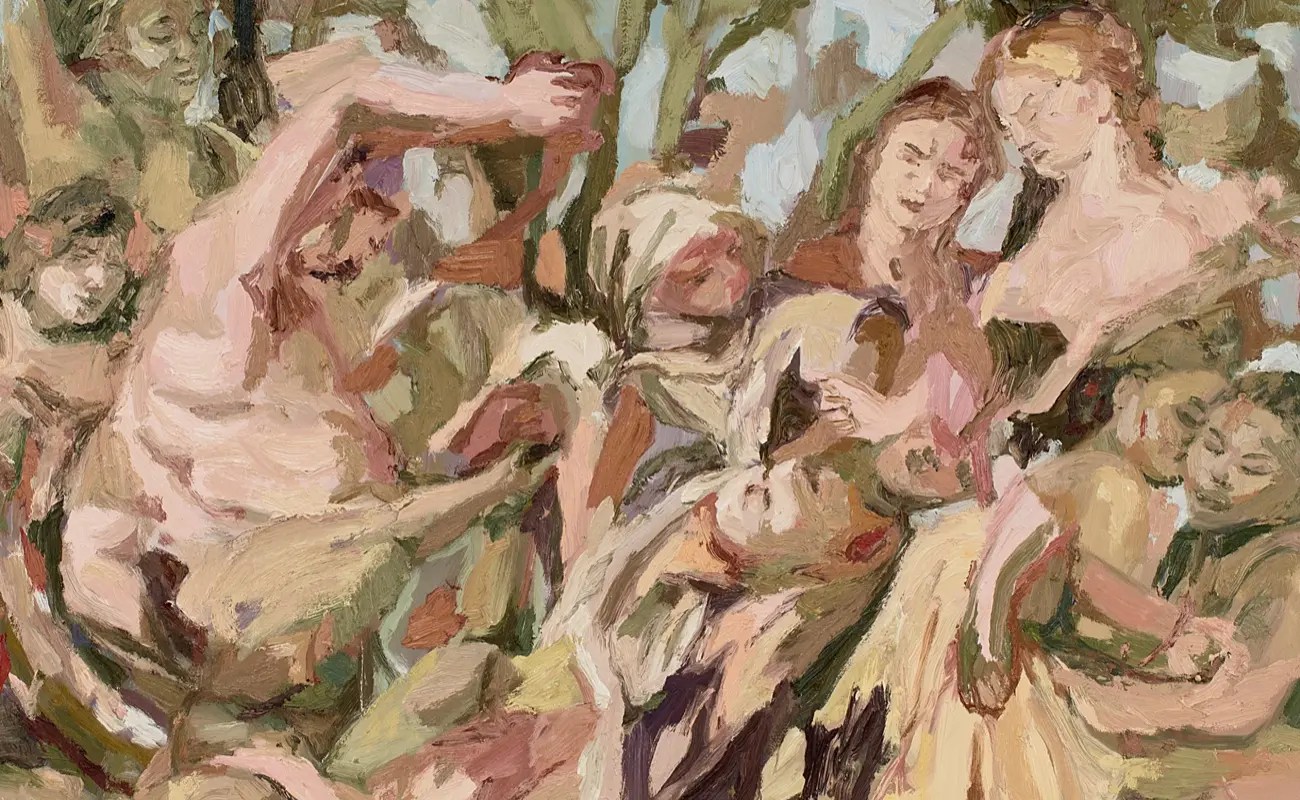
Mia Chaplin paints bodies that refuse to stay contained. Across canvases dense with oil, women recline, gather, sleep, embrace, and dissolve into one another, while their surroundings press back into their forms. A limb may lose its owner; flesh can become landscape; an intimate encounter can carry the unease of exposure. Born in Durban in 1990 and now based in Cape Town, the South African painter and sculptor has built a practice around such unstable boundaries. Intimacy, sexuality, vulnerability, protection, sensuality, and violence coexist without settling into simple oppositions. Figuration gives her work an anchor, but gesture and material continually disturb it.
Chaplin grew up with her mother and three older sisters. Her mother worked as a social worker, an environment that brought both female community and the violence affecting women in South Africa into Chaplin’s early experience. These realities later found resonance in her sustained attention to bodily autonomy, gendered power, vulnerability, and protection. Rather than separating strength from exposure, her work considers how both can inhabit the same person and the same moment. That resistance to fixed categories extends to the female types inherited from art history. Chaplin has questioned divisions between virgin, mother, and witch, insisting instead on the possibility of contradictory identities occupying a single body.
Painting entered her life early. Around the age of sixteen, she copied an Edvard Munch work for a school assignment and began experimenting with oils, quickly becoming absorbed by their possibilities. She later moved to Cape Town, completing a BFA at the Michaelis School of Fine Art in 2011. During her studies, a poor, pixelated photograph of a snowy mountain unexpectedly changed her approach. Unable to extract enough visual information for conventional reproduction, she used thick paint to construct the mountain’s physical sensation. The problem shifted from depicting a landscape to asking how paint itself might become landscape. That distinction became fundamental to her practice.

Mia Chaplin: Painting Against the Photograph
Impasto in Chaplin’s work is not simply a recognizable surface treatment. Its weight and sensuality make the physical act of painting inseparable from the image. Individual strokes remain visible, recording decisions rather than concealing them beneath illusion. Early paintings often began with analogue family photographs, alongside images of friends, interiors, flowers, and landscapes. Chaplin valued the awkwardness and emotional distance of old photographs, but resisted treating them as instructions. In works connected with Binding Forms in 2016, recognizable rooms, portraits, and still lifes cohere from afar only to fragment into color and marks when approached.
Speed helped her loosen photography’s authority. Smaller paintings could sometimes be completed in a single sitting, allowing momentum and instinct to interrupt the source material. That productive distance has since become more deliberate. Chaplin gathers or makes photographs and digitally disrupts them through layering, repetition, erasure, altered colors, and glitch-like collage. The resulting references withhold information rather than supply it. Faced with an image that cannot simply be copied, she must resolve uncertainty through paint. Strong initial lines establish compositional tension before colors and forms begin accumulating, shifting, and obscuring one another.
Her palette participates in this instability. Pinks, peaches, browns, and reds evoke flesh, while greens and neighboring tones make bodies bleed into their environments. Chaplin has compared her attraction to color with an aging bouquet, whose palette moves from freshness toward bruising, decay, and near-rot. Beauty is therefore never entirely innocent. The same attraction can contain evidence of deterioration, just as softness may carry threat. In Under a Boiling River from 2017, cloth became a recurring device for negotiating these tensions. Curtains, drapery, bodies, and interiors operated like membranes between concealment and revelation, shame and protection, private experience and public visibility.

Intimacy Under Pressure
Chaplin’s female figures increasingly occupy compositions in which physical closeness cannot be reduced to comfort. Mouth, developed partly during a residency at Cité internationale des arts in Paris, brought paintings into conversation with sculptural objects and domestic space. Women breastfeed, converse, dress, rest, and inhabit moments of proximity. Embrace, painted in Paris and partly informed by Chaplin’s encounter with Joan Mitchell’s gestural paintings, proved important to the densely interwoven compositions that followed. Figures began spreading across the picture plane, weakening the distinction between body and ground. Tenderness remained, but so did questions of agency, spectatorship, exposure, and potential violence.
This tension also informs Chaplin’s engagement with the historical female nude. Renaissance Venuses, reclining bodies, and traditions of voyeuristic looking remain points of reference, yet her paintings frustrate the stability those conventions often demand. Faces disappear behind paint, bodies overlap, limbs become ambiguous, and flesh exceeds anatomical borders. Sensuality is neither denied nor offered as uncomplicated spectacle. Instead, Chaplin separates the sensual body from the assumption that it exists principally for observation. A woman in her work can be vulnerable without becoming passive, threatening without surrendering tenderness, and beautiful while carrying signs of discomfort or decay.
The relationship between care and danger becomes particularly acute in Held Tight. Its title can suggest an embrace, but also restraint, allowing affection and constriction to occupy the same phrase. Violence acquires a different scale in the monumental The Sinking of the World (after Rubens’ ‘Massacre of the Innocents’), which connects Chaplin’s interest in historical images of brutality with persistent violence against women and children in South Africa. Yet she distinguishes her approach from the spectacle associated with historical painting. Violence in her own work is often quieter and embedded within intimacy, drawing attention to forms of harm that can remain concealed precisely because they occur alongside tenderness.

Mia Chaplin: Bodies Built to Transform
Sculpture gives physical weight to concerns already active on Chaplin’s painted surfaces. Working with bronze and plaster as well as wire, papier-mâché, plaster bandages, cement, adhesives, and oil paint, she has developed curving, vessel-like objects associated with holding, bodily heaviness, protection, and femininity. Their surfaces may carry flowers, mouths, knives, traps, and related symbols. Comfort and danger are placed in direct contact. These objects do not resolve whether protection offers safety or restriction. Instead, they give mass and volume to the same contradictions that destabilize her figures on canvas.
In Swamp, paintings and sculptures presented bodies as porous structures capable of leaking into water, vegetation, and other bodies. Cutting Silk extended this erosion of fixed borders through metamorphosis and camouflage, proposing transformation as a possible means of survival. Nature provides Chaplin with a parallel model for understanding such permeability. Natural systems depend upon relationships between organisms and their surroundings, as well as continuous processes of growth and destruction. Her figures behave accordingly. They touch, overlap, merge with landscapes, and extend through their environments rather than appearing as autonomous, sealed individuals.
This concern with connection has remained consistent while Chaplin’s practice has moved across painting, printmaking, and sculpture. The 2017 monotype series The Making of a Sharp Blade translated the immediacy of painting into a collaborative process that reduced her direct control over the final image. Residencies at OBRAS Foundation in Portugal, Nirox Arts Foundation in South Africa, Cité internationale des arts in Paris, and Fountainhead in Miami have accompanied the work’s development, while collections including Spier Arts Trust, LAM Museum, and the Francesca Lavazza Collection reflect its international reach. Through these shifts in medium and context, one question persists: how can the body escape being fixed into a single identity? Chaplin’s response is material rather than declarative. She allows it to change, merge, contradict itself, and resist containment.