
Eclipse as Grammar, Image as Instrument
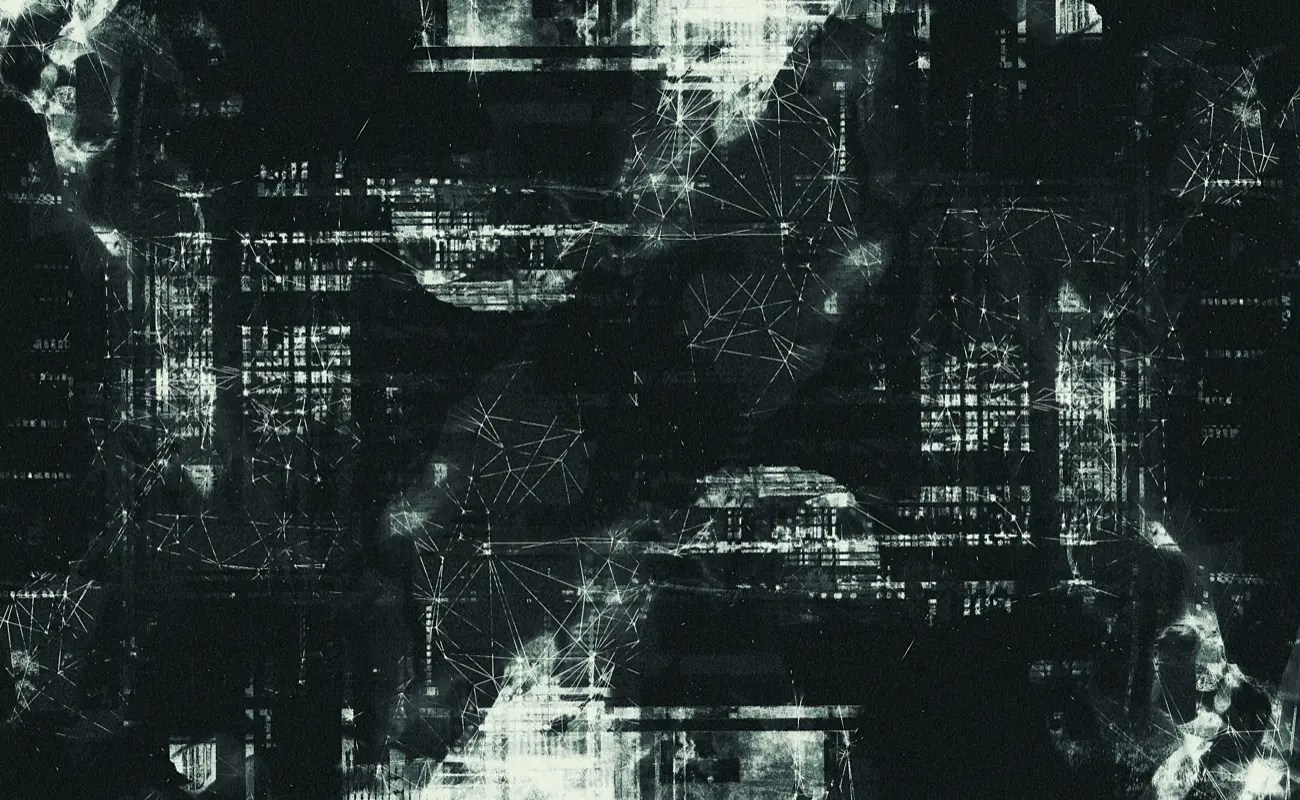
The practice of Danish artist Kasper Bergholt finds an unusually productive intersection in Sun: Triptychs for Solar Eclipses, where post-photography, system poetry, moving image, sound, code, and astronomical recurrence are treated less as separate media than as different notational systems. The most immediately arresting visual element is the black-and-white digital composite, dominated by an expansive field of near-black from which fragmented architectural forms, pale striations, triangulated lines, and scattered points of light intermittently emerge. Its tonal severity gives the image the appearance of a damaged astronomical plate, an urban ruin viewed by machine vision, or a map whose coordinates have partially disappeared. Against that density, the pale interface of the poem generator is almost clinically restrained. Noun, verb, and adverb occupy separate columns; a circular Saros indicator sits to the right; the generated phrase appears below in italic type. The contrast is crucial. One component produces opacity and visual excess, while the other exposes rules, categories, counts, and controls. Bergholt makes the eclipse significant not primarily as spectacle, but as a problem of representation: what disappears, what becomes perceptible, and what structures remain active when ordinary visibility fails.
The photographic origin sharpens that tension. The raw material came not from astronomical observation but from photographs of a broken card reader at Hellerup Station, made with a Nikon D200 and a Carl Zeiss Milvus 50mm f/2 lens. That mundane source materially strengthens the project because it prevents the celestial subject from drifting into generic sublimity. A damaged object associated with recognition, passage, and technological access is converted into something that appears planetary or cosmographic. The transformation is conceptually apt without requiring the photograph to illustrate an eclipse literally. Aperture and obstruction already belong to photography, while a broken reader introduces a second kind of failed legibility: the machine that should recognize information no longer functions according to expectation. Within the composite, rectangular fragments resemble damaged displays or structures, while hairline geometries suggest diagrams, constellations, tracking systems, or computational meshes. None of those associations has to settle into a single identification. Their instability is productive. The image preserves the physical abrasions and infrastructural character of its source while allowing them to migrate toward another order of scale, turning a fragment of transit technology into an image concerned with celestial recurrence and interrupted sight.
The triptych principle extends this oscillation between perceptual experience and classificatory structure. Aperture, Apparition, and Augury operate as closely related terms, yet each names a distinct relationship to visibility. An aperture permits seeing through an opening; an apparition appears without guaranteeing stable explanation; an augury interprets a sign as an indication of something still to come. Together they establish a progression from optical condition to manifestation to prediction, which gives the triptych greater conceptual precision than a simple three-part arrangement would possess. Bergholt’s invocation of Byzantine and Greek Orthodox triptychs adds another layer, since the historical format joined portability, protection, ritual repetition, and the framing of an image as a threshold. The digital project does not imitate a devotional object formally, but it reactivates the triptych’s concern with mediated access. Here, however, the sacred central image has no stable location. Image, poem, moving sequence, code, and sound repeatedly displace one another as potential centres. That instability is one of the project’s strongest formal decisions. The eclipse becomes less an icon to be contemplated than a condition under which different systems of perception, language, and prediction reveal their own limitations.

Kasper Bergholt: Constraint, Mutation, and the Poetics of Recurrence
The ten-word grid gives Bergholt’s conceptual architecture its clearest numerical form. Three nouns, three verbs, four adverbs, and two syntactic orders generate seventy-two distinct sentences, matching the seventy-two eclipses of Saros 126 between 1179 and 2459. The elegance of that 3 × 3 × 4 × 2 structure lies in its economy. A very small lexicon produces a historical span of approximately thirteen centuries, so extreme temporal scale is compressed into an interface that can be understood almost instantly. More importantly, the present version carries the history of its own corrections. The 2011 precursor contained a grammatically irregular noun column, while an earlier 2026 formulation miscounted permutations as distinct displayed sentences. Bergholt does not conceal those faults but incorporates revision into the meaning of the piece. The system consequently resists the fantasy of the flawless algorithm descending fully formed. Its rules have been argued with, audited, narrowed, and rebuilt. A productive tension nevertheless remains in the one-to-one relation between poem and eclipse. The correspondence is rigorous at the level of enumeration and indexing, but the sentences do not simply transcribe astronomical measurements. Their relationship to the Saros is constructed rather than mimetic. That conceptual gap is not a defect, although it is where the project’s poetic claim must do its hardest work.
Louis Hjelmslev’s distinction between commutation and permutation gives the generator more than terminological sophistication. Exchange within a paradigm and alteration within a chain become visible operations, allowing grammar itself to function as a model of recurrence. Roman Jakobson’s account of shifters becomes especially consequential through the addition of “now.” Eighteen of the seventy-two variants contain this single temporal deictic, producing an asymmetry that is more interesting than a perfectly balanced system would have been. “Rhythmically,” “vertically,” and “recursively” specify manners of action; “now” demands an occasion of utterance. It therefore brings embodied time into a structure otherwise capable of running indefinitely without human presence. Bergholt’s further distinction between the predominantly Latinate or Greek vocabulary and the Germanic “thicken” and “now” intensifies that contrast between classification and immediacy. The reading is persuasive when it remains attached to the specific texture of the poem: “thicken” is tactile, monosyllabic, and bodily in a way that “recursively” is not. It becomes less secure when treated as a universal law dividing Germanic English from Latinate abstraction. Historically suggestive etymology can enrich the poem, but too much explanatory weight risks turning linguistic tendency into categorical destiny. The project is strongest when etymology generates pressure rather than proof.
The sound system offers a more formally demonstrable translation. Each poem line is voiced over a fixed A2 drone at 110 Hz, with letters mapped to partials according to alphabet position modulo twelve and weighted by recurrence. Noun, verb, and adverb are parsed in a stable sequence, while the lexical choices change the distribution of energy above the fundamental. The relation to the Saros is convincing because a constant ground supports recurring variations, just as members of an eclipse family return through a stable orbital relation while changing in circumstance. Particularly strong is the acoustic behaviour attributed to “now.” Its letters map to partials that do not reinforce the fundamental, meaning the term that linguistically anchors utterance to the present produces, acoustically, a temporary departure from the sonic ground. That inversion has genuine poetic force: presence is marked by ungrounding. At the same time, the sonic component exposes a recurring challenge in rule-based art. Much of its conceptual specificity depends on explanation. An unaided listener is unlikely to infer alphabetic modulo mapping or the significance of the missing fundamental from sound alone. Bergholt therefore works at a productive but demanding threshold between sensuous experience and procedural literacy, where the listener’s pleasure and the reader’s comprehension do not necessarily arrive at the same moment.

Broken Readers, Ancient Machines, and the Politics of Legibility
The Antikythera Mechanism provides the project’s most compelling historical analogue because it connects prediction, inscription, recurrence, and situated viewing without reducing the artwork to a technological metaphor. The ancient mechanism transformed cycles in the sky into marks that could be read on a material surface, and its predictions were calibrated to geography. Bergholt’s grid performs an inverse operation. Saros 126 is retained as an organizing cycle, while geographic specificity is largely removed and linguistic deixis becomes the point at which location and moment re-enter the structure. That comparison also distinguishes the work from a broad category of contemporary projects that use astronomical data mainly for visual spectacle. Here, astronomy functions as a grammar for thinking about recurrence rather than as a source of decorative datasets. The connection with Howard Russell Butler’s eclipse triptychs makes the distinction sharper. Butler’s famous eclipse paintings sought observational and scientific accuracy; Bergholt’s composite refuses direct depiction and instead constructs an eclipse through displacement. The difference marks a historical change in representational confidence. Scientific observation once supplied painting with a rare phenomenon to record. In Bergholt’s work, the greater problem is how many technical, linguistic, photographic, and archival systems intervene before an event can be said to have entered cultural memory.
That problem of legibility returns insistently to the broken card reader. A transit reader is an apparatus designed to convert a person’s credential into an instantaneous binary judgment: valid or invalid, passage or refusal. Once damaged, it ceases to be transparent infrastructure and becomes visible as an object with a surface, a history, and a vulnerability. Bergholt’s decision to transform such material into the project’s central monochrome image permits a social reading that the astronomical framework alone would not necessarily generate. The composite links cosmic prediction with everyday systems of access, both of which depend upon protocols that determine whether signals can be recognized. Its luminous fragments appear caught between ruin and reconstruction. Fine connective lines promise order but never fully stabilize the field, while pale architectural masses continually dissolve into darkness. This is where the image exceeds its role as accompaniment to a system poem. It embodies the uncertainty that the grid, by contrast, tries to regulate. Apertures align; apparitions emerge; auguries thicken. Yet the visual surface continually frustrates clean alignment, emergence, and prediction. The project becomes more persuasive because its image and its linguistic machine are not simple equivalents. One exposes the appeal of systematic regularity, while the other keeps returning experience to noise, interruption, and incomplete recognition.
Within art history, Bergholt’s procedure can be positioned near several overlapping traditions without being comfortably absorbed by any single one: concrete and system poetry, Oulipian constraint, conceptual instruction-based practice, generative literature, sound art, and contemporary code poetry all provide relevant points of comparison. The use of a limited vocabulary and combinatorial rule privileges structure over confessional authorship, while the executable and archival dimensions make the rule operational rather than merely described. Bergholt’s earlier experience running the NetLock BBS FidoNet node during adolescence adds a biographical continuity to this interest in networks, command structures, and machine-readable exchange, though the artwork does not require that history to function. Its originality lies less in any single device than in the degree to which separate procedures are made to answer one another. Grammar counts to seventy-two; the Saros supplies seventy-two events; letters become partials; photography begins with failed infrastructure; code is archived through a scientific data repository; an ancient astronomical machine becomes a conceptual precedent. The danger of such density is interpretive surplus. Antikythera, Hjelmslev, Jakobson, Byzantine triptychs, Butler, Shakespeare, etymology, Prolog, and spectral mapping can compete for attention. The strongest passages are those where two or three systems lock together visibly, allowing structure to generate meaning without requiring every reference to validate every other one.

Kasper Bergholt: Exhibition, Archive, and the Problem of Permanence
The institutional history of Sun is unusually well aligned with its subject. The project originated in relation to eclipse-timed open calls and was subsequently adapted for “Solar Eclipse: An Exhibition” at MTU Blackrock Castle Observatory in Cork, where all seventy-two poem variants and the three video visualizations could coexist with an actual astronomical event. Such a setting matters because the work does not simply borrow scientific language; it tests how artistic structures behave in proximity to institutions dedicated to observation, measurement, and public explanation. Its adaptability is equally significant. One originating exhibition context later became sound-only, demonstrating that the project can be decomposed into components rather than depending on a single privileged installation form. That flexibility suits the conceptual logic, although it also raises a useful question about where the artwork is most fully itself. The image carries opacity, the interface makes combinatorics legible, the written material provides theoretical depth, and the sound transforms letters into frequency. Removing any component changes not only presentation but interpretive emphasis. Sun therefore functions most convincingly as a distributed work whose identity lies in relations among media. Institutions presenting it face the productive challenge of preserving those relations without turning the surrounding explanation into an illustrated lecture.
The attempted CERN archive adds a particularly effective temporal event because its imperfection prevents the archival gesture from becoming triumphalist. Bergholt intended the Prolog code to enter CERN’s data infrastructure via GitHub and Zenodo at the moment the eclipse reached maximum visibility in Copenhagen, but the repository timestamp records the deposit roughly ten minutes later. Conceptually, that missed synchronization is more interesting than perfect timing might have been. Saros cycles suggest astronomical regularity measured across centuries, while digital archiving depends on networks, timestamps, service layers, and human execution. The discrepancy exposes the difference between celestial recurrence and infrastructural time. It also gives the project a modest performance dimension: an intended coincidence between eclipse and archive becomes a documented failure of coincidence. The archive consequently does not stand outside the artwork as neutral preservation. It participates in the same questions of timing, indexing, and presence that organize the poem. The MIT license further complicates conventional assumptions about preservation by allowing the code to be reused broadly. Instead of defending an untouchable original, Bergholt allows the system to circulate, fork, and potentially acquire descendants, making continuity dependent upon executable rules and documentation rather than solely upon possession of a singular object.
That open structure gives Bergholt an interesting position within both institutional and market contexts. Museums, archives, media-art organizations, poetry institutions, and science-oriented exhibition spaces can each approach the project from a different disciplinary doorway, while none entirely contains it. For collectors, its logic complicates conventional scarcity because publicly licensed code and online circulation are built into its existence. The more relevant question becomes what constitutes responsible stewardship of a work distributed across image, text, software, sound, video, interface, documentation, and historical timing. Such complexity can be an asset in institutional settings increasingly concerned with the conservation of software-based and networked art, although it demands unusually precise decisions about what is essential and what may change. Bergholt’s most substantial achievement is therefore not the numerical neatness of seventy-two poems for seventy-two eclipses by itself. It is the way successive acts of correction, translation, and reformatting turn recurrence into an artistic method. The project’s principal challenge remains the abundance of its explanatory architecture, which can occasionally eclipse the sensuous economy of the work it seeks to illuminate. When rule, image, sound, and temporal event are allowed to carry equal weight, Sun becomes a rigorous meditation on how systems remember, how language locates a present, and how permanence can be constructed from things designed to change.