Illusion at the Threshold of Perception
Jochen Mühlenbrink has established himself as one of the most compelling voices in contemporary German painting by transforming illusion into a philosophical investigation. Born in Freiburg im Breisgau in 1980, he has developed a practice that bridges technical mastery and conceptual depth, positioning him within an international dialogue on perception and representation. Living and working between Düsseldorf and Oldenburg, Mühlenbrink moves fluidly between regional roots and global visibility. His works have been presented in respected institutions such as the Bundeskunsthalle, Kunsthalle Osnabrück, and KIT, and are held in prominent public and private collections including the Deutsche Bundesbank, G2 Kunsthalle, and the Stadtmuseum Oldenburg. These achievements reflect not only the precision of his craft but also the intellectual rigor that underpins it. Through a refined trompe l’oeil approach, he challenges viewers to reconsider how images function, how surfaces deceive, and how painting can question the reliability of sight itself.
International recognition has accompanied Mühlenbrink’s steady artistic development since the mid 2000s. After studying painting at the Kunstakademie Düsseldorf from 2001 to 2006, and completing his master studies under Markus Lüpertz in 2007, he began exhibiting widely across Europe, North America, and Asia. Cities such as Amsterdam, Copenhagen, New York, Seoul, and Taipei have hosted his exhibitions, underscoring the broad resonance of his work. Institutions including Kunstmuseum Solingen, Morat Institut Freiburg, Osthaus Museum Hagen, Kunsthalle Wilhelmshaven, Kunsthal Rotterdam, and Museum Het Valkhof in Nijmegen have featured his paintings, reinforcing his reputation as an artist whose concerns extend beyond national boundaries. Representation by galleries in Leipzig, Stuttgart, Amsterdam, Copenhagen, and New York further situates him within a dynamic international network. This broad platform amplifies his sustained exploration of illusion, memory, and visual uncertainty, themes that consistently define his evolving body of work.
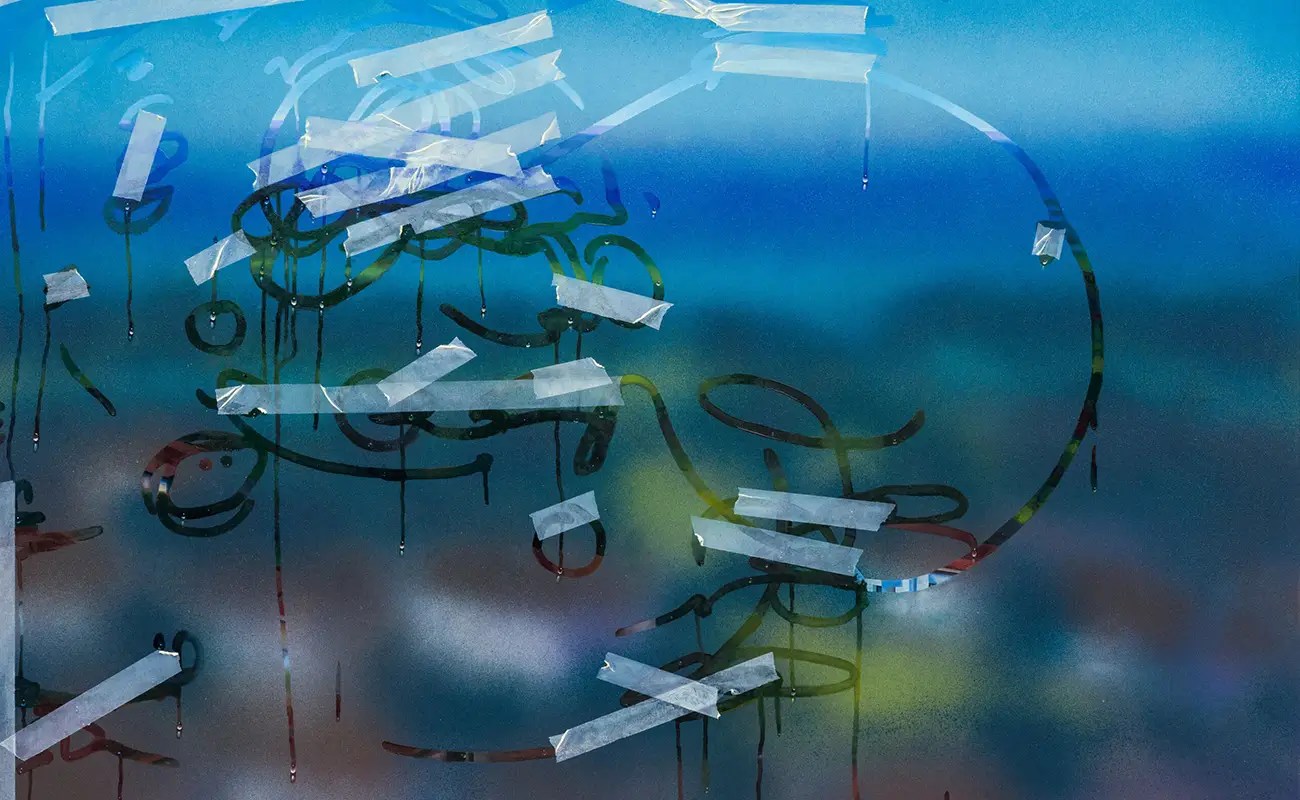
At the core of Mühlenbrink’s practice lies a deep engagement with the historic tradition of trompe l’oeil, yet his approach moves far beyond technical bravura. He employs oil paint to construct surfaces that mimic fogged windows, strips of masking tape, droplets of condensation, and even casual doodles traced onto glass. Each element appears convincingly tangible, inviting the viewer to question whether what is seen might be physically present. However, the very act of recognition becomes unstable upon closer inspection. The tape that seems to cling to the canvas is nothing more than pigment; the moisture that looks freshly formed is dry oil paint. By activating this tension between expectation and revelation, Mühlenbrink positions painting as both image and object. His works prompt reflection on how easily perception can be persuaded and how swiftly certainty dissolves when confronted with crafted illusion.

NYWP, 2023
140 x 200 cm, two parts
Oil and acrylics on canvas
Jochen Mühlenbrink: Between Classical Discipline and Modern Skepticism
The formative years at the Kunstakademie Düsseldorf shaped Mühlenbrink’s enduring commitment to painting as a rigorous intellectual and technical pursuit. Under the mentorship of Markus Lüpertz, he absorbed a strong grounding in the traditions of modernist and classical art while cultivating an independent conceptual direction. Rather than rejecting historical precedents, he integrates them into a contemporary framework that questions the authority of vision. His reliance on oil paint connects him to centuries of European art history, yet he uses this medium to simulate phenomena associated with transience and fragility. Transparency, condensation, and adhesive strips are rendered with extraordinary clarity, even though they suggest fleeting states. This deliberate contrast between permanence and impermanence underscores his philosophical orientation. Painting becomes a site where the durability of material confronts the instability of perception, inviting viewers to rethink what it means to trust the eye.
Modern skepticism permeates Mühlenbrink’s compositions, though it is expressed through subtle means rather than overt critique. In many works, blurred houses and landscapes appear behind misted glass, partially obscured by finger-drawn patterns or strips of tape. The viewer’s gaze shifts between foreground and background, uncertain which layer holds primacy. Is the subject the distant scenery or the intervening surface? By foregrounding the pane itself, he transforms what would normally be a transparent medium into the central focus. This inversion unsettles conventional hierarchies within painting, where depth typically commands attention over surface. Furthermore, his recurring depiction of tape seems to fasten the image in place, emphasizing the canvas as a constructed object rather than a window into illusionistic space. Through these strategies, Mühlenbrink merges historical illusionism with contemporary doubt, revealing how even the most convincing image remains a fragile agreement between artwork and observer.
The intellectual dimension of his work is inseparable from its visual allure. Viewers often experience an initial moment of astonishment when confronted with the realism of a droplet or the convincing texture of adhesive tape. Yet that amazement gradually shifts into contemplation as the realization emerges that everything presented is painted. This progression from belief to awareness mirrors the broader questions that animate his practice. What is real, what is visible, and what can truly be depicted? Such inquiries echo longstanding debates within art theory, yet Mühlenbrink addresses them through quiet, concentrated imagery rather than grand statements. The absence of dramatic gesture heightens the sense of introspection. Each painting becomes a carefully constructed scenario in which perception is tested, revealing that sight is not passive reception but an active negotiation shaped by memory, expectation, and context.

WP Princess, 2024
100 x 70 cm
Oil and acrylics on canvas
WP Play, 2023/2024
120 x 100 cm
Oil and acrylics on canvas
Windows, Tape, and the Suspended Moment
Among Mühlenbrink’s most recognized bodies of work are his Window Paintings, which depict scenes glimpsed through fogged glass. Houses, landscapes, and atmospheric gradients hover indistinctly beyond a surface marked by condensation and finger-drawn lines. Smiley faces, crowns, and spontaneous patterns appear as though traced by someone standing before the pane, yet that presence remains invisible. These gestures suggest human activity while simultaneously pointing to absence. The condensation captures a fleeting instant before evaporation, transforming a transient phenomenon into a fixed image. Through oil paint, he grants durability to what would normally vanish within minutes. The window functions both as barrier and threshold, separating interior from exterior while connecting them through vision. By emphasizing this liminal space, Mühlenbrink encourages viewers to consider how perception is always mediated, filtered through surfaces that shape what can and cannot be seen.
The Tape Paintings extend this inquiry into perception by introducing adhesive strips that appear to secure fragments of imagery onto the canvas. These strips sometimes overlap underlying motifs, partially concealing and partially revealing what lies beneath. Narrow slits of visibility emerge between the bands of tape, directing the gaze through controlled openings. The viewer becomes acutely aware of looking through something rather than directly at something. In both the Window Paintings and the Tape Paintings, these interruptions create a rhythm of obstruction and disclosure. The eye navigates between layers, reconstructing a fragmented view. Such compositional strategies highlight the act of seeing as an active process shaped by limitation. By simulating tape with paint, Mühlenbrink further complicates the experience, since the obstruction itself is illusion. The resulting tension underscores his central concern: perception is never straightforward, and even the simplest surface can conceal complex questions.
Color plays a subtle yet crucial role in reinforcing the atmospheric quality of these works. Cool blues, muted greens, silvery greys, and gentle violets often dominate the compositions, recalling the tonal sensitivity associated with Romantic landscape traditions. However, the distant scenery is frequently reduced to soft fields of light and hue, verging on abstraction. The background dissolves into indistinct gradients, while the foreground elements of condensation or tape claim visual authority. This reversal destabilizes expectations about spatial hierarchy. Instead of gazing outward into depth, viewers remain conscious of the surface that interrupts their view. The result is a suspended moment in which time seems paused. The condensation will never evaporate, and the tape will never peel away, because both exist only as pigment. By freezing these transient states, Mühlenbrink invites reflection on memory and ephemerality, transforming everyday phenomena into enduring meditations on sight.

WP zzz, 2025
100 x 140 cm
Oil and acrylics on canvas
Jochen Mühlenbrink: Painting as Object, Question, and Experience
Although primarily recognized for his paintings, Mühlenbrink also works with sculpture and installation, expanding his investigation of illusion into spatial contexts. In certain object based works, actual materials intersect with painted surfaces, intensifying the dialogue between reality and representation. When tangible elements meet convincingly rendered illusions, the viewer’s uncertainty deepens. The boundary between what is physically present and what is depicted becomes increasingly difficult to discern. This interplay reinforces his commitment to painting as both image and object. Rather than treating the canvas as a neutral support, he foregrounds its material presence. Tape that appears to affix something to the surface emphasizes the artwork’s constructed nature, even though it is entirely simulated. Through such strategies, Mühlenbrink underscores the physicality of art while simultaneously undermining the viewer’s trust in appearances.
Representation by galleries across Germany, the Netherlands, Denmark, and the United States reflects the sustained relevance of his approach within contemporary discourse. His presence in exhibitions from Bonn to Rotterdam, from Amsterdam to New York, demonstrates the universal resonance of his questions about visibility and belief. Despite international acclaim, the essence of his practice remains intimate and contemplative. Each painting invites close observation, rewarding patience with subtle revelations. The works do not impose answers; instead, they cultivate a space in which doubt and curiosity coexist. Through disciplined technique and conceptual clarity, Jochen Mühlenbrink continues to refine a body of work that transforms simple motifs into profound reflections on perception. His art stands as a reminder that seeing is never neutral, and that even the most ordinary surface can open onto a complex inquiry into reality itself.