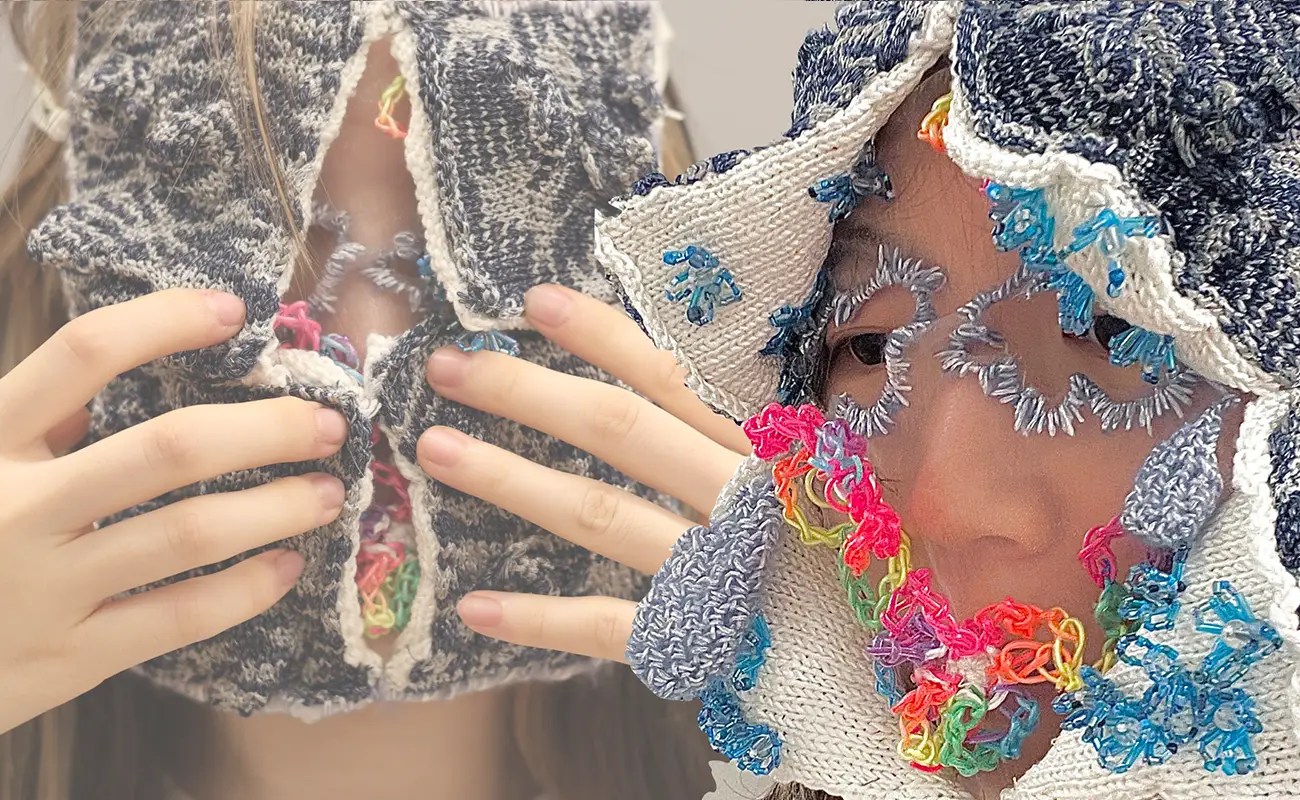
“Threads of Distance brings together my personal history and material experimentation, creating a space where memory, body, and environment intersect.”
Between Movement and Stillness
Jingyi Yang stands among a new generation of textile artists who are reshaping how material can speak about memory, identity, and spatial experience. Born and raised in Inner Mongolia and now working in New York, she brings together contrasting environments that continue to inform her creative language. Her work grows from the friction between nomadic traditions and settled urban life, a contrast she has encountered both personally and academically. Graduate study in Textile Design at Parsons School of Design provided a platform to expand these reflections into complex installations that move beyond decorative or functional expectations. Through this evolving practice, textiles become active participants in shaping perception, inviting viewers to navigate both physical and emotional terrain. Her installations offer encounters that feel immersive yet intimate, emphasizing how fabric structures can influence how bodies occupy space and relate to one another.
Foundations in fashion design introduced her to textiles through the lens of garment construction and surface embellishment. Over time, curiosity pushed her to question whether fabric could exist independently of the human body, functioning as a medium with its own conceptual voice. This shift marked an important turning point in her development, opening pathways toward dimensional structures and spatial compositions. Instead of treating textiles as passive coverings, she began to imagine them as environments that could expand, fold, suspend, or respond to movement. This expanded vision allowed her to experiment with modular systems and interactive formats that engage viewers directly. The progression from wearable design to installation-based work illustrates a commitment to exploring how material presence can redefine the boundaries between art object, architecture, and sensory experience.
Her contemporary practice draws on both traditional craftsmanship and emerging technologies, reflecting a commitment to bridging heritage with experimentation. Techniques such as hand weaving, digital jacquard production on TC2 looms, knitting, and biofabrication coexist within her installations. This hybrid methodology enables her to create layered compositions that evoke cultural memory while pointing toward future possibilities. Themes of transformation and spatial awareness recur throughout her work, shaped by her early experiences of open landscapes and close-knit communities. By positioning textile structures within architectural contexts, she creates encounters that highlight proximity, distance, and relational movement. In doing so, Yang constructs environments that encourage reflection on how identity evolves through shifts in geography, culture, and lived experience.

Jingyi Yang: From Inner Narratives to Cultural Landscapes
The journey toward becoming an artist unfolded gradually for Yang, guided by a growing desire to prioritize material exploration over conventional design outcomes. Initial training in fashion focused on crafting garments that communicated personal emotion through silhouette and texture. While this introspective process offered a foundation, it also sparked deeper questions about the origins of feeling and expression. Her creative focus began to move outward, considering how environments, histories, and cultural transitions shape individual perception. This expansion transformed her approach from personal storytelling into a broader investigation of collective experience. By examining the shifting landscapes of Inner Mongolia, she found a compelling framework through which to examine continuity and change. Textile installations became a way to translate these reflections into tangible forms that viewers could physically encounter.
Her stylistic language today reflects a dialogue between tradition and innovation, combining established craft practices with experimental biomaterials. This synthesis supports ongoing inquiries into proxemics, the study of spatial relationships between bodies. Through carefully considered placement and scale, her installations encourage audiences to consider how distance can foster connection or tension. Cultural themes also remain central, particularly the gradual fading of nomadic customs within rapidly modernizing contexts. Rather than presenting nostalgia, her work acknowledges transformation as a constant force. Materials are manipulated, layered, and reconfigured to suggest emotional shifts as well as environmental adaptation. This emphasis on process underscores her belief that meaning emerges through interaction, not simply through observation.
Transformation functions as both subject and method within Yang’s evolving practice. Emotional resonance, cultural displacement, and material change intertwine to create works that feel both grounded and speculative. By integrating organic substances alongside digital production techniques, she creates a visual language that reflects contemporary complexity without abandoning tactile authenticity. Her installations often invite viewers to move around or through textile structures, reinforcing the idea that perception is shaped by position and movement. This commitment to experiential engagement distinguishes her work within current textile discourse. It positions her as an artist who not only questions inherited narratives but also proposes new ways of sensing and inhabiting shared spaces.

Echoes of Environment and Artistic Awakening
Environmental memory remains one of the most profound forces guiding Yang’s creative outlook. Growing up in an Inner Mongolian city characterized by simplicity and openness instilled in her an appreciation for unadorned authenticity. Daily life unfolded in close connection with nature and community, fostering an emotional clarity that continues to influence her material choices. These formative experiences inform how she constructs spatial compositions that feel expansive yet grounded. In her installations, viewers may sense traces of wind-swept landscapes or communal rhythms translated into woven surfaces and suspended forms. Such references are never literal, instead emerging through atmosphere and structural logic. By drawing from these early impressions, she cultivates a practice that values sincerity over spectacle.
Among visual influences, René Magritte played a significant role in expanding her understanding of artistic possibility. Encountering his work introduced her to the power of presenting the familiar in unexpected ways, encouraging a reconsideration of representation itself. This realization functioned as an awakening, prompting her to explore how textile forms could disrupt conventional perception. Surreal juxtapositions find subtle echoes in her installations, where recognizable materials assume unfamiliar spatial roles. Rather than depicting illusionistic imagery, she channels this influence through conceptual strategies that challenge viewers’ assumptions. Fabric becomes architecture, biomaterial fragments suggest organic growth, and modular units create shifting visual rhythms. Such transformations highlight her interest in revealing hidden dimensions within everyday matter.
Music provides another layer of inspiration, shaping both mood and process within her studio practice. Listening to composers and bands such as Hyukoh and Radiohead reinforces her attraction to emotional clarity and understated intensity. Their soundscapes demonstrate how subtle tonal shifts can carry deep expressive weight, a principle she seeks to translate into material arrangements. Textiles in her installations often evoke similar qualities, balancing softness with tension, repetition with variation. This musical sensibility contributes to the pacing of her creative workflow, guiding intuitive decisions about scale, density, and spatial flow. Together, environmental memory, artistic discovery, and sonic influence converge to sustain a practice rooted in transformation and emotional authenticity.

Jingyi Yang: Threads That Measure Distance
One of Yang’s most meaningful works, Threads of Distance, exemplifies the convergence of personal history and technical experimentation that defines her artistic vision. This textile installation combines digital jacquard weaving on a TC2 loom with hand-assembled fragments of biotextile, including kombucha-derived cellulose. Through this layered construction, the piece investigates the concept of distance across cultural, spatial, and emotional dimensions. It reflects on the evolving identity of Inner Mongolia within contemporary contexts, acknowledging both continuity and disruption. By bringing together industrial precision and organic growth, the installation creates a visual dialogue about adaptation. Viewers encounter surfaces that appear simultaneously fragile and resilient, suggesting the complexities inherent in navigating change.
The significance of Threads of Distance lies in its ability to create an environment where memory, body, and landscape intersect. Suspended textile elements invite movement around and between forms, reinforcing the theme of proxemics that recurs throughout her work. The integration of biomaterials introduces a temporal dimension, as these substances respond to humidity, light, and touch. Such responsiveness underscores her interest in transformation as an ongoing process rather than a fixed outcome. Through this installation, Yang articulates how distance can function as both separation and connection. Cultural heritage is neither preserved in isolation nor erased by modernization, instead shifting through dynamic interaction with new environments.
Her daily working rhythm supports the development of projects that require sustained experimentation and conceptual depth. Studio sessions often begin with intuitive sketches or loosely imagined forms that guide initial material tests. From there, she engages in an iterative dialogue with fibers, structures, and techniques, allowing unexpected discoveries to influence direction. Research remains integral to this process, encompassing reading, documentary viewing, and the study of visual references. Looking ahead, she plans to extend the Threads of Distance series during a residency at Pine Meadow Ranch Center for Arts and Agriculture in Oregon from April to May 2026. By juxtaposing environmental and cultural elements from her Inner Mongolian background with the local landscape, she aims to create a new installation that reflects how identity and material respond to changing surroundings.