Windows Between Memory and Place
Jeremy Miranda has built a distinctive reputation through paintings that appear calm at first glance yet gradually reveal surprising emotional depth. His images often stand at the meeting point of interior life and the outside world, where kitchens, tables, bookshelves, and studio corners seem ready to drift toward rivers, coastlines, or evening skies. This blending of domestic space with landscape gives his work a recognisable identity and explains why viewers return to it with curiosity. Rather than presenting scenes as fixed records, he paints them as lived experiences shaped by remembrance, longing, and perception. Nostalgia is present, but it is never heavy or sentimental. Instead, it works alongside intimacy and quiet wonder, allowing ordinary rooms to feel charged with possibility. Many artists seek drama through grand subjects, yet Miranda frequently finds stronger resonance in a window, a chair, or the changing light at dusk. Through that approach, he transforms the commonplace into something reflective and deeply human.
The painter’s roots in New England have long informed this sensibility. Raised in Middletown, Rhode Island, he grew up amid coastal weather, seasonal shifts, and the specific textures of northeastern towns. Those experiences continue to echo throughout his art, where fog, winter light, shoreline atmosphere, and muted interiors appear with recurring force. He later studied painting at the Massachusetts College of Art and Design, completing a BFA in 2004, and also attended the School of the Museum of Fine Arts in Boston. Such training provided technical discipline, but just as important was the daily habit of looking carefully and working steadily. Miranda’s career suggests that craft is built through repetition as much as inspiration. The patience required to notice subtle changes in tone, shape, and atmosphere can be felt in his finished paintings. Even when scenes contain impossible spatial combinations, they remain grounded in attentive observation and a clear understanding of how pictures are constructed.
This balance between imagination and observation has helped Miranda stand apart within contemporary painting. His pictures can feel dreamlike, yet they are never vague. Furniture, architecture, shoreline edges, and household objects retain convincing form, which makes their surprising combinations more compelling. A room opening onto the sea or a shelf leading toward open sky becomes believable because the details are handled with care. Viewers sense both the solidity of real life and the fluidity of memory. That tension gives the work emotional force. It also allows his paintings to speak to common experiences: the way home can contain echoes of places once visited, or how familiar spaces change according to mood and season. Miranda’s art invites people to slow down and notice these subtle psychological shifts. In doing so, he demonstrates that painting remains a powerful medium for translating private sensation into shared visual experience.

Jeremy Miranda: Architect of Dreamlike Thresholds
One of the most striking features of Miranda’s earlier work is the invention of spaces that seem assembled from recollection rather than geography. He often fused fragments of shoreline architecture, studio interiors, ladders, porches, cliffs, and sunrooms into settings that could not exist in practical terms, yet felt entirely truthful on an emotional level. A seaside room might dissolve into ocean water, or a narrow ladder might rise along the side of a towering rock face. These combinations are playful, but they also carry psychological meaning. They suggest aspiration, vulnerability, solitude, and the desire to connect separate parts of life. Instead of offering literal narratives, the paintings operate like remembered dreams, where transitions happen naturally and logic gives way to feeling. This mode of image making became central to his visual language and earned admiration from audiences who recognised in those scenes the strange precision of memory itself.
Such compositions reveal a painter interested in thresholds rather than boundaries. Inside and outside, shelter and exposure, safety and risk all appear close together in his imagery. A domestic room can feel comforting while also opening toward immense weather or distance. The result is not contradiction but complexity. Human experience often contains both steadiness and uncertainty at once, and Miranda captures that condition with notable sensitivity. His invented architecture reinforces this idea. Stairs, ladders, windows, and doorways recur because they are forms associated with passage, movement, and change. They connect spaces physically while also implying transitions of thought or feeling. In his hands, these everyday structures become symbols without losing their practical identity. This ability to sustain both literal and poetic meaning helps explain why the paintings remain accessible to broad audiences while rewarding deeper study.
Another important quality of these works is their atmosphere of quietness. Even when the spaces are impossible, they rarely feel chaotic. Instead, there is often still air, measured light, and an almost meditative pause. This restraint keeps the paintings from becoming fantasy for its own sake. They remain connected to lived time, to the hush of late afternoon or the silence of a room after activity has ended. Miranda seems less interested in spectacle than in emotional resonance. The impossible enters gently, as though it had always belonged there. That subtle strategy allows viewers to project their own memories into the scenes. Many people recognise the sensation of dreaming about a childhood house that suddenly opens into another place entirely. Miranda turns that private mental experience into shared imagery, making his paintings both personal and widely relatable.

The Poetry of Daily Routine
Over time, Miranda’s practice moved toward more direct observation, though without abandoning the mysterious quality that defines his art. Recent paintings are closely tied to the routines of everyday life, especially the spaces nearest his studio and home. Tables with scattered objects, kitchens marked by use, winter yards, changing weather, and the glow of evening have become recurring subjects. This shift does not represent a loss of imagination. Instead, it shows confidence in the visual richness of ordinary surroundings. He recognises that wonder can emerge from a saucepan releasing steam, from snow settling into dusk, or from the brief appearance of fireflies on a summer night. By focusing on what is immediately present, he asks viewers to notice how much is often overlooked. Familiar things become newly vivid when given sustained attention, and Miranda’s paintings communicate that awakening with unusual clarity.
Family life and changing responsibilities appear to have deepened this attention to the near and immediate. Parenthood and routine can narrow available time, yet they can also sharpen awareness of fleeting details. Miranda’s newer works suggest precisely that sharpened gaze. Rather than seeking distant spectacle, he returns to forms encountered every day and studies them until they reveal emotional complexity. A cluttered tabletop may carry traces of shared life, while a dim room can hold the calm after noise and motion. Seasonal shifts also play a major role. New England weather, with its snow, gray skies, humid evenings, and sudden clear light, offers constant transformation. Miranda uses these conditions not as background decoration but as active participants in mood. The atmosphere outside a window can alter the emotional register of an entire interior, binding domestic experience to the larger cycles of nature.
This evolution in subject matter has strengthened the universality of his work. Many viewers know the feeling of standing in a kitchen at twilight, noticing light settle across familiar objects, or watching weather change from inside a warm room. Miranda captures such moments without exaggeration. He does not insist that they are grand events, yet he reveals their significance through composition and tone. That honesty gives the paintings their contemplative charge. They suggest that meaning is not always found through dramatic experiences but through repeated encounters with ordinary life. In a fast-moving culture, this perspective feels especially valuable. His art becomes a form of attentive seeing, encouraging patience and presence. By grounding his imagery in daily routine while preserving traces of wonder, Miranda has expanded rather than narrowed the emotional reach of his practice.

Jeremy Miranda: Craft, Color, and Continuing Presence
Miranda’s technical approach plays a major role in the power of his images. He works in both oil and acrylic, selecting each medium for its distinct possibilities. Acrylic has often been important to him because of its speed and responsiveness, allowing rapid changes while still supporting layered complexity. Yet speed alone does not define the process. He frequently builds surfaces through sanding, scraping, dragging, and reworking paint until the final image carries evidence of physical engagement. This hands-on method gives even smooth passages a tactile presence. Viewers sense that the painting has been tested, revised, and shaped through labor. Whether he is depicting an expansive shoreline or a compact tabletop arrangement, structure remains strong. Forms are carefully organised so that atmosphere never drifts into vagueness. The result is work that feels both immediate and thoughtfully composed, balancing spontaneity with control.
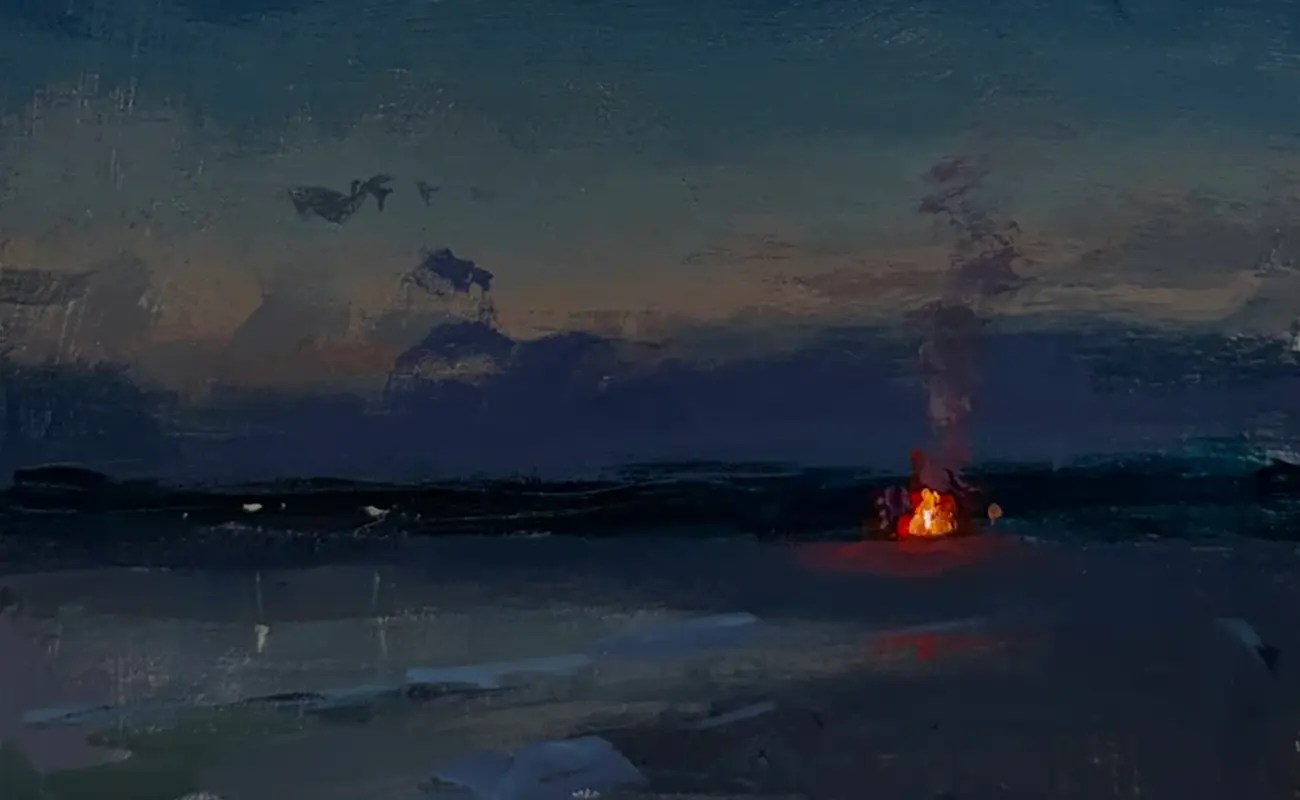
Color is equally central, though Miranda rarely depends on loud intensity. His palettes are often restrained, drawing from seasonal grays, weathered whites, coastal blues, warm wood tones, and muted interior shadows. Against these quieter ranges, selective moments of brightness become especially potent. A patch of sunset orange, a lamp’s glow, or summer green seen through a window can animate the entire composition. Because these accents are used sparingly, they carry emotional weight rather than decorative excess. Light in his paintings often feels remembered as much as observed, filtered through mood and time. This sensitivity to tonal relationships supports the introspective quality of the work. Instead of overwhelming the eye, color guides attention gently and creates space for reflection. It is one reason his paintings can feel calm while remaining visually compelling.
Miranda’s exhibition history reflects the steady growth of this distinctive practice. His work has appeared with Dianna Witte Gallery in Toronto, Room 68 in Provincetown, Paradigm Gallery in Philadelphia, and other venues across the United States and Canada. He has maintained a long relationship with Dianna Witte Gallery since 2014, a sign of sustained recognition. Now based in Maine, after periods connected to Dover, New Hampshire, and Eliot, Maine, he continues to paint from close observation and lived experience. Geography matters in his story, yet no single address defines the work. What remains consistent is his commitment to revealing the extraordinary within the ordinary. Through rooms, weather, memory, and modest objects, Jeremy Miranda continues to show that wonder is often nearest when people learn to notice what is already before them.