“Without my scientific background, I believe my art would lack its depth and critical edge. Science provided structural rigour; art offered emotional and conceptual freedom.”
From Laboratory Precision to Visual Investigation
Carmel Louise, a Melbourne-based artist working from Brunswick, has built a compelling creative practice shaped by an uncommon trajectory that bridges scientific research and fine art photography. After graduating with distinction from RMIT University in 2010 with a Bachelor of Fine Art in Photography, she began refining an approach that extends beyond image-making as simple documentation. Earlier years spent in applied science and laboratory environments cultivated a mindset grounded in observation, discipline, and sustained curiosity. These formative experiences instilled an investigative sensibility that continues to guide her artistic thinking. Rather than separating her scientific past from her creative present, she treats both as interconnected foundations that inform the conceptual depth of her work. Her camera operates not only as a recording device but as an analytical instrument, allowing her to examine the relationships between appearance, perception, and meaning. This dual perspective has positioned her practice within contemporary photography as one that actively questions what an image can reveal.
Working within research settings taught her to question surface assumptions and to understand phenomena through careful analysis. The patience required to observe microscopic change, to test hypotheses, and to interpret data became transferable skills when she transitioned into visual practice. Photography offered another method of inquiry, one that retained the structured thinking of scientific investigation while opening pathways for emotional and conceptual exploration. Her dissatisfaction with conventional conceptual photography soon emerged, particularly with imagery that felt confined to representation alone. Static images that merely depicted reality seemed insufficient for expressing the complexity she sought. This desire to expand the medium’s expressive capacity led her toward abstraction, where visual uncertainty could encourage deeper engagement. Through this shift, her focus moved from documenting subjects to uncovering the unseen conditions embedded within them, whether psychological, spatial, or material in nature.
Following her departure from the research sector, Carmel returned to formal study with a specialisation in ceramics, drawn to the physical immediacy of working with clay. This engagement with sculptural processes broadened her sensitivity to structure, balance, and texture, strengthening her understanding of how objects occupy and define space. The transition from laboratory precision to tactile manipulation enriched her visual language, reinforcing the significance of surface relationships and compositional integrity. Living in Brunswick further intensified these concerns. The suburb’s layered identity, shaped by its industrial past and ongoing urban renewal, provides an environment filled with contradiction and transformation. Factories coexist with contemporary developments, while sites of decay intersect with spaces of regeneration. Such surroundings resonate with her investigative impulse, encouraging her to focus on overlooked locations such as construction zones, architectural fragments, and transitional landscapes. Through attentive observation and experimental image-making, these everyday scenes become dynamic sites of visual excavation.

Carmel Louise: The Emergence of DeConstructed Photography
The evolution of Carmel Louise’s distinctive methodology, known as DeConstructed Photography, reflects a sustained commitment to experimentation and research-driven practice. This process begins with a single photographic capture, which she treats as raw material rather than a finished image. Using digital tools alongside intuitive decision-making, she fragments and reconfigures the original file to generate new visual possibilities. By imposing self-defined rules and working exclusively with the data contained within one photograph, she establishes a conceptual framework that balances structure with openness. The outcome remains undetermined at the outset, allowing the image to evolve organically through successive stages of transformation. Recognition and abstraction coexist within the resulting compositions, creating works that challenge viewers to reconsider how perception operates. Photography, in her hands, becomes an active process of dismantling and rebuilding, a method that emphasises inquiry over certainty.
Her distinction between digital art and DeConstructed Photography is central to understanding this approach. While digital art may originate entirely within computer-generated environments, her work remains rooted in the act of capturing light from the external world. Even after extensive manipulation, the original pixels retain the memory of the photographed moment, anchoring the work in photographic tradition. This conceptual position underscores her interest in continuity rather than rupture. Technological advances have transformed the tools available to artists, yet she sees these innovations as extensions of photography’s foundational principles. Cameras, editing software, and printers form part of an expanded toolkit that allows her to test how far the medium can stretch without losing its identity. In this sense, her practice operates within the tension between permanence and change, drawing attention to the evolving nature of visual culture.
Broader cultural influences also inform her thinking, particularly the possibilities offered by contemporary digital technologies. The capacity for rapid experimentation, iteration, and reinterpretation aligns with her investigative mindset, enabling her to produce imagery that reveals itself through process rather than predetermined intention. Historical avant-garde movements that embraced modernity and technological progress provide conceptual resonance, reinforcing her belief that photography must continually adapt. Yet her primary influence remains the philosophical question of what photography can become in an era shaped by constant innovation. DeConstructed Photography represents her response to this ongoing inquiry, proposing a model of image-making that honours the medium’s origins while embracing its future potential. Through this methodology, she invites audiences to experience photography as an evolving field of exploration grounded in curiosity and critical reflection.

Materiality, Meaning, and the Power of Endurance
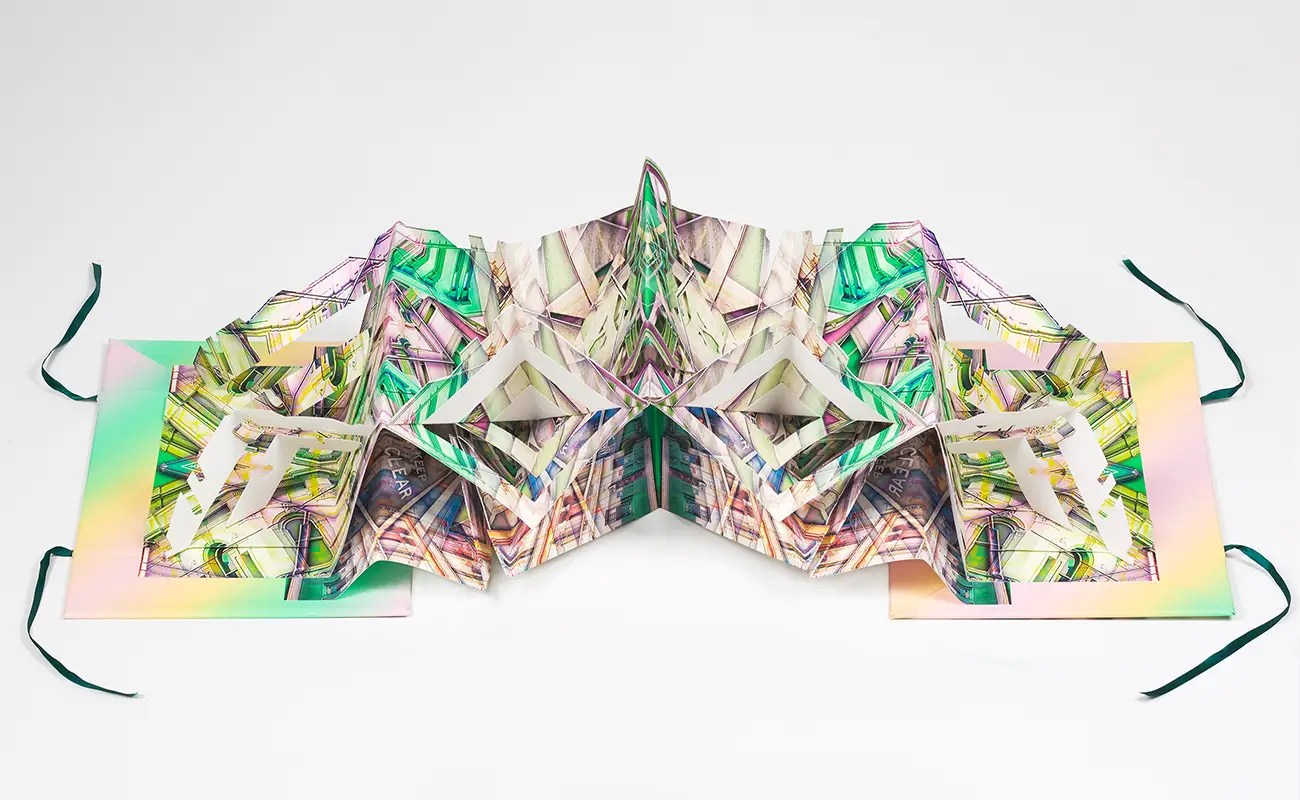
Among Carmel Louise’s body of work, Constructional No.1, V4 holds particular significance as a comprehensive expression of her conceptual and technical concerns. Created through her DeConstructed Photography methodology, the piece began with a single photographic source that underwent a prolonged period of digital transformation. Over several months, she systematically dismantled the original image into patterned base forms, isolating structural elements that could be recombined into a new visual configuration. This investigative phase required sustained attention and trust in a process that did not promise immediate clarity. Each adjustment responded to the internal logic of the photograph itself, allowing composition and meaning to emerge gradually. The work embodies her commitment to endurance and precision, demonstrating how persistence can shape the evolution of an artwork from initial capture to final realisation.
What distinguishes Constructional No.1, V4 is its movement beyond the flat surface into a sculptural dimension that engages viewers physically as well as visually. The transition from screen-based manipulation to tangible construction involved approximately two hundred hours of labour. Identical printed layers were carefully templated, hand cut, and mounted onto foam core to ensure structural stability before being stacked and refined. This repetitive yet purposeful activity reinforced her sensitivity to detail and spatial organisation. The resulting object oscillates between image and relief, encouraging audiences to navigate around it and observe how light, shadow, and depth interact. Colour relationships and kaleidoscopic patterning create shifting perceptual experiences that transform with movement. Such qualities highlight her belief that photography can operate as a constructed space rather than a passive representation.
The significance of this work extends beyond its visual impact, reflecting the convergence of her scientific background, technological engagement, and material experimentation. Constructional No.1, V4 demonstrates that photography can inhabit multiple dimensions simultaneously, functioning as both analytical investigation and expressive form. The piece stands as evidence of what can be achieved when digital inquiry intersects with hands-on craftsmanship, bridging conceptual thought with physical execution. Through this integration, she challenges conventional boundaries that separate mediums, proposing instead a fluid continuum where image, object, and process inform one another. For Carmel, the artwork represents a milestone that validates her commitment to exploration and reinforces the potential of DeConstructed Photography to expand the language of contemporary visual practice.

Carmel Louise: Community, Identity, and Future Directions
Balancing personal artistic pursuits with professional responsibilities defines Carmel Louise’s daily working rhythm. She operates her own photography-based business, specialising in fine art printing, artwork documentation, photo restoration, and commercial photographic services. This practical engagement with the technical aspects of image production keeps her closely connected to issues of colour accuracy, archival quality, and presentation. Client projects require problem-solving skills and consistent craftsmanship, ensuring that her expertise remains grounded in real-world applications. While such commitments structure much of her time, they also inform her understanding of material processes and reinforce the discipline necessary for sustained creative development. Her studio practice often unfolds in intervals shaped by reflection and long-term planning, allowing ideas to mature gradually before taking form as finished works.
Creative thinking continues even when she is not actively producing new pieces. Observing her surroundings, refining conceptual frameworks, and envisioning future projects are integral components of her methodology. This cumulative approach emphasises patience and intention rather than impulsive production. A current focus of her attention is the Brunswick Mullet Project, an ambitious portrait series that documents one hundred individuals connected to the suburb who share the distinctive hairstyle. Initiated in 2024, the project represents a deliberate shift toward a more traditional photographic format. Direct human engagement and documentary clarity become central, offering a contrast to the abstraction of her DeConstructed Photography works. Through this series, she examines how identity is expressed visually and how personal style can foster collective belonging within a specific cultural environment.
The Brunswick Mullet Project also reflects her ongoing interest in community narratives and the evolving character of Melbourne’s inner north. Participants are united not only by their appearance but by their relationship to place, creating a visual archive that captures a particular moment in time. The scale of the undertaking presents both logistical and conceptual challenges, yet it also fuels her enthusiasm for presenting the completed series as a cohesive exhibition. This forward-looking ambition underscores a broader continuity within her practice. Whether engaging with experimental image reconstruction or documentary portraiture, her guiding impulse remains consistent. Careful observation, thoughtful documentation, and an openness to transformation define her artistic direction. By navigating between innovation and tradition, Carmel Louise continues to shape a body of work that reflects both individual perception and shared experience.