
From Landscape Memory to an Abstract Syntax
Aria Artis has developed a visual language in which movement appears less as a depicted event than as the underlying condition of space itself. Across her practice, watercolor and soft pastel operate not merely as mediums of delicacy but as instruments for testing how forms can expand, bend, overlap, and reorganize themselves without abandoning compositional coherence. Earlier compositions retain recognizable associations with landscape and the built environment. Mountains become undulating planes, roads turn into directional ribbons, trees are reduced to vertical organic markers, and architectural silhouettes emerge through stacked lines and simplified masses. Yet these elements rarely behave as conventional description. They are already being pressed toward abstraction, with color carrying spatial weight and contour functioning rhythmically. Warm ochres, reds, oranges, and dark blues create alternating zones of compression and release, while softened edges prevent geometry from becoming rigid. The significance of this development lies in the way Artis allows observed or remembered space to become a structural vocabulary. Representation does not disappear abruptly. Instead, it is gradually transformed into a system of arcs, planes, intervals, and directional forces.
The landscape-oriented composition with two dark green tree forms is particularly revealing within this evolution. Its hills and mountains remain legible, but naturalistic perspective has been subordinated to a sequence of overlapping curves that behave almost like folded fabric or geological strata. The two trees occupy an ambiguous position between motif and symbol. Their simplified, upright silhouettes create a moment of stillness amid an environment defined by sweeping diagonals and compressed color bands. The road extending toward them introduces depth, yet it also functions as a formal device that draws separate regions of the picture into a unified rhythm. What initially reads as a landscape is therefore already organized according to principles that will become central to Artis’s later abstraction. The dark blue and red slopes expand into broad directional masses, the road narrows into a flowing band, and the distant mountains are flattened into layered chromatic zones. Natural space is not simply depicted; it is reorganized through rhythm.
Similar transformations occur in the red, black, gray, and white urban compositions, where architectural forms become increasingly stylized until towers, bridges, streets, and structural frameworks are difficult to separate from purely abstract shapes. In one such work, vertical black and red structures remain recognizably connected to a city skyline, yet broad white and gray curves move through them with a freedom that destabilizes conventional architectural space. Circular red forms appear almost suspended above the built environment, while repeated verticals create a measured counter-rhythm to the larger sweeps. The city becomes less a specific place than a field of competing directions. These works demonstrate that Artis’s later abstraction did not emerge through the rejection of imagery. It arose through an extended process of distillation in which natural and architectural references were reduced to their most active properties: verticality, curvature, repetition, directional tension, and spatial interruption.
This gradual withdrawal from recognizable subject matter gives the development unusual continuity. Artis’s practice does not present abstraction as an escape from the visible world but as an attempt to identify the forces beneath appearances. Such an approach places her in conversation with strands of modern abstraction that treated landscape, architecture, and sensation as starting points rather than destinations. Kandinsky’s interest in rhythm and psychological resonance is relevant here, particularly in Artis’s tendency to make color and directional movement carry emotional meaning independently of narrative. Yet Artis’s compositions are distinguished by their persistent architectural scaffolding. Even the softer passages appear governed by an implicit armature. The strongest early works therefore function as transitional structures: they preserve the memory of physical environments while simultaneously converting them into visual systems. Their importance lies less in stylistic consistency than in showing how the later vocabulary was generated through repeated negotiations between observation, intuition, and organization.

Aria Artis: Between Organic Motion and Architectural Order
The most distinctive feature of Artis’s mature vocabulary is the tension between sweeping organic motion and geometric constraint. In the compositions that move furthest from recognizable architecture, broad bands curve across rectangles, grids, vertical lines, and suspended circular forms. These elements create two competing spatial logics. One suggests planning, measurement, and construction; the other implies bodily movement, airflow, musical phrasing, or currents of energy. Rather than allowing one system to dominate, Artis repeatedly stages their interaction. A curve may cross a grid without conforming to it, while a rigid vertical may interrupt an otherwise continuous sweep. Rectangular zones behave like fragments of architectural plans, yet their opacity varies enough to prevent them from becoming purely diagrammatic. This opposition gives the paintings their internal vitality. The geometry establishes resistance, and the curves generate momentum against that resistance. Such an arrangement is particularly effective because it avoids the common weakness of lyrical abstraction in which gestural movement can become merely atmospheric. Artis’s forms remain accountable to structure, even at their most fluid.
This relationship becomes particularly clear in the warm orange, red, blue, and cream composition dominated by a large circular form and an elongated sweep through the center. Architectural elements remain visible as dark verticals, rectilinear divisions, and window-like structures, but they are repeatedly crossed by larger curvilinear forms. A pale blue band rises through the composition before turning back into the surrounding field, while a red and orange trajectory bends across the lower edge and accelerates upward. Fine linear arcs extend beyond these heavier forms, creating a secondary network of movement that makes the surface feel active at several speeds simultaneously. The large circular form in the upper left acts both as a point of visual concentration and as a counterweight to the more open movement on the right. Rather than constructing depth through perspective, Artis builds spatial experience from intersections, directional changes, and differences in visual weight.
The association with Zaha Hadid is especially useful for understanding this relationship. Hadid’s architecture transformed the idea of the building from stable enclosure into something closer to a field of vectors, trajectories, and directional pressures. Artis similarly treats space as active rather than neutral. Curves do not simply decorate underlying structures. They appear to bend, accelerate, or redistribute the composition around themselves. In several works, elongated ribbons cross the picture in broad loops, creating visual pathways that resemble neither traditional perspective nor flat pattern. They suggest space being generated through motion. At the same time, Artis’s practice remains firmly pictorial. The relationships between line, color, transparency, and edge are designed for a frontal surface, and the most compelling passages are those in which the paintings preserve this ambiguity between architectural suggestion and autonomous abstraction. The connection is therefore less about borrowing a recognizable formal signature than about sharing a conception of structure as something capable of behaving dynamically. Architecture becomes a way of thinking about movement rather than a subject to be depicted.
This balance also produces one of the central challenges within the work. Artis has established a highly fluent vocabulary of arcs, ribbons, grids, circles, softened rectangles, and directional lines. Its sophistication is evident, but fluency can become predictable when recurring devices begin to resolve tension too efficiently. Several later compositions approach a level of formal harmony in which every curve seems elegantly answered by another curve, every dark zone balanced by a luminous passage, and every geometric interruption incorporated into a stable whole. Such control gives the paintings considerable visual appeal, particularly in contexts where abstract painting is valued for spatial clarity and sustained viewing. Yet the next stage of the practice will depend on how much friction Artis permits within this system. Greater asymmetry, sharper disruptions of scale, denser collisions, or more pronounced moments of emptiness could prevent the vocabulary from settling into a recognizably decorative mode. The strength of the current language lies in its capacity to organize complexity. Its future force may depend on allowing certain compositions to resist resolution.

Light, Rhythm, and the Psychology of Space
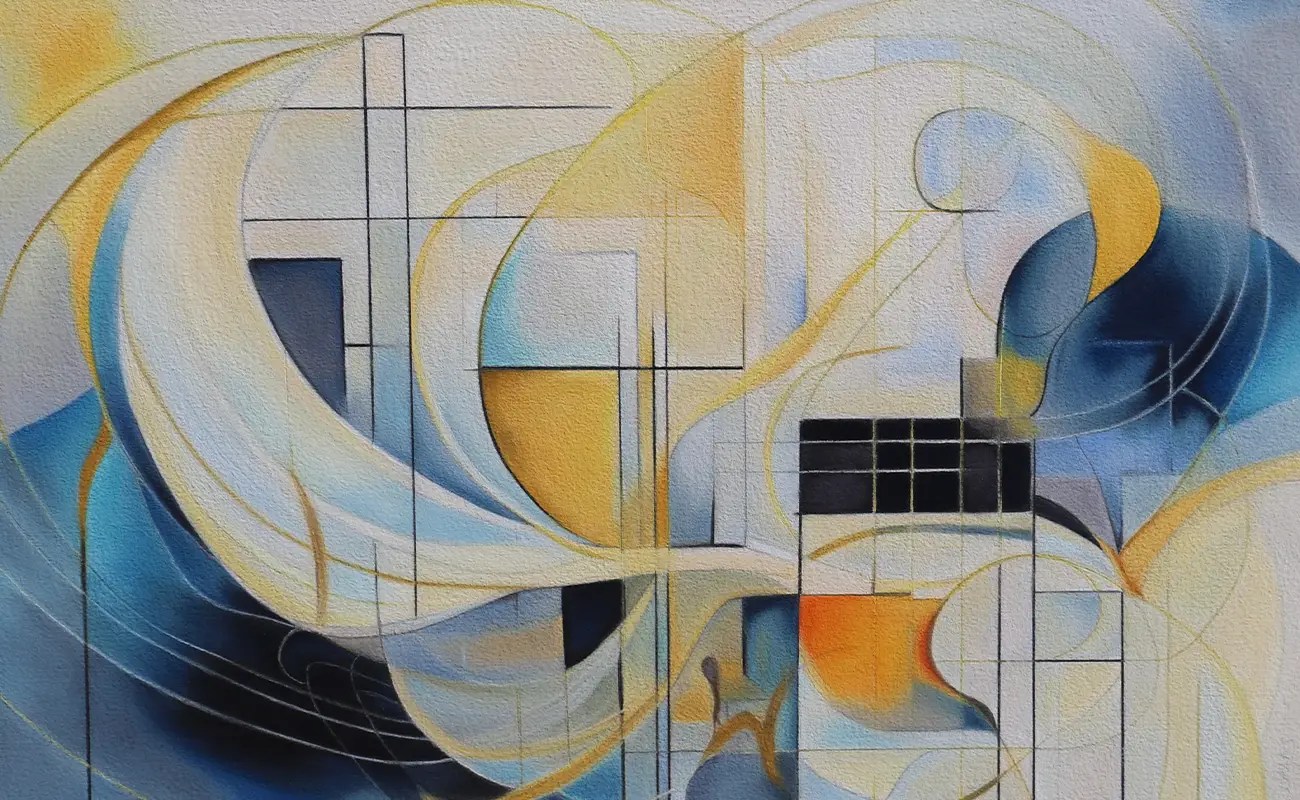
Architecture of Light and Energy (2026) marks the clearest articulation of Artis’s shift toward abstraction as an independent psychological and spatial structure. In these works, light no longer appears as illumination applied to forms. It behaves almost as a compositional material. Pale blues, creams, whites, translucent yellows, and softened grays generate zones that seem to expand beyond their boundaries, while deeper navy, charcoal, and occasional red or orange passages create counterweights of density. This produces a rhythm of emergence and recession across the surface. Some shapes appear to advance because of chromatic intensity; others dissolve into the paper through reduced contrast. Artis uses these fluctuations to create a sense of breathing space rather than conventional depth. The eye moves through alternating regions of saturation and suspension, encountering broad sweeps, fine linear frameworks, translucent blocks, and concentrated dark anchors. The result is contemplative without becoming inert. Light functions as a psychological register, suggesting openness, distance, memory, or release, while darker elements introduce weight and resistance.
One composition from this phase makes these relationships especially clear. A broad blue and white curve rises from the lower left before sweeping across a field structured by delicate vertical and horizontal lines. Rectangular zones overlap without becoming solid enclosures, allowing the grid to remain visible as both structure and atmosphere. Several circular forms punctuate the field at different scales. A small black circle and a pale gray disc appear almost diagrammatic, while the larger dark blue sphere at the upper right carries greater visual and chromatic weight. Their different positions interrupt the continuity of the surrounding curves and prevent the composition from becoming a single uninterrupted gesture. Yellow and turquoise passages move through the grid with varying degrees of transparency, so that the viewer experiences light not as a source located outside the painting but as something generated by the relations among colors, edges, and intervals.
Rhythm is equally central to the series. Artis’s stated interest in music can be felt most convincingly not through literal analogy but through repetition and variation. Thin lines recur at changing intervals, circular forms punctuate larger fields, and broad curves establish extended visual phrases that are interrupted by short verticals or rectangular accents. In the composition described above, this rhythmic logic is particularly evident in the contrast between the sustained arc of the main sweeping form and the sharper pauses created by circles and grid intersections. The gaze does not absorb the work all at once; it follows sequences, doubles back, pauses at denser intersections, and accelerates along broader contours. The resulting compositions can therefore be read temporally.
Kandinsky’s belief that visual relationships could generate effects comparable to musical relationships offers a historical precedent, but Artis’s version is quieter and more architectural. Her rhythm is often produced through measured spacing rather than expressive gesture. This restraint gives the paintings a particular contemporary character. Their emotional atmosphere emerges from calibrated relationships between movement and stillness, not from overt dramatization. The most successful works create the impression of an internal structure that remains coherent even as individual forms seem to drift, expand, or pass through one another.
The psychological dimension becomes especially persuasive where Artis leaves enough open space for the viewer to experience uncertainty. Her refusal to attach fixed narratives to the paintings is consistent with their formal construction. Circles may suggest planets, lights, apertures, or nodes, yet they never settle into a single symbolic function. Curves can evoke waves, pathways, fabric, architectural spans, or bodily movement without becoming illustrations of any of them. This openness gives the work emotional elasticity. The forms remain suggestive precisely because their identities are never fixed. Scale, transparency, edge, and spatial relation allow associations to emerge briefly before dissolving back into the larger composition.
The challenge is to preserve that ambiguity as the visual language becomes increasingly distilled. Repeated use of highly recognizable formal motifs could eventually turn openness into a personal code whose meanings feel predetermined. Maintaining psychological depth will require continual variation in how those motifs behave, collide, dissolve, and occupy space.

Aria Artis: Positioning a Contemporary Abstract Practice
Within contemporary abstract painting, Artis occupies a productive intersection between lyrical movement, geometric organization, and architectural imagination. The paintings resist classification as either purely geometric abstraction or purely gestural abstraction because they rely on each mode to destabilize the other. Their strongest contribution is this sustained negotiation. Organic forms carry emotional charge, but grids and structural lines prevent them from becoming purely atmospheric. Geometric systems imply control, yet translucent color and curving movement keep those systems from hardening into impersonal design. This combination has clear relevance within current abstraction, where the distinction between painting, spatial thinking, design history, and architectural visualization has become increasingly porous.
Artis’s work participates in that expanded field while retaining a recognizable investment in painterly sensitivity. The color transitions, softened edges, and overlapping transparencies remain inseparable from the handmade surface. That distinction matters because the compositions could easily move toward digital or graphic appearance. Their credibility as paintings depends on maintaining traces of material variation, touch, and optical unpredictability alongside their highly controlled structures.
The decision to continue Architecture of Light and Energy exclusively through large-scale acrylic painting has the potential to alter the practice significantly. Watercolor and soft pastel naturally encourage transparency, diffusion, and gradual tonal transitions. Acrylic introduces different possibilities: greater opacity, sharper layering, physical accumulation, and more assertive relationships between color fields. Scale will also change the viewer’s relation to Artis’s curves and architectural frameworks. What currently functions as an elegant visual trajectory on paper could become bodily at mural-like dimensions, requiring the viewer to experience movement through physical orientation rather than distant observation. This transition could strengthen the architectural character of the work and make its central concerns with movement, light, geometry, and emotional space more immediate.
It also raises a productive technical question. If acrylic is used merely to reproduce the softness of watercolor at a larger size, the new medium may add scale without fundamentally transforming the language. Greater ambition would come from allowing acrylic’s material capacities to challenge the established vocabulary, introducing new densities, surfaces, edges, and interruptions.
From a curatorial perspective, Artis’s developing direction has several clear strengths. The body of work is coherent enough to be recognizable while retaining visible evidence of evolution, an important quality for exhibition contexts because it permits the practice to be understood as a sustained inquiry rather than a sequence of isolated stylistic experiments. The connection between abstraction and architecture creates possibilities for presentations concerned with spatial perception, urban imagination, design culture, and the psychological experience of constructed environments. Large-scale acrylic works could also intensify the paintings’ relationship to architectural settings without reducing them to decoration, provided the compositions continue to preserve tension and conceptual specificity.
The principal task ahead is therefore not greater polish but greater differentiation within an already persuasive language. Artis has reached a point at which movement, light, geometry, and memory no longer appear as separate themes. They function as interdependent components of a visual system. The future significance of that system will depend on how boldly it can be expanded, disrupted, and materially rethought while retaining the contemplative intelligence that already defines it.