“The goal is not simply to depict the world accurately, but to create paintings that encourage viewers to see familiar things differently.”
The Quiet Drama Hidden Within Ordinary Landscapes
Contemporary painting often gravitates toward spectacle, yet Adam Normandin has built a distinctive practice around places that most people scarcely notice. Based in Southern California, he turns his attention toward construction sites, vacant storefronts, industrial buildings, utility networks, temporary barriers, and other overlooked environments that quietly shape daily experience. Rather than treating these locations as documentary subjects, he approaches them as vehicles for exploring memory, perception, concealment, and the psychological traces embedded within the built world. Through carefully observed paintings, familiar environments are transformed into contemplative spaces charged with uncertainty, absence, and emotional resonance.
Throughout his career, Normandin has remained fascinated by the subtle ways contemporary environments reveal and conceal human activity. Whether depicting construction fencing, industrial corridors, transportation infrastructure, or weathered urban surfaces, he is drawn to places that exist in a state of transition. These environments balance permanence with impermanence, visibility with obscurity, inviting reflection on the systems and experiences that shape everyday life. Such subjects occupy a compelling middle ground where familiarity meets ambiguity, a tension that has become central to his artistic practice.
Painting emerged as the ideal medium through which Normandin could unite technical rigor with conceptual inquiry. While his work is frequently associated with realism and hyperrealism, he does not regard accuracy as the ultimate objective. Instead, realism serves as a visual language that invites viewers into deeper questions concerning absence, transformation, concealment, repair, and the invisible forces that influence contemporary existence. The result is artwork that appears precise and observational at first glance yet gradually reveals more complex psychological dimensions.

Adam Normandin: Precision Beyond Documentation
A defining aspect of Normandin’s work is the way it shifts realism beyond straightforward representation. Construction zones, weathered surfaces, industrial structures, urban edges, transportation networks, and temporary interventions within the landscape are rendered with extraordinary clarity, yet these scenes rarely function as simple records of specific locations. The artist intentionally focuses on environments that feel suspended between activity and abandonment, places marked by human intervention while remaining strangely unoccupied. This careful balance creates an atmosphere where viewers sense the presence of people without necessarily seeing them.
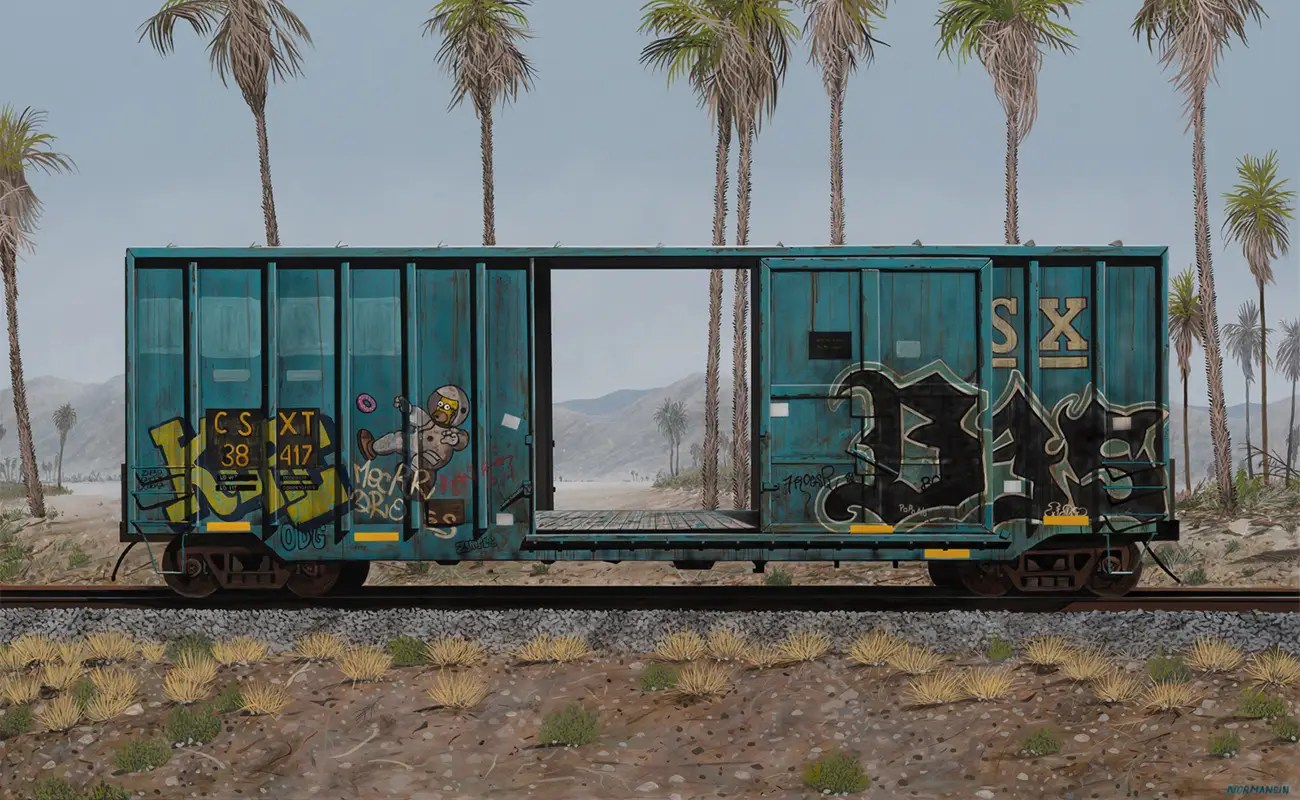
Visual structures play a significant role in reinforcing these ideas. Fences, windows, barriers, boxcars, and architectural openings frequently appear throughout the paintings, creating layered compositions that separate viewer from subject. These recurring elements act as visual filters, suggesting that perception is always mediated through distance, memory, and experience. Instead of offering unrestricted access, the paintings invite viewers to navigate systems of concealment and revelation. Every opening simultaneously reveals and withholds information, creating subtle psychological tension within otherwise ordinary settings.
Normandin’s engagement with liminal spaces further distinguishes his work. Rail corridors, industrial lots, construction sites, and transitional urban environments become stages upon which broader themes unfold. Movement, labor, maintenance, displacement, and urban transformation remain ever present, even when no narrative is explicitly depicted. Human activity is inferred through traces, markings, and structures rather than direct storytelling. This restraint allows the paintings to operate in a more open-ended manner, encouraging individual interpretation while maintaining a strong emotional undercurrent.

Surfaces of Time and the Language of Concealment
Among the most meaningful works within Normandin’s practice is Tarp, a painting that encapsulates many of his central concerns. Measuring 36 by 48 inches and executed in acrylic on panel, the piece depicts a simple green tarp draped across a construction fence. Although the subject appears remarkably ordinary, the artist became captivated by its contradictory nature. The tarp acts simultaneously as a barrier and an invitation, suggesting the existence of something beyond while denying direct access to it. What initially appears mundane gradually becomes psychologically charged.
For Normandin, the significance of Tarp lies not in the object itself but in the questions it generates. The painting examines uncertainty and projection, exploring the tendency to search for meaning when information remains incomplete. The concealed space behind the barrier becomes as important as the visible surface. In this way, the work extends beyond physical description and enters conceptual territory, asking viewers to confront the limits of perception and the assumptions formed when confronted with absence.
The painting also highlights the artist’s sophisticated handling of surface and technique. Traditional brushwork is combined with carefully controlled airbrushed passages, creating a visual experience that moves between photographic precision and painterly abstraction. This tension appears throughout his broader body of work. Graffiti, weathered textures, scratches, reflections, stains, and folded materials are treated as records of accumulated time rather than decorative details. Hard geometric structures often coexist with fluid marks and atmospheric ambiguity, reinforcing the coexistence of permanence and change that defines his artistic vision.

Adam Normandin: Painting the Residue of Experience
Color and atmosphere contribute significantly to the emotional impact of Normandin’s paintings. His palette frequently relies on subdued blues, muted greens, concrete grays, and weathered earth tones. These restrained color relationships create a contemplative mood that aligns with the themes of memory, distance, and reflection. Brighter colors occasionally emerge through graffiti, industrial signage, safety equipment, or painted surfaces, creating visual interruptions that punctuate otherwise quiet compositions. Light itself is often diffuse rather than dramatic, generating a sensation closer to recollection than spectacle.
Influences on the artist extend beyond painting into photography, cinema, industrial design, and everyday observation. He is particularly interested in creators who transform familiar subjects into psychologically complex experiences. The attraction lies less in stylistic imitation than in the conceptual ability to reveal tension and mystery within ordinary circumstances. Personal encounters with transportation networks, industrial corridors, and transitional spaces have proven equally influential, continually providing material through which broader ideas about labor, movement, and change can be explored.
Normandin’s working process reflects the same thoughtful approach evident in the finished paintings. Extensive observation, photography, sketching, and research precede the development of each composition. Subjects are selected not simply because they are visually compelling but because they resonate conceptually. In the studio, paintings are built gradually through multiple layers, balancing discipline with experimentation. Looking ahead, he aims to expand both scale and ambition while continuing to investigate the intersection of realism, abstraction, and contemporary experience. Through this evolving practice, familiar environments become sites of reflection, revealing the psychological weight that lingers long after a moment has passed.