The Human Figure Under Pressure
Samuel Salcedo has built a striking position in contemporary sculpture through works that transform familiar human features into sites of tension, recognition, and emotional uncertainty. Born in Barcelona in 1975, he belongs to a generation of artists who inherited both classical sculptural knowledge and a rapidly changing visual culture shaped by photography, media images, and shifting identities. Rather than pursue spectacle for its own sake, he uses the face and body as direct instruments for examining what people hide, display, and struggle to understand within themselves. His sculptures often appear immediately accessible because viewers recognise the human subject at once, yet that first recognition quickly gives way to more complex reactions. A frozen grin may seem humorous before turning unsettling. A tired expression may carry tenderness and unease at the same time. This layered response explains why his work resonates across varied audiences. He does not present distant symbols or coded puzzles, but instead returns to the most common image of all, the human figure, and shows how unstable that image can become when observed carefully.
The emotional force of Salcedo’s practice often begins with scale and proximity. By enlarging heads or isolating faces, he gives ordinary expressions an unexpected monumentality. Features that might pass unnoticed in everyday life become impossible to ignore when translated into sculpture. A yawn, a grimace, or a moment of distraction gains the gravity usually reserved for heroic portraiture. Yet he rejects heroic ideals. His figures are not polished icons of perfection, nor do they celebrate conventional beauty. Instead, they inhabit the awkward territory of ordinary existence, where embarrassment, fatigue, uncertainty, and irony shape the way people appear. This refusal of idealisation is central to his importance. He invites viewers to confront the parts of themselves often edited out of public presentation. In galleries and museums, where art can sometimes feel remote from common experience, Salcedo’s sculptures return attention to recognisable vulnerability. They suggest that truth may be found less in grand gestures than in involuntary expressions and brief moments when social control slips.
Another defining quality of his work is the open emotional reading each sculpture permits. Salcedo frequently creates expressions that cannot be fixed into one clear category. A face may hover between laughter and discomfort, between pain and pleasure, between amusement and anxiety. Because of this ambiguity, the viewer becomes an active participant rather than a passive observer. People project their own moods, memories, and assumptions onto the sculpture, discovering as much about themselves as about the object before them. This strategy gives the work lasting power, since meanings can shift from one encounter to the next. A piece seen during a joyful day may appear playful, while the same work might feel melancholic under different circumstances. Such elasticity places Salcedo among artists who understand sculpture not merely as form in space, but as a psychological meeting point between object and audience. His figures stand still, yet the emotions around them remain in motion.

Photo by Moritz Rehbein
Samuel Salcedo: Formation, Discipline, and the Turn to Sculpture
Salcedo’s artistic development reflects a rigorous education combined with practical experience in demanding studio environments. He studied Fine Arts at the University of Barcelona, completing his degree in 1998, and later continued his training at Manchester Metropolitan University. These years provided a broad grounding in artistic methods, historical awareness, and technical processes that would later support the precision visible throughout his mature practice. Academic study, however, was only one part of his formation. He also absorbed lessons from direct work in professional settings where discipline, repetition, and material understanding are tested daily. That combination of intellectual preparation and hands-on labour helps explain the confidence of his later sculptures. Whether working in resin, metal, or other materials, he approaches each medium with the seriousness of someone who understands both concept and craft. Many contemporary artists separate idea from execution, but Salcedo’s career shows how strongly those two elements can reinforce one another when developed together over time.
A particularly significant chapter in his early career was his period assisting the renowned Spanish sculptor Jaume Plensa. Working in that environment offered more than technical exposure. It likely strengthened Salcedo’s awareness of scale, surface, production processes, and the emotional possibilities of figurative art within contemporary contexts. Studio assistance can be formative because it reveals the hidden labour behind major works: moulding, casting, revisions, structural decisions, and the countless practical judgments that shape final results. For Salcedo, this experience helped refine an already serious methodology and sharpen his sensitivity to how sculpture occupies space. Although his own visual language would become distinctly personal, the benefits of such apprenticeship can be felt in the assurance with which he handles complex forms. His later sculptures, whether intimate or monumental, suggest an artist who knows how to move from idea to object through disciplined stages rather than relying on impulse alone.
Interestingly, Salcedo did not begin exclusively as a sculptor. He first exhibited primarily as a painter before gradually redirecting his energy toward three-dimensional work. That transition reveals much about his priorities. Painting can describe bodies and faces, but sculpture places them physically before the viewer, sharing the same space and demanding a more immediate encounter. Salcedo sought a language that felt more direct and visceral, and sculpture provided that intensity. The move also aligns with his fascination for emotional nuance. A carved or cast face can catch light differently as the viewer moves, allowing expression to shift in ways impossible on a flat surface. Likewise, scale becomes bodily rather than optical. An oversized head in sculpture can feel confrontational because it occupies real space. His journey from painting to sculpture therefore was not a simple change of medium, but a decisive search for the most effective vehicle for psychological presence.

Materials That Breathe with Uneasy Life
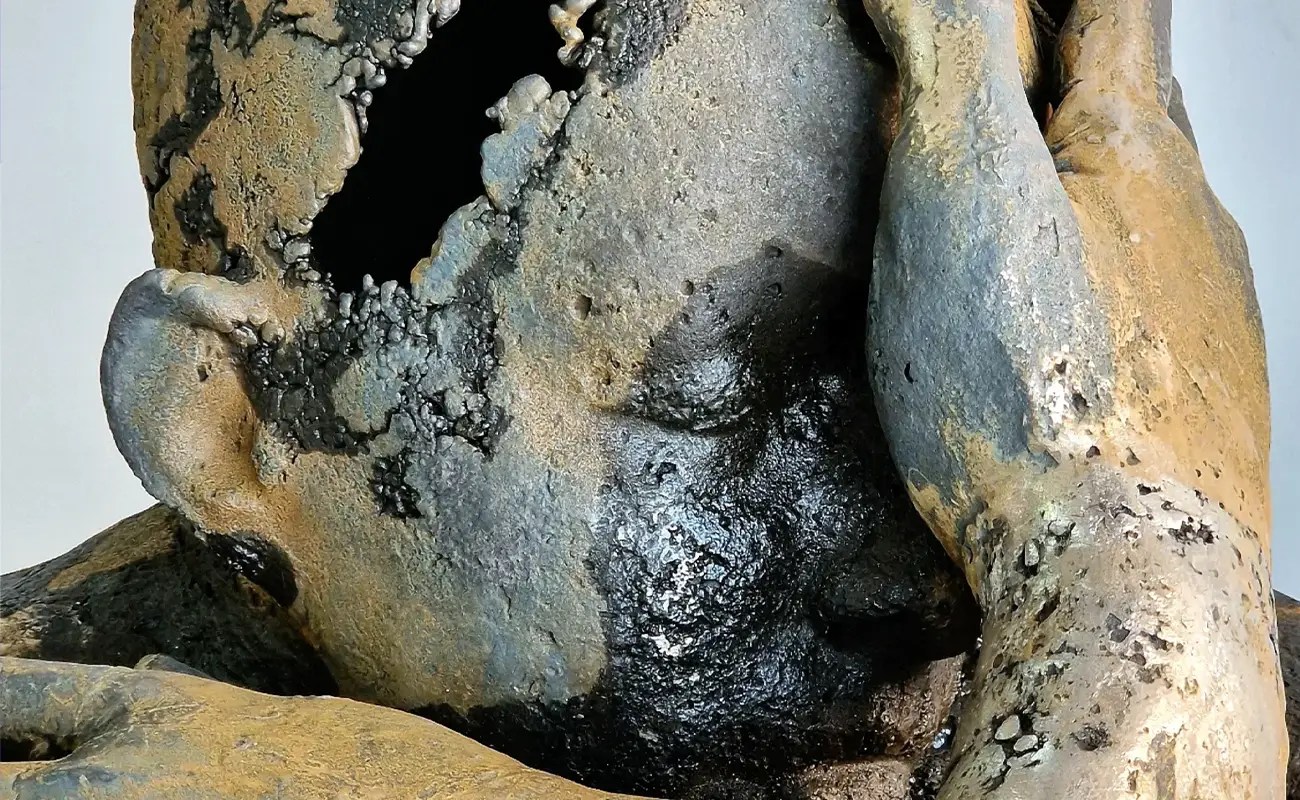
Technical versatility is one of the strongest foundations of Salcedo’s reputation. He has worked with polyester resin, polyurethane, epoxy, aluminium, bronze, iron, and cast or recycled foundry sand, among other materials. Such range is not merely a display of skill. Each substance carries different expressive possibilities. Metals can suggest permanence, weight, and public monumentality, while resin and synthetic compounds permit subtle detail and highly responsive surfaces. Foundry sand introduces roughness, fragility, and traces of industrial transformation. By choosing among these materials, Salcedo adjusts the emotional temperature of a sculpture before a viewer even interprets the subject. A polished form may feel distant or reflective, whereas a coarse surface can evoke erosion, memory, or discomfort. This sensitivity to matter separates serious sculptors from image-makers who only reproduce appearances. Salcedo understands that in sculpture, meaning resides not only in what is represented but also in the physical character of what carries that representation.
Equally notable is his treatment of colour and surface. Through polychromy, spray painting, and the use of coloured pencils, he achieves skin tones, textures, and tonal transitions that approach lived presence while never collapsing into simple imitation. Hyper-realism in weaker hands can become a technical trick, admired briefly for resemblance alone. Salcedo avoids that trap because his surfaces always serve emotional ambiguity. A convincingly rendered cheek or eyelid draws the viewer closer, but once close, one confronts an expression that remains difficult to decode. Realism becomes an entry point rather than a final destination. The slight distortions he introduces can intensify this effect. Features may seem almost natural yet subtly exaggerated, placing the viewer in uncertain territory between recognition and estrangement. This threshold between likeness and alteration is crucial to the atmosphere of his work, where familiarity never becomes comfort for long.
Reflective materials such as polished aluminium or black epoxy add another dimension to his practice by incorporating the spectator directly into the encounter. When viewers see fragments of themselves mirrored in a sculpture, observation becomes reciprocal. One no longer stands outside the work as a detached judge. Instead, personal image, surrounding space, and sculpted form mix in changing ways depending on movement and light. This strategy deepens Salcedo’s recurring concern with identity and projection. People approach the sculpture seeking to read another face, only to find their own presence folded into the scene. The object becomes both portrait and mirror. Such material intelligence shows how carefully he thinks through perception itself. Rather than treating sculpture as static mass, he uses surfaces to create shifting relationships between object, viewer, and environment. The result is art that continues to change after installation because every new observer activates it differently.

Samuel Salcedo: International Presence and Lasting Resonance
Since the late 1990s, Salcedo has exhibited widely in Spain and abroad, establishing a sustained international presence rather than a brief moment of attention. His solo presentations have appeared in cities including Barcelona, Madrid, Paris, Berlin, Cologne, Hanover, Lisbon, Bologna, and Miami. This geographic spread matters because figurative sculpture often encounters different expectations in different cultural contexts. Some audiences approach realism through classical traditions, while others connect it with contemporary social commentary or psychological inquiry. Salcedo’s ability to speak across these settings suggests the universality of his chosen subject: the unstable human self. Viewers in diverse places recognise the gestures, hesitations, and emotional contradictions embedded in his figures. While styles and markets shift quickly, work grounded in shared human experience can travel with unusual strength. His exhibition history therefore reflects not only professional success but the portability of themes that remain relevant across languages and borders.
Institutional recognition has reinforced that reach. His sculptures are held in important public and private collections such as Fundación La Caixa, the Vila-Casas Foundation, the Fran Daurel Foundation, the DKV Foundation, the Bassat Collection, SOLO Collection, and the Salsali Private Museum, among others in Europe and the Middle East. Inclusion in such collections signals confidence in the durability of his contribution. Museums and foundations often seek works that can sustain repeated interpretation over time, and Salcedo’s art offers precisely that quality. Because his sculptures are rooted in emotional complexity rather than temporary novelty, they remain open to future viewers with different concerns. A generation focused on identity may read them one way, while another attentive to vulnerability or public image may discover new meanings. Collection histories often become a record of cultural priorities, and Salcedo’s presence within them marks him as an artist whose concerns extend beyond short-term fashion.
Recent visibility at the Moco Museum in Barcelona has further affirmed his standing in the city where he was born and where he lives and works. That local connection is meaningful. Many artists achieve recognition abroad yet remain distant from their place of origin. Salcedo’s continued relevance in Barcelona suggests an ongoing dialogue between his international career and his home context. His sculptures, with their blend of seriousness, wit, discomfort, and compassion, continue to feel current because the pressures they describe have not faded. People still perform polished versions of themselves while carrying private doubts and contradictions beneath the surface. Salcedo gives form to that split with rare clarity. Through faces caught mid-expression and bodies suspended in vulnerable moments, he reminds viewers that identity is less stable than it appears. In doing so, he has secured a distinctive and enduring place within contemporary figurative sculpture.