“Becoming an artist wasn’t a thing I did, it was simply me being.”
Where the Natural World Begins to Dream
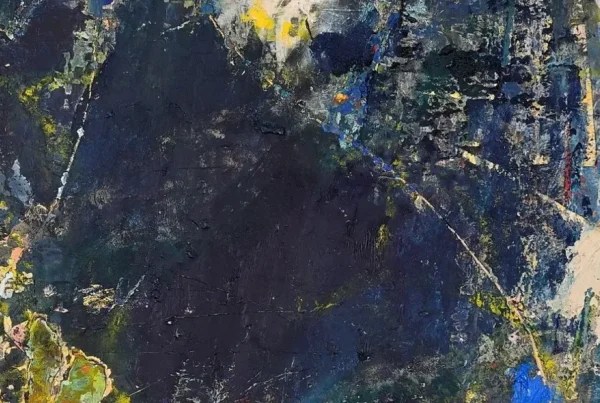
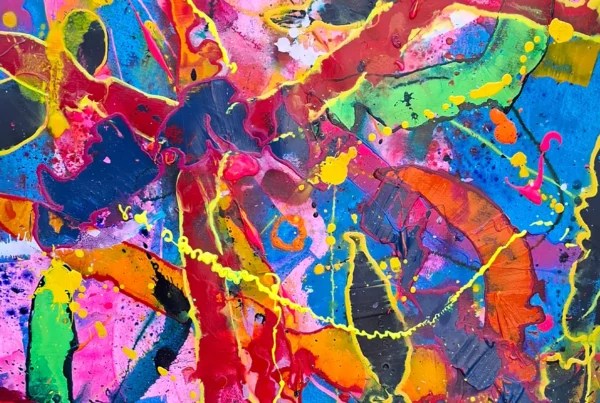
Carolyn Hardy has built a career around the conviction that imagination can reveal what ordinary perception leaves hidden. The Southern Ontario artist works primarily in acrylic on canvas, creating surrealist scenes marked by bright color, fluid movement, and recurring swirling forms. Her paintings are intended to do more than create visual impact. They ask viewers to recognize emotion, symbolism, and unseen patterns within familiar experience. That combination of expressive energy and philosophical inquiry has become a defining feature of her practice, giving her work a distinctive identity across hundreds of original paintings.
Hardy grew up in the southernmost part of Canada, surrounded by the Great Lakes, and she describes that environment as a lasting influence. Water appears in her thinking not only as subject matter, but as a model for movement. Its fluidity is echoed in the sweeping motion of her compositions, while trees, changing hues, and the broader natural world become carriers of feeling and character. Nature is not treated as a passive backdrop. It becomes active, animated, and psychologically charged, providing a foundation from which Hardy constructs imagined worlds populated by symbolic figures and emotional presences.
Her relationship with art began long before she considered it a profession. Hardy has been creating since childhood and identifies herself as entirely self taught. She held her first solo exhibition at eighteen and has since sold more than 800 original paintings that entered private collections. Rather than describing becoming an artist as a single decision, she sees it as a continuous way of living: practicing, experimenting, and protecting the freedom to follow her own visual instincts. Years of independent work allowed her to refine a recognizable style without abandoning the curiosity that first drew her to making images.

Carolyn Hardy: Building a Language of Swirls
The swirling structures that move through Hardy’s paintings function almost like a visual signature. They can suggest water, energy, atmosphere, or psychological motion depending on the image, but their importance lies in the sense of transformation they create. Solid forms rarely feel completely fixed. Instead, colors and shapes appear to shift into one another, giving the impression that the visible world is only one layer of a larger experience. Even when she paints outdoors, Hardy says the same unmistakable character remains present, allowing her plein air work to retain the expressive identity of her studio practice.
That identity developed through persistence rather than formal instruction. Hardy has spent years testing concepts, materials, and techniques while remaining committed to her own instincts. She enjoys moving beyond familiar methods and learning what different media can offer, yet surrealism remains especially important because it gives her imagination room to operate without the restrictions of literal representation. For Hardy, the possibilities of surrealist art are effectively unlimited. Any event, story, philosophy, natural form, or observation can become the starting point for an image.
The purpose behind those images is equally important to her. Hardy wants her paintings to inspire, provoke feeling, teach, or draw attention to what she calls an energy signature. Her outlook is fundamentally affirmative: life can contain beauty, happiness, meaning, and majesty, even when perception narrows what people are able to recognize. Surrealism offers her a way to challenge those limits. By breaking reality into symbolic and subconscious forms, she can question accepted viewpoints and encourage viewers to consider a situation from an unfamiliar angle. A changed perspective, in her view, can alter more than the interpretation of a painting.

Standing at the Edge of the Unknown
One work that concentrates many of Hardy’s ideas is “The Edge of the Abyss,” created during a live painting performance. The image shows a figure stepping beyond a checkered floor and into an open abyss. As the figure leaves the stable patterned surface, it levitates and begins turning gold. The composition transforms a moment of uncertainty into a visual threshold, balancing the fear of losing solid ground against the possibility that something unexpected may become possible once certainty is left behind.
The painting was inspired by Patrick Overton’s poem “Faith,” particularly its image of moving beyond the edge of known light and trusting what might happen in the unknown. Hardy connects that idea directly to her own life. For her, the work represents the courage required to pursue an artistic calling without guarantees. It recalls the suspicion, anxiety, and uncertainty that can accompany major decisions, while emphasizing the need to continue moving forward despite them. The figure does not simply fall. Its transformation into gold and its suspended position recast risk as an act of belief.
“The Edge of the Abyss” has since been published in international art magazines and exhibited in Toronto and Paris. Its public life reflects the way Hardy’s personal symbolism can extend beyond autobiography. The image originates in her own experience of choosing an artistic path, yet the situation it presents is broadly recognizable: a person reaches the boundary of what feels secure and must decide whether to remain still or move ahead. The painting leaves that moment open enough for viewers to bring their own fears, ambitions, and interpretations to the scene.

Carolyn Hardy: A Daily Practice of Possibility
Behind the imaginative worlds in Hardy’s paintings is a highly regular working routine. She creates art every day and balances her personal work with a steady schedule of commissions. Organization helps her protect that creative momentum. Large projects are broken into smaller tasks, and daily to do lists allow her to make measurable progress without losing sight of broader goals. The method is practical, but it also reflects something central to her career: artistic freedom has been sustained through consistent work rather than waiting for ideal circumstances or occasional inspiration.
That consistency has made prolific production part of Hardy’s identity. She does not describe creativity as something separate from ordinary life or reserved for special moments. Painting is how she spends her time, entertains herself, studies new ideas, and continues developing her visual language. Her curiosity extends beyond art itself. She enjoys learning about a wide range of subjects, and that appetite for information feeds a practice in which almost anything can become material for a surrealist composition. Life, for Hardy, provides more possibilities than any single body of work could exhaust.
Her current plans continue that pattern of expansion. Alongside ongoing commissions, Hardy is producing new paintings intended for international art fairs in 2027. She approaches the prospect with the same sense of enjoyment that has shaped her practice from the beginning: making new work because the act of making remains compelling. After decades of experimentation, exhibitions, sales, and stylistic refinement, she still returns to the basic impulse that first defined her relationship with art. The future of the work lies not in abandoning that instinct, but in giving it new images through which to move.