“I am interested in remaining on that threshold where familiar forms are dissolving and others are only just beginning to emerge.”
The Body as a Living Archive
The body, memory and transformation have always been central to Patrizia Trevisi’s artistic research. The Rome-based Italian artist and textile sculptor has worked across drawing, illustration, painting, scenography and three-dimensional form. Her work considers the body not as a stable image to reproduce, but as a sensitive surface marked by time, memory and change. Canvas, fiber, rope, embroidery and found objects give physical presence to experiences that cannot be reduced to anatomy. Organic forms, wounds, growth, decay and regeneration coexist, allowing the human body to expand toward a broader idea of living matter.
She studied at the Liceo Artistico and later Art History at Sapienza University of Rome, while classical ballet training at the Teatro dell’Opera di Roma taught her to understand weight, balance, rhythm and the body’s relationship with space from within. Travel also shaped her imagination. She spent extensive periods abroad, including time living in Africa, where the plastic and symbolic force she encountered entered into dialogue with the classical culture of her upbringing. These influences became part of an internal vocabulary through which physical form could carry both personal history and broader symbolic associations.
Scars left by personal and physical events became signs of passage rather than imperfections to conceal, redirecting her attention from visible appearance toward experiences retained beneath the surface. Her interest in organic structures and analogies between anatomy and nature gradually pushed her work beyond the flat plane. Plaster reliefs grew in thickness until they seemed to demand space, leading her toward sculpture and toward canvas as a primary medium. Its flexibility offered something close to skin: a material that could stretch, tear, be sewn together, hold tension and preserve the trace of a wound.

Patrizia Trevisi: A Material Language of Tension and Repair
Canvas became central because its flexibility and elasticity allowed the artist to model it like skin, as a fabric capable of constructing and containing volumes. She stretches, models, pads, incises and stitches it, allowing the material to register the force applied to it. Ropes construct and contain volumes while also functioning as lines across the sculptural body, sometimes closing a rupture or suggesting a suture. Plant fiber gives mass to forms while retaining a connection to the natural world. Embroidery introduces another tempo: thread advances gradually across the surface, producing paths and networks through a gesture associated with inherited knowledge of the hands. Each material carries both a physical task and a conceptual charge.
The textures in these sculptures are not added ornament. Folds, seams, reliefs and tensions are the visible residue of actions, a material writing that records how a form came into being. Ready-made objects gathered during her travels enter works such as Vierge and 365 storie, retaining traces of their previous use while becoming part of a new sculptural context. Patrizia Trevisi identifies Biomorphic Organic Abstraction and Fiber Art as key coordinates of her language. Abstraction allows forms to resist a single definition. A shape may suggest a root, cavity, seed, organ or terrain without settling completely into any one reading.
This openness connects her biomorphic forms with an archetypal dimension. She describes archetypes as primordial images that move across cultures and periods while reappearing in altered forms. The Great Mother has become the most persistent of these figures, embodying origin, generation, transformation and renewal. Francis Bacon demonstrated to her how the body could become a threshold toward inner movement and psychic depth, while she finds resonance in the work of Louise Bourgeois and Maria Lai through their treatment of memory, vulnerability, femininity and textile matter. A psychoanalytic experience further helped the artist recognize figures already emerging in her drawings, including androgynes, couples, alchemical presences, deities and Great Mothers that later acquired sculptural form.

Complexity in Motion
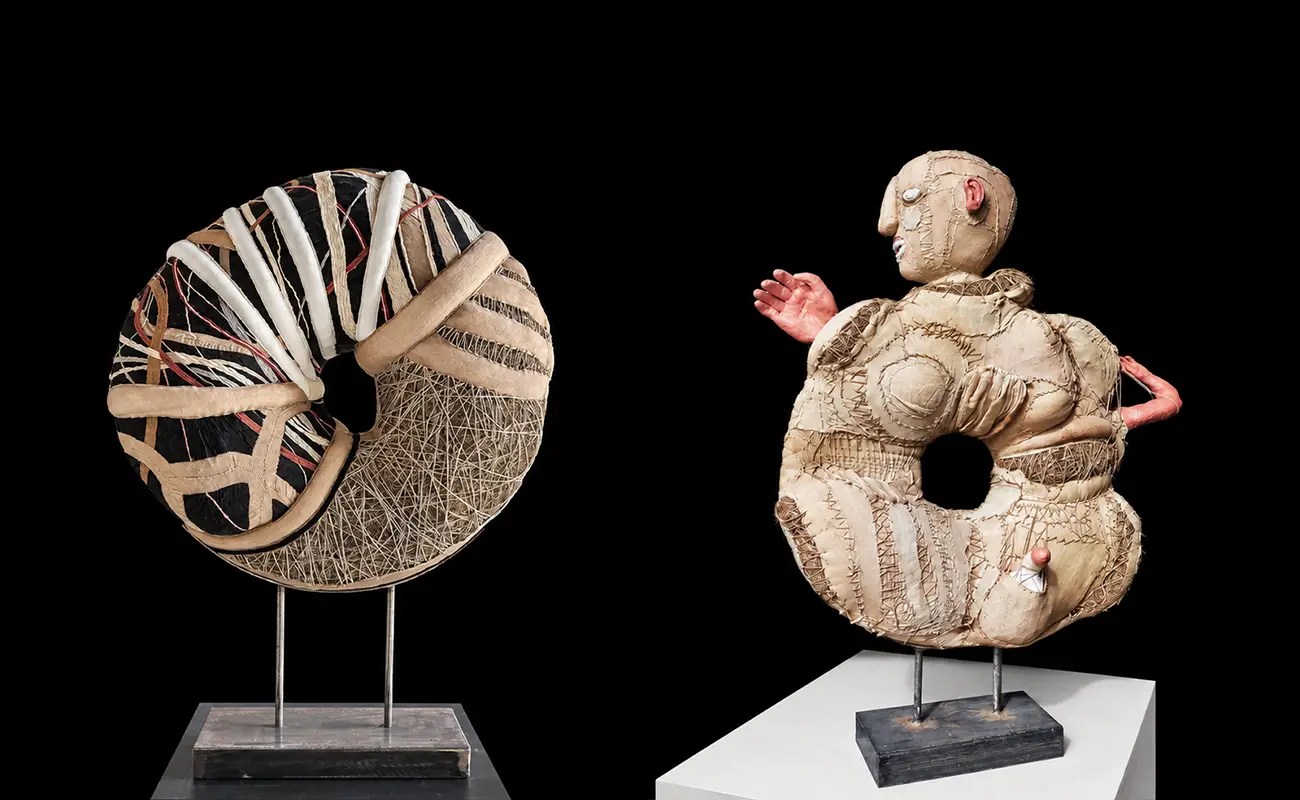
INSIDE XI – Elogio della complessità (In Praise of Complexity), created in 2021, brings many strands of her research into one concentrated structure. The sculpture is organized by circular movement. Lines and volumes develop within this rotation, establishing a rhythm that suggests growth, dissolution, transformation and renewed formation. There is no obvious beginning or terminal point. Instead, the work is governed by continuous circulation, making complexity something experienced through the construction itself. Its coherence depends on multiple forces acting at once.
Its materials make that complexity visible. Modelled canvas produces rib-like reliefs, embroidery marks pathways, cords define and restrain volumes, and plant fiber gives density to the structure. Only one side of the work, contained by a weave of lines-cords, marks a pause in this infinite rotation. It is the part that is undergoing decay; the matter that is disintegrating and losing its form: a pause before being once again drawn into that complex and intricate vortex.
The work also demonstrates how closely meaning is linked to making. Complexity emerges through the interaction of materials, tensions and gestures. The circular configuration allows opposing conditions to exist together: containment and release, construction and breakdown, continuity and interruption. Her long engagement with the body remains present, but the sculpture does not describe literal anatomy. In INSIDE XI, the body is not represented but evoked through tensions, pressures and movements that refer to the continuous transformation of living matter.

Patrizia Trevisi: Nature at the Point of Mutation
The artist begins each sculpture with a vision, sometimes sharply defined and sometimes still uncertain. A project gives that vision structure by establishing volumes and their relationship with space, but during the making process the material itself may suggest directions that modify the project. Canvas responds to stretching, padding, modelling and sewing in ways that cannot be fully predicted. A fold may appear under tension, a seam may redirect the eye, or padding may shift a volume. She does not automatically correct these developments. She observes them and, when they reveal a compelling possibility, incorporates them. Her method depends on this exchange between the initial intention and what the material reveals during the act of making.
That exchange now informs DE REBUS NATURAE, a cycle developed in relation to the Anthropocene. Patrizia Trevisi considers nature at an unstable moment when an earlier condition has disappeared but a new one has not yet settled into recognizable form. Plastic joins canvas, plant fiber, roots, ropes and vegetal remnants, introducing an artificial substance now pervasive in contemporary environments. In Mutans Mater, organic and artificial elements contaminate one another until they form a hybrid body. Muta Mater returns to the Great Mother, now carrying the desiccation of the earth. Ecocidio (Ecocide) uses plastic as a shroud, shifting metamorphosis toward accusation and environmental damage.
The Great Mother is no longer only a generative archetype but also a figure carrying the pressures imposed by humans on the natural world. Her earlier equivalence between body and landscape gains urgency because damage to the earth is understood as damage inflicted on the same living matter. The artist does not use these works to predict a future state. She remains focused on the unstable interval where forms are dissolving and unnamed ones are beginning to appear. This threshold, filled with remnants, mutations and unresolved possibilities, currently drives her sculptural research.