“For me, this painting represents courage, transformation, commitment, and the moment when you decide to trust yourself and move forward into the unknown.”
Choosing Art Without a Map
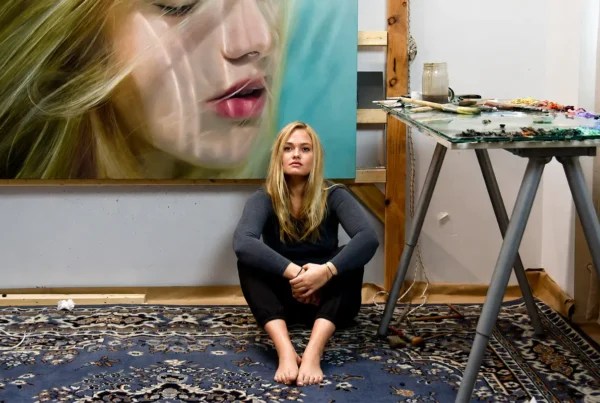
Constantina Seracin’s practice began with a decisive change rather than a conventional art-school trajectory. A self-taught painter, she left a managerial career in the supermarket industry to commit herself fully to art. The move exchanged professional security and structure for a creative life built through curiosity, experimentation, and personal conviction. That shift remains central to the way she understands her work. Painting is not simply a new occupation for Seracin, but the result of choosing a path that felt more aligned with who she wanted to become.
Her earlier career still informs the discipline behind that choice. Management taught her leadership, organisation, responsibility, problem-solving, and the demands of working closely with people. Although these skills developed far from a studio, they became part of the foundation she carried into her artistic life. The contrast is significant: she moved from an environment governed by established systems and operational demands into a practice where intuition often determines what happens next. The change did not erase her previous experience. Instead, it gave her a practical understanding of commitment alongside a growing willingness to trust uncertainty.
Without formal artistic training, Seracin developed by testing ideas and learning through the act of making. She describes self-teaching as a process that encouraged her to trust her instincts, accept challenges, and search for a creative voice on her own terms. Her background also sharpened the personal meaning of perseverance. Leaving a secure position required her to act on a long-standing connection to art, and that decision continues to shape the values behind her paintings: courage, transformation, self-belief, and the possibility of changing direction when an established life no longer feels authentic.

Constantina Seracin: Painting From Inner Images
Seracin does not always approach the canvas with a fixed composition or a fully formed concept. Her process is intuitive, and Trataka meditation plays an important role in creating the mental conditions from which images can emerge. She uses the practice to quiet her mind and become more receptive to intuition. At times, vivid images or visions appear during or after meditation, giving her a starting point for a painting. Rather than forcing a predetermined outcome, she allows these impressions to develop into visual material.
That receptive state also extends beyond meditation. During ordinary conversations, Seracin sometimes begins to visualise scenes or possible future situations connected to the subject being discussed. She does not claim certainty about where these images originate. What matters to her practice is the decision to notice them, trust their presence, and investigate them through painting. This method gives her work a speculative quality, allowing an internal image to become a way of thinking about events, behaviours, or futures that may not yet be fully understood.
For Seracin, style is therefore less a fixed visual formula than a consistent way of working. Her paintings begin with an openness to images and ideas that surface through intuition, then become vehicles for examining possible realities. The process keeps personal perception closely tied to broader questions, especially those involving change. Instead of defining herself through a rigid set of formal rules, she locates continuity in the act of translation itself: an image arrives internally, she follows it, and painting becomes the means through which that image can be tested, developed, and made visible.

Technology, Behaviour, and an Unfinished Future
Artificial intelligence has become one of Seracin’s central subjects because she sees the technology as inseparable from questions about human life. She is interested not only in AI as a technical development, but in what its expansion may mean for emotion, identity, connection, and relationships. The evolving bond between people and technology gives her a subject that refuses to stand still. Each new development or conversation can shift the questions, which makes the theme particularly suited to her intuitive and future-oriented way of working.
Her attention to technology sits alongside an interest in human behaviour. Social media, especially the ways people present themselves and interact with one another, offers another lens through which she considers identity and connection. These concerns meet themes of self-development and personal transformation, linking public behaviour with inner change. Seracin’s paintings use these subjects to explore how people understand themselves while the conditions around them continue to evolve. The future in her work is therefore not treated as an abstract destination. It is approached through choices, relationships, habits, and images that are already forming in the present.
This focus has led to an ongoing AI series that Seracin does not expect to reach a definitive endpoint. For her, the lack of closure reflects the subject itself. Artificial intelligence continues to change, and so does the way people respond to it. New developments give her new material, while her own intuitive process generates further visual possibilities. She describes the series as a continuing visual conversation with the future, one shaped both by technological change and by the images that arise within her. Its open structure leaves room for uncertainty rather than pretending that the consequences of AI can already be settled.

Constantina Seracin: The Point of No Return
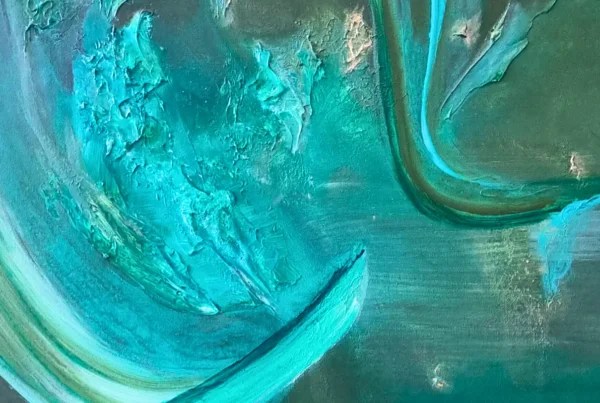
One painting gives Seracin’s philosophy of commitment a particularly personal form. “Burn All the Boats,” from her Inner Alchemy series, is an acrylic on canvas work rooted in the decision to leave her managerial job and become an artist. Its title draws on the story of a conqueror who arrives in a new land with his soldiers and orders their boats burned, removing the possibility of retreat. Seracin connected that image of irreversible commitment to the moment when she chose art over the security of her former career.
The metaphor became powerful because it described the psychological condition she believed the transition required. Keeping one foot in her old life, or continually looking back toward the security she had left, would make it harder to commit fully to the direction she wanted. In the painting, burning the boats stands for more than risk. It represents the deliberate refusal to preserve an easy route backward. Seracin associates the work with courage, transformation, commitment, and the decision to trust oneself while moving into circumstances that cannot be completely predicted.
“Burn All the Boats” also connects the artist’s biography to the broader concerns that recur throughout her practice. Personal transformation is not treated as a vague aspiration but as an action with consequences. The painting records the emotional turning point when Seracin began creating a new life around art, while her current work continues to look toward other forms of change that are still unfolding. Her daily process remains open and intuitive, but the commitment behind it is firm: she follows the images that come, tests them through painting, and keeps building a practice around questions that do not yet have final answers.