Where Bodies Become Fluid
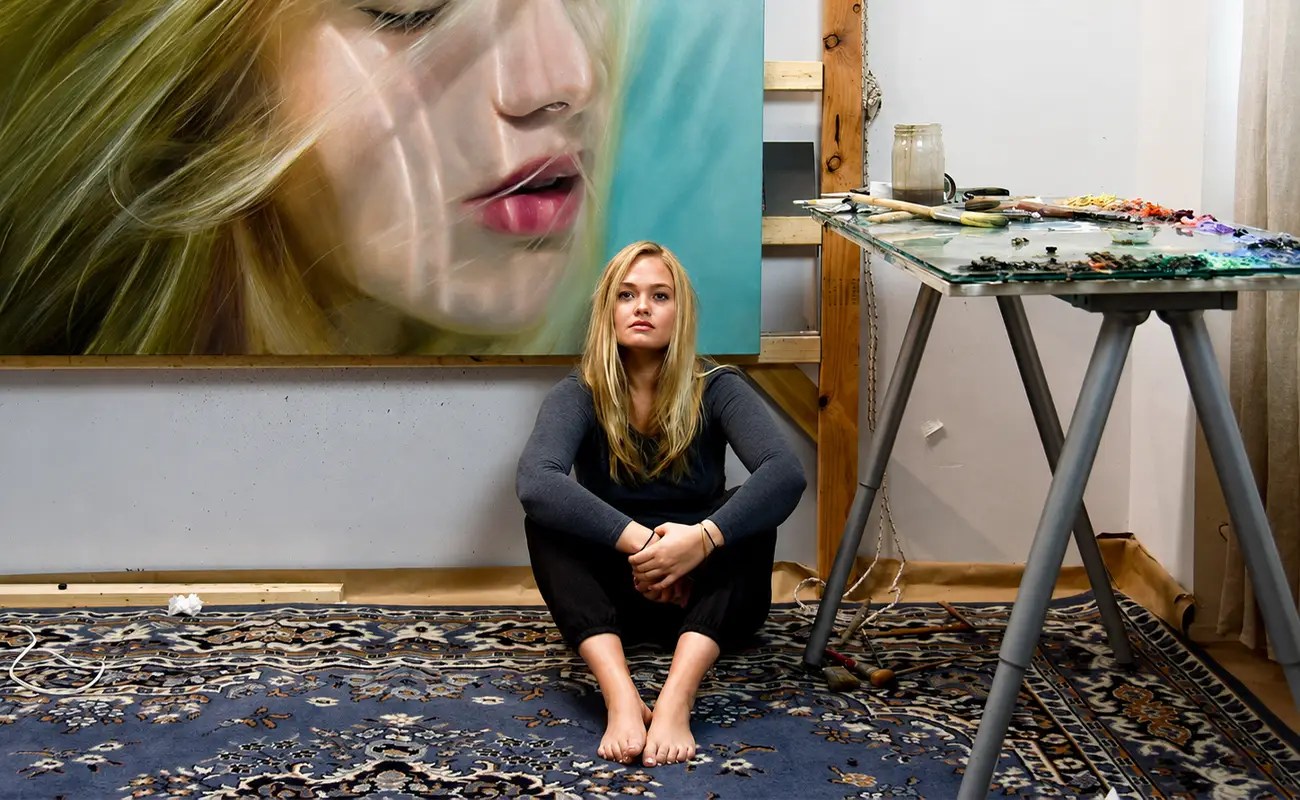
Reisha Perlmutter builds paintings around an experience that is at once ordinary and transformative: entering water and watching familiar forms change. Bodies bend through refraction, sunlight splinters across skin, and stable outlines become difficult to trust. Born in Naples, Florida, in 1990, the American contemporary painter grew up near the Gulf, where observing sunlight underwater helped shape her sensitivity to the shifting relationship between figure, light, and landscape. That early fascination has developed into a practice concerned with perception, memory, identity, femininity, and the ecological systems that connect human life to the natural environment.
Water carries much of this inquiry, but Perlmutter does not treat it simply as scenery surrounding a figure. It acts upon everything within the image. Reflections alter bodies, currents disturb their contours, and illumination creates moments of extraordinary clarity beside passages that seem to disappear. Her figures swim, float, dive, or remain suspended beneath the surface, inhabiting a physical space in which visual certainty is temporary. The resulting paintings make separation difficult: skin can become reflection, landscape can become color, and light can interrupt the recognizable structure of a body.
This visual instability is grounded in rigorous figurative training. Perlmutter studied painting and Latin American Studies at Bates College before completing a BFA at the School of the Art Institute of Chicago in 2012. She received an MFA from the New York Academy of Art in 2015, while additional study took her to Studio Escalier in Paris and summer residencies at the International School of Drawing, Painting, and Sculpture in Umbria. Classical and figurative foundations remain visible in her technical command, yet precision becomes a starting point rather than an endpoint. Realistic representation is continually challenged by atmosphere, movement, transparency, and expressive brushwork.

Reisha Perlmutter: Painting at the Limit of a Breath
Perlmutter’s understanding of underwater space comes from direct physical experience. She is both a freediver and an underwater photographer, roles that make the creation of source imagery an embodied part of her painting process. Following her studies in Chicago, she traveled through parts of Europe, Mexico, and the United States, photographing beneath the surface while freediving. Producing these images requires far more than observing from a distance. She must hold her breath, control a camera, navigate the water, and respond quickly to light and conditions that cannot be fully directed.
Those restrictions are integral to the meaning of the work. A breath provides only a limited window, introducing vulnerability and urgency even when an image appears serene. Underwater, control exists alongside surrender. The body must adapt to an environment that resists complete mastery, while perception itself changes with movement, pressure, reflection, and light. Perlmutter experiences these conditions before translating them into paint, giving the finished compositions a physical foundation in which beauty and difficulty are inseparable.
Her earlier underwater paintings frequently developed through self portraiture. Immersion offered a form of meditation and self examination that reconnected her with childhood memories while producing the curious sensation of being both connected to and detached from herself. The contradictions of freediving became especially productive: peace accompanies physical struggle, stillness contains continual movement, and bodily fragility can coexist with strength. With each descent constrained by the duration of a breath, water became more than an optical device. It provided Perlmutter with a structure through which to consider consciousness, embodiment, and the unstable experience of perceiving oneself.

From Self Portrait to Shared Experience
Eventually, Perlmutter turned her attention toward other people, asking whether sensations initially encountered through self portraiture could move beyond an individual perspective. Painting other subjects broadened her investigation of the body into something at once specific and universal. Personal identity does not disappear from these works, but portraiture is complicated by the surrounding environment. Faces and limbs remain recognizable while water continuously reorganizes their appearance, preventing the figure from becoming a fixed object isolated from its surroundings.
That shift is particularly significant in her depictions of women. Perlmutter frequently paints female figures underwater, often nude, while engaging with cultural ideas surrounding femininity and beauty. Rather than presenting the body against a passive background, she subjects it to the same natural forces that affect every other element in the composition. Light moves across skin, reflections fragment anatomy, and immersion unsettles conventional ways of looking. Her approach allows beauty to remain present without reducing the figure to a decorative or sexualized object.
The tension between exactitude and dissolution gives these paintings much of their visual force. Perlmutter is associated with highly realistic painting, yet photorealistic description alone does not define the work. Detailed areas sit beside looser, more expressive passages; sharply rendered forms can suddenly soften into color or reflected light. Transparency, shadow, landscape, and skin overlap until distinctions become uncertain. Realism therefore serves a perceptual question rather than merely demonstrating technical accuracy. By showing how convincingly observed forms can become unstable, Perlmutter directs attention toward the act of seeing itself and the ease with which apparently reliable appearances can change.

Reisha Perlmutter: Interdependence Beneath the Surface
The merging of body and environment also carries an increasingly ecological dimension. Perlmutter is interested in what people choose to acknowledge or overlook about humanity’s relationship with the destruction of ecosystems on which human survival depends. Her underwater imagery makes interdependence visible in immediate physical terms. A submerged figure cannot behave as though the surrounding environment is irrelevant. Every movement is conditioned by water, every breath is made more precious by its absence, and every visible form is transformed by the medium through which it is seen.
This environmental concern complicates the serenity often associated with her imagery. Water can suggest liberation, meditation, and transcendence, but it is also a vulnerable natural system. The same element that visually connects figure and landscape points toward the material dependence of people on the ecosystems they inhabit. Conservation consequently grows from a principle already embedded in Perlmutter’s compositions: human beings and nature cannot ultimately be separated. Her paintings place beauty and vulnerability together, asking viewers to consider the environment not as a distant subject but as something inseparable from bodily existence.
Perlmutter has extended these ideas into photography and moving image, using film to incorporate sound, movement, breath, duration, and aspects of underwater creation that a static painting cannot fully register. Her work has appeared in the United States and internationally, including presentations at the Naples Art Institute and Sotheby’s New York. In 2023, she collaborated with actress and author Kerry Washington on painted and photographic imagery for the cover of Washington’s memoir Thicker Than Water. Across these contexts, Perlmutter continues to approach art as communication beyond fixed narrative or shared spoken language. Water gives physical form to the contradictions at the center of that pursuit: it conceals and reveals, supports and resists, separates and connects.