“The Everdream is the space between Heaven and Earth, and that space is the human imagination.”
The Childhood Dream That Refused to Disappear
For Michael Moss, becoming an artist was less a career decision than an early recognition of how powerfully imagination could reshape ordinary experience. Drawing and coloring were already his favorite activities as a toddler, but a dream at five years old gave those instincts a deeper meaning. In the dream, his coloring books possessed an extraordinary power. Turning each page revealed images more astonishing than the one before, with heroes, kings, ominous forests, and distant landscapes appearing to come alive. Faced with seemingly endless possibilities, the young Moss could hardly decide where to begin. His box of 64 crayons became more than a childhood possession. It represented access to places that did not yet exist outside his mind. That early encounter with imagined worlds established a principle that would eventually sit at the center of his practice: creativity begins when the mind moves beyond what has already been placed in front of it.
The following morning transformed that dream into something more lasting. Moss rushed to the playroom expecting the coloring books to contain the same astonishing visions he had encountered while sleeping. Instead, he found conventional children’s illustrations waiting to be filled in. The contrast was profound. What had seemed mysterious and almost dangerous in the dream suddenly appeared limited when compared with the images his own mind had produced. Disappointment quickly gave way to a realization that would influence the direction of his life. The pictures within his imagination were more compelling to him than the printed ones on the page. Rather than accepting a predefined image, he wanted to create the image himself. Moss identifies that childhood moment as the point when his identity as an artist became clear, establishing an enduring connection between art and the possibility of seeing beyond what already exists.
That formative experience continues to echo through a practice centered on wonder, fantasy, and the capacity of human beings to envision something before it becomes tangible. Moss describes himself as an artist from birth, and his later development can be understood as an expansion of that first discovery. The impulse that once drew him toward crayons eventually became a disciplined commitment to brushes, canvases, and panels. Yet the essential objective remained remarkably consistent: to make visible what begins internally. Rather than treating imagination as an escape from reality, Moss considers it an active human faculty capable of influencing what comes next. His paintings therefore emerge from a philosophy as much as from technical skill. They invite viewers to reconsider imagination not as something reserved for childhood, but as a vital creative force that adulthood often allows to weaken. His work seeks to reverse that process by restoring curiosity to the center of visual experience.

Michael Moss: Learning to Discover Rather Than Design
The imaginative artists Moss admired while growing up provided both inspiration and an artistic lineage he hoped to extend. Roger Dean, Stanley Mouse, and Maxfield Parrish became especially important influences, and Moss studied reproductions of their work through the books he collected. Their ability to construct distinctive visual worlds demonstrated that fantasy and imagination could sustain serious artistic practices. Moss never felt compelled to reject the traditions that inspired him simply for the sake of novelty. Instead, he wanted to contribute to established forms he genuinely loved and push their possibilities through his own perspective. That intention became particularly significant because two of his childhood influences would later enter his life personally. What began as distant admiration eventually developed into direct exchanges with artists whose work had helped shape his ambitions, allowing inspiration to become mentorship and professional dialogue.
In 2017, Moss was taken to the studio of Stanley Mouse to discuss art. The meeting developed into a friendship, with Mouse offering insights into both Moss’s work and the wider realities of the art business. Particularly meaningful to Moss was the sense that Mouse regarded him as a peer. Recognition from someone he had admired for years strengthened his determination rather than encouraging complacency. He responded by working harder and continuing to test the limits of his abilities. The encounter also marked a shift in his artistic development. The figures he had once encountered primarily through printed reproductions were no longer remote examples of artistic achievement. Their knowledge could now inform his own evolving practice directly. For Moss, this relationship reinforced the idea that artistic growth does not end when technical competence is achieved. Recognition can instead create a new responsibility to deepen the work and pursue more demanding creative questions.
Another decisive change arrived in 2020, when Moss believed his abilities had reached a ceiling and found himself searching for a teacher capable of pushing him further. During the pandemic, Roger Dean accepted ten students from around the world for a seven week course focused on abstract landscape painting. Moss became one of them. Dean recognized that Moss could already compose a competent painting, but proposed a different challenge: learning how to “discover” a painting rather than simply designing one. That distinction opened a new direction for Moss. Instead of approaching every work through predetermined control, he began exploring a process in which a painting could reveal possibilities during its creation. The experience altered his understanding of how images could emerge and expanded the creative vocabulary available to him. Technical command remained important, but it could now coexist with discovery, responsiveness, and the unexpected paths that appear while a work is taking form.

Building The Everdream Between Heaven and Earth
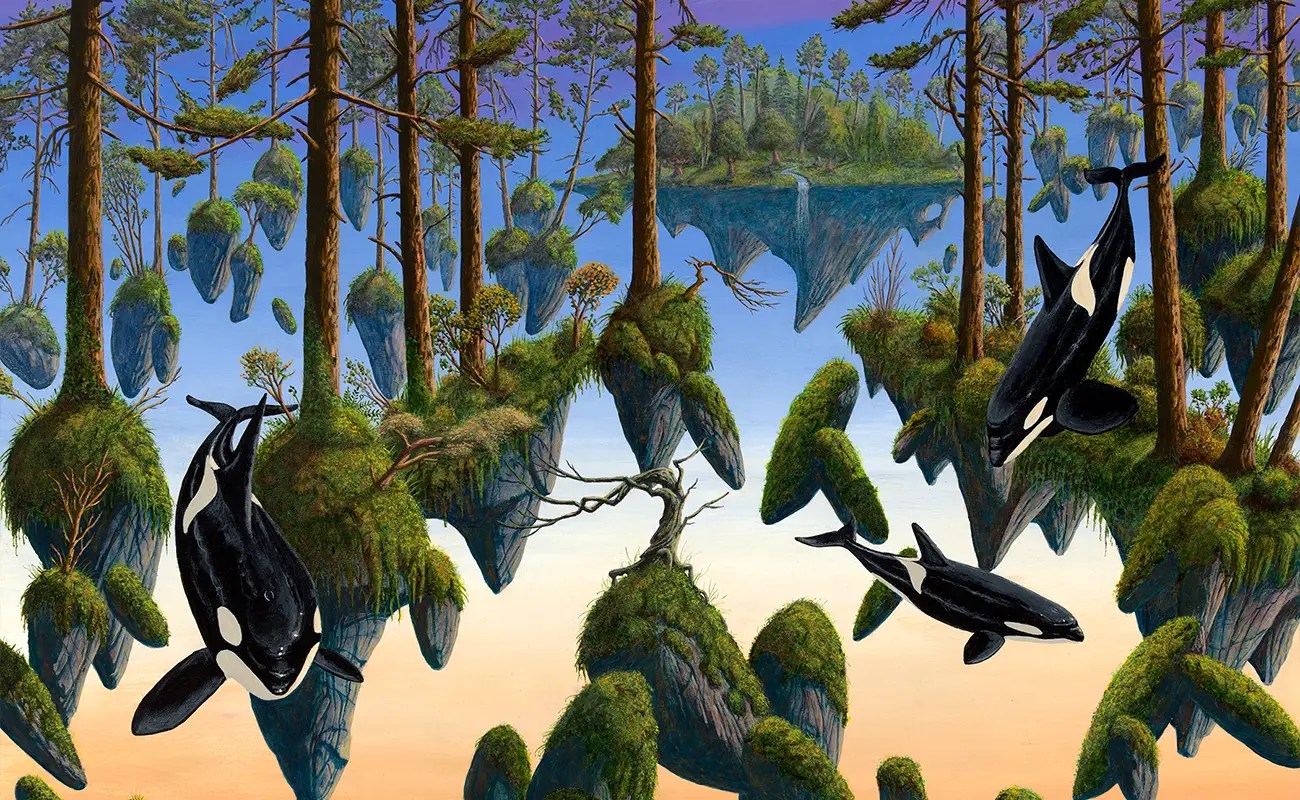
The world that emerged from Moss’s evolving practice has a name: The Everdream. He describes it as the space between Heaven and Earth, identifying that space with the human imagination itself. This concept provides the philosophical foundation for his paintings and connects their dreamlike imagery to a broader argument about creativity. Moss considers imagination the most powerful of human faculties because it can reach beyond information delivered by the five senses. Sensory experience may tell a person what has already happened, while imagination can propose what might happen next. Everything people create, in his view, begins first as an internal possibility. The Everdream gives visual form to this conviction. Rather than presenting fantasy solely as spectacle, Moss uses invented landscapes and imaginative imagery to encourage viewers to recognize the generative ability of their own minds. His paintings become invitations into one person’s vision while pointing toward a creative capacity he believes belongs to everyone.
That invitation has acquired greater urgency for Moss in contemporary life. He believes many adults have neglected their imaginative capacities because modern routines leave too little space for sustained creative exploration. He is also concerned about the degree to which computer graphics and artificial intelligence can substitute ready made imagery for the act of imagining independently. His response is rooted in the physical act of painting. Moss works with a brush on canvas or panel, producing dreamscapes through direct human effort rather than digital processes. His technique can become so precise and technically controlled that viewers sometimes assume computers must have played a role, an interpretation he explicitly rejects. For him, the absence of digital intervention is not merely a technical fact. It supports his wider belief that extraordinary results remain possible when people dedicate themselves fully to an idea and cultivate their abilities through persistent work.
The visual character of The Everdream is closely connected to art Moss encountered during childhood, particularly fantasy imagery and album cover design associated with the 1970s. He has developed multiple approaches informed by that period and continues to value them rather than seeking novelty simply for its own sake. His ambition is not to invent an entirely new artistic form, but to expand forms that already hold meaning for him. This position gives his work an unusual relationship with influence. Historical inspiration is not something to disguise or abandon, but a foundation that can be carried into new paintings through individual experience and sustained experimentation. The landscapes and visions of The Everdream consequently sit between memory and possibility. They recall visual languages that shaped Moss while also serving his present objective: encouraging people to pick up a brush, exercise their own creativity, and recognize imagination as something that can be strengthened through active use.

Michael Moss: Turning Creative Conviction Into Momentum
The years following Moss’s studies with Roger Dean brought substantial professional momentum. Moss reports selling more than 100 paintings over a three year period while rapidly establishing himself within the San Francisco gallery scene. In 2025, he secured his first gallery position in San Francisco. Less than a year later, he was invited to join Modern Eden Gallery, which he identifies as one of the leading surrealist galleries in the United States. The progression reflects the growing visibility of a practice shaped by years of technical development, artistic influence, and an increasingly defined philosophy. Moss’s commitment is also intensely physical. When circumstances allow, he prefers to paint for nine hours a day, an approach that helps explain the precision viewers encounter in his surfaces. The demanding schedule connects directly to his belief that creative potential becomes meaningful through dedication. Imagination may supply the starting point, but sustained labor allows an imagined world to acquire visible form.
His gallery trajectory expanded again shortly before his exhibition with Modern Eden. Moss was offered long term representation by Dacia Gallery in New York City’s East Village. His first exhibition there is scheduled as a full gallery solo presentation running from August 23 through August 30, 2026. According to Moss, the gallery intends to introduce his work to leading buyers over the following years through recurring solo and group exhibitions. The New York opportunity represents another stage in a career that has accelerated significantly, yet it remains connected to the same imaginative foundations established in childhood. The boy who once opened a coloring book hoping to encounter impossible worlds now constructs those worlds through his own hand and presents them within major art markets. Rather than allowing professional progress to replace his original motivations, Moss frames each development as another opportunity to bring The Everdream before a wider audience.
Looking beyond New York, Moss and his team are interested in bringing his work to additional major markets, with particular attention directed toward Asia and Japan. His interest grows from what he describes as a strong respect for and affinity with Asian art and culture, alongside a desire to share his vision with audiences there. Wherever the work travels, its central proposition remains consistent. Moss wants viewers to recover a sense of wonder and then turn that feeling inward, using his imagination as an invitation to explore their own. The goal is not passive admiration but renewed creative awareness. From a childhood dream to encounters with Stanley Mouse and Roger Dean, from San Francisco galleries to a New York solo exhibition, Moss has built his practice around the belief that human creativity can accomplish remarkable things when imagination and commitment reinforce one another. The Everdream ultimately asks viewers to consider what might become possible once imagination is treated not as an indulgence, but as a faculty worth developing.
With great joy today AATONAU was ranked among the top three art blogs worldwide by the highly respected Top Art Blogs, a ranking site that uses data-driven research and objective metrics to evaluate leading art publications.