A City of Illusion and the Making of a Singular Vision
Alex Prager has established a distinctive place in contemporary art by creating photographic and cinematic works that blur the distinction between reality and fabrication. Working from Los Angeles as an artist, photographer, filmmaker, director, and screenwriter, she produces elaborate visual narratives that appear to capture fleeting moments from films that never existed. Every composition is carefully orchestrated, yet the emotional atmosphere remains intriguingly uncertain, inviting viewers to question what they are witnessing. Rather than documenting everyday life, Prager transforms familiar environments into psychologically charged stages where beauty, anxiety, isolation, longing, and anticipation exist simultaneously. This unique approach has earned widespread recognition, including participation in the Museum of Modern Art’s influential New Photography 2010 exhibition and inclusion among the “25 New Faces of Independent Film” in 2023. Throughout her career, she has continued to investigate the complexities of human behavior by presenting theatrical scenes that encourage audiences to become active participants in constructing meaning. Her photographs and films challenge conventional storytelling while revealing how easily appearances shape perception.
Born on November 1, 1979, in Los Feliz, Los Angeles, Prager followed an unconventional route into the arts. She left school at the age of fourteen and traveled independently to Switzerland, where she worked in a knife shop in Lucerne before eventually earning her GED at sixteen. These formative experiences fostered an independent mindset that later defined her creative practice. A decisive turning point arrived when she encountered William Eggleston’s photographs at the Getty Museum while living in Los Angeles in her early twenties. The exhibition transformed her understanding of photography and inspired her to dedicate herself entirely to the medium. Rejecting formal academic training, she purchased a Nikon N90s camera and learned through experimentation, printing her photographs in a home darkroom. This self-directed education encouraged her to trust personal instinct over established conventions, allowing her to develop a visual language rooted in imagination rather than documentary observation. That commitment to independence continues to shape every stage of her artistic process.
Los Angeles occupies a central place within Prager’s work, functioning as far more than a recognizable backdrop. The city becomes a symbolic environment where glamour, aspiration, performance, and quiet unease intersect. Drawing inspiration from Hollywood history, popular culture, mythology, fashion photography, Technicolor cinema, and film noir, she transforms familiar urban spaces into dreamlike environments filled with emotional tension. Influences associated with directors such as Alfred Hitchcock, David Lynch, and Douglas Sirk, alongside photographers including Cindy Sherman and Gregory Crewdson, contribute to the atmosphere of suspense without reducing her work to homage. Instead, these references become part of an original visual vocabulary that examines how identity is constructed through appearance, costume, gesture, and performance. Los Angeles, with its reputation for reinvention and illusion, becomes the ideal setting for exploring the fragile boundary between authenticity and fiction, a recurring concern that remains at the heart of her artistic practice.

Alex Prager: Building Entire Worlds One Carefully Composed Frame at a Time
Prager approaches photography with the discipline and ambition of large-scale filmmaking. Every production involves extensive planning that includes storyboards, elaborate costumes, carefully designed sets, makeup, props, lighting, and sizeable crews. Although each element is thoughtfully prepared, she intentionally leaves room for spontaneous moments to emerge within this highly structured environment. Her commitment to practical production techniques remains fundamental to her philosophy. Rather than relying on digital manipulation, she insists that everything visible within the frame physically exists before the camera. She has explained that it is important to her that viewers could theoretically touch everything they see. This emphasis on tangible construction lends remarkable credibility to scenes that are otherwise unmistakably theatrical. The resulting images occupy a fascinating middle ground where obvious artifice enhances, rather than diminishes, emotional authenticity. By embracing physical craftsmanship, Prager creates photographs that feel simultaneously timeless, cinematic, and psychologically immediate.
Costume and character development play equally significant roles within her storytelling. Drawing from an extensive personal wardrobe collection, Prager creates figures whose clothing communicates social identity, emotional condition, and narrative possibility before a single expression is interpreted. Her protagonists frequently appear as glamorous women, anonymous commuters, workers, travelers, performers, or spectators, each positioned at the threshold of an event that remains unresolved. These carefully styled individuals function as recognizable archetypes while retaining hints of deeply personal interior lives. Rather than providing complete stories, Prager presents fragments that encourage viewers to imagine what has happened or what may occur next. This deliberate ambiguity gives her photographs remarkable emotional depth, allowing beauty, tension, humor, melancholy, and uncertainty to coexist naturally within the same image. Her visual language demonstrates how appearance can become both a storytelling device and a reflection of psychological complexity.
Throughout her career, Prager has consistently expanded the relationship between still photography and moving image. Early photographic series such as Polyester, The Big Valley, and Week-End introduced many of the qualities that would become synonymous with her practice, including saturated colors, timeless styling, dramatic compositions, and unresolved narratives. Her transition into filmmaking developed these ideas further rather than replacing photography. Her first short film, Despair, starring Bryce Dallas Howard, was exhibited alongside her photographs in MoMA’s New Photography 2010, demonstrating how seamlessly the two mediums complement one another. Prager has often described photography as preserving a suspended instant, while film allows emotional progression through time. Maintaining an active dialogue between these forms enables her to explore different dimensions of storytelling while preserving the distinctive visual identity that defines her practice across both photography and cinema.

Crowds, Performance, and the Emotional Weight of Looking
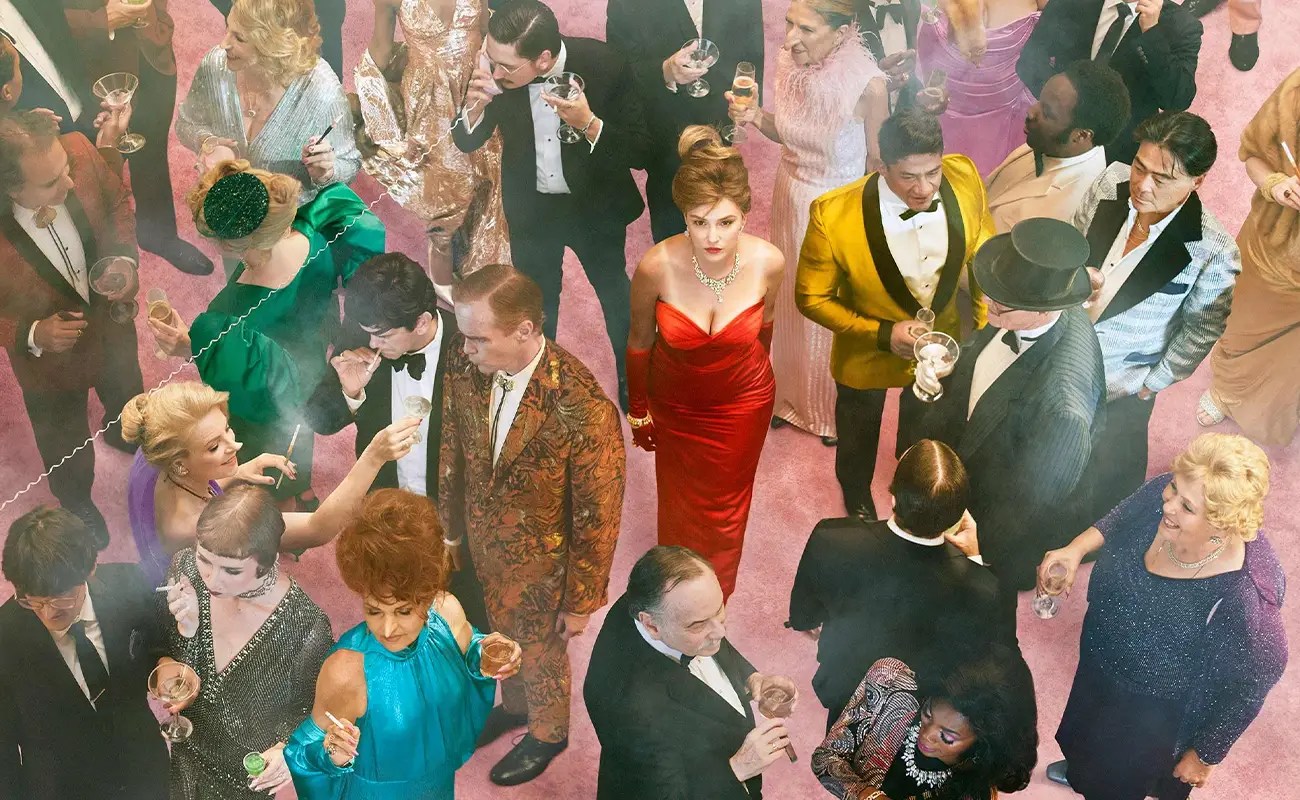
One of the most significant developments in Prager’s artistic evolution came through her exploration of crowds as expressive subjects. While earlier works often focused on isolated protagonists, later projects shifted attention toward densely populated scenes where countless individuals occupy the same physical space while remaining emotionally disconnected. These carefully choreographed compositions transform ordinary gatherings into powerful reflections on community, loneliness, and shared vulnerability. Each extra receives thoughtful direction regarding costume, posture, and emotional presence, emphasizing that every participant contributes meaningfully to the larger composition. Rather than presenting anonymous masses, Prager reveals collective life as an intricate balance between individuality and belonging. Her crowd scenes suggest that the fear of disappearing within society can exist alongside the comfort of shared human experience. Through these monumental arrangements, she encourages viewers to consider how identity changes when people become part of something larger than themselves.
This investigation reached an important milestone with Face in the Crowd, first presented at the Corcoran Gallery of Art in Washington, D.C. The accompanying film installation, featuring Elizabeth Banks, expanded these themes by examining spectatorship and the complex exchange between observing others and being observed. Throughout the project, Prager questioned how people construct narratives based solely on appearances, encouraging audiences to recognize their own role in assigning meaning. Her work highlights the psychological labor involved in everyday performance, suggesting that expressions, gestures, clothing, and social behavior often become carefully managed presentations of identity. Connections have been drawn between these studies of collective life and historical photographic projects such as August Sander’s Face of Our Time and Irving Penn’s Small Trades, both of which documented ordinary people through visual typologies. Prager extends this conversation into the contemporary world by examining class, occupation, privilege, gender, and belonging through highly theatrical yet emotionally resonant imagery.
The act of looking itself remains one of Prager’s central artistic concerns. Her photographs intentionally invite interpretation while refusing definitive answers, encouraging viewers to confront their own assumptions about strangers. Glamour becomes inseparable from voyeurism, nostalgia intersects with uncertainty, and beauty frequently carries an undercurrent of danger. Humor and discomfort coexist within scenes that appear polished yet emotionally unstable. Through symbolism, allegory, conceptual strategies, and occasional surreal touches, Prager explores universal questions surrounding identity, fear, desire, and human connection. She has explained that each project reflects both her personal questions and broader concerns shared across society. This openness prevents her work from functioning as straightforward narrative, instead transforming every image into an invitation for reflection. Viewers become collaborators, completing stories that remain intentionally unfinished while discovering how perception itself shapes emotional reality.

Alex Prager: Expanding the Language of Contemporary Photography and Film
Prager’s artistic investigations have continued through an impressive succession of photographic series and films that broaden her recurring themes without abandoning her signature visual language. Compulsion examined catastrophe and the shifting perspectives through which dramatic events acquire meaning. La Petite Mort considered mortality within an imaginative parallel universe where tragedy and unexpected lightness coexist. La Grande Sortie, produced in collaboration with the Paris Opera, explored the relationship between performers and audiences, examining how spectacle depends upon mutual observation. Returning to her lifelong connection with Los Angeles, Play the Wind became a deeply personal reflection on the city that has consistently inspired her imagination. Subsequent projects including Part One: The Mountain and Run continued her investigation into fear, uncertainty, and psychological pressure through fictional narratives filled with symbolic resonance. Her feature-length work DreamQuil extended these concerns into questions surrounding automation, identity, and what fundamentally defines human existence within an increasingly technological future.
Recognition from leading cultural institutions has accompanied the steady evolution of Prager’s career. Beyond the breakthrough presentation of her work at the Museum of Modern Art, she has exhibited internationally at venues including the National Gallery of Victoria, the Los Angeles County Museum of Art, and numerous other respected institutions. Her major mid-career survey, Alex Prager: Silver Lake Drive, traveled to The Photographers’ Gallery, the Museum of Fine Arts Le Locle, Foam Fotografiemuseum Amsterdam, Fotografiska, and additional international venues, offering audiences a comprehensive view of her creative development across photography and film. She has also received notable honors including the Foam Paul Huf Award and a News and Documentary Emmy Award for Touch of Evil. These achievements reflect not only institutional recognition but also the growing influence of her distinctive approach within contemporary visual culture.
What ultimately distinguishes Alex Prager is her ability to use carefully constructed fiction to illuminate genuine emotional experience. Her photographs and films openly embrace theatricality while revealing truths about loneliness, performance, memory, spectatorship, vulnerability, and the fragile connections that bind people together. Every gesture, expression, costume, color palette, and carefully positioned figure contributes to scenes that resist easy explanation while remaining immediately recognizable on an emotional level. Rather than offering fixed interpretations, Prager creates suspended moments that encourage prolonged engagement and personal reflection. Her work demonstrates that artifice does not conceal reality but can instead expose dimensions of human experience that documentary approaches may overlook. By combining the visual language of cinema with the precision of staged photography, she has created a body of work that continues to reshape conversations about perception, identity, and the emotional possibilities of contemporary image making.