Where Morning Light Meets the News
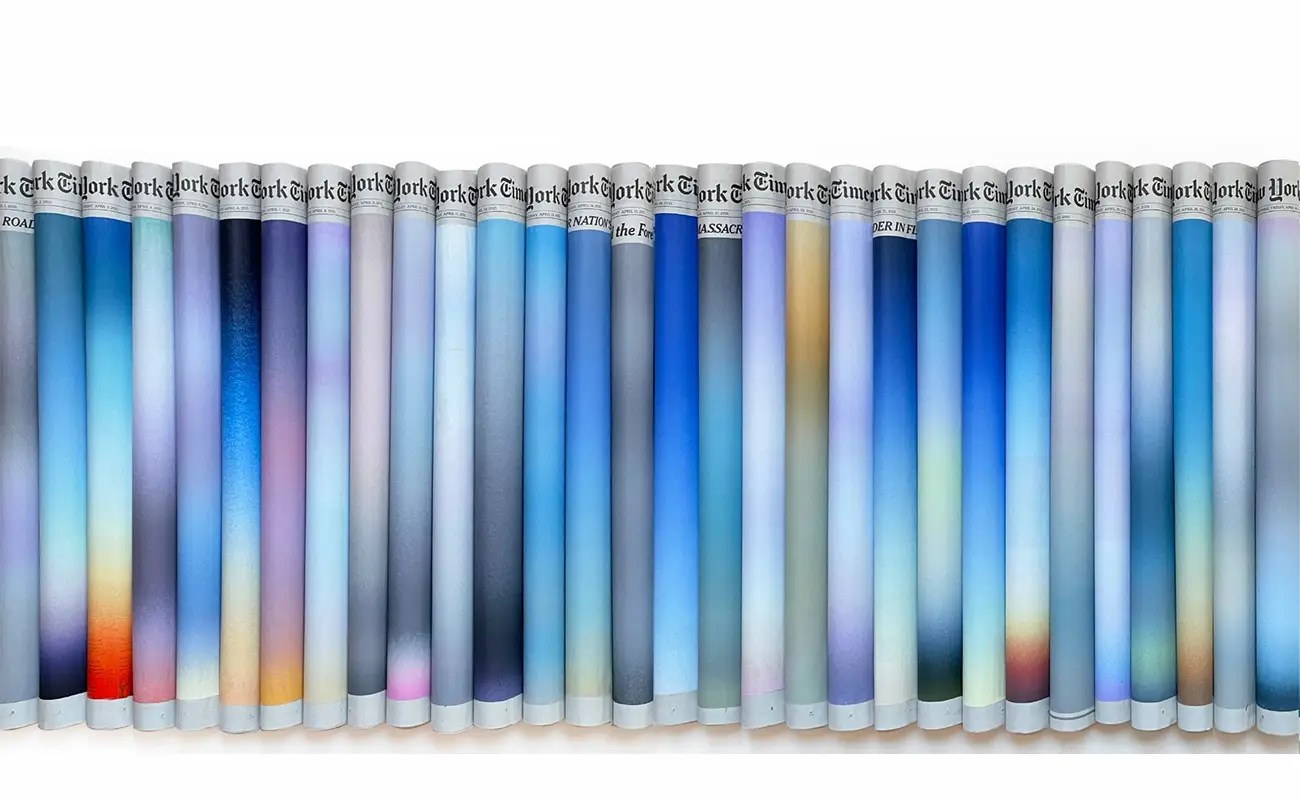
Sho Shibuya has built an artistic practice around a deceptively ordinary encounter: looking at the sky, reading the newspaper, and registering what it means to inhabit both realities at once. The Japanese artist, born in Fukuoka in 1984, raised in Chiba, and now based in Brooklyn, transforms daily newspapers into paintings that measure passing time through color, information, and repetition. His continuing Sunrise from a Small Window series places the serenity of morning light alongside reports of political upheaval, violence, environmental disaster, death, and cultural change. Each work belongs to a particular day, yet its significance grows through its relationship with all the days surrounding it.
Before painting became central to his life, Shibuya studied architecture and moved into graphic design, eventually developing a career in editorial design and art direction. After relocating to New York in 2011, he worked independently and became an art director at Away before founding the creative agency Placeholder in 2018. That design background remains visible in his paintings. He favors economy and immediate communication, seeking images that can transmit an idea with something of the directness of a billboard. Complex events are often distilled into a color, shape, cut, or physical alteration rather than explained through extensive text.
Shibuya began painting in 2016 without formal training. Watching lettering artists paint personalized initials onto luggage sparked his interest in applying paint by hand, while a visit to Dia Beacon introduced him to On Kawara’s date paintings. Kawara’s use of newspapers alongside works marking individual dates revealed how repetition and commonplace records could acquire greater significance through accumulation. Shibuya initially experimented with painted katakana, including a character derived from his own name, exploring the point at which writing could become an image. Small paintings made after work and during travel gradually established a routine in which rules provided continuity while leaving room for variation.

Sho Shibuya: A Small Window Onto an Unstable World
The structure that would define Shibuya’s practice emerged during New York’s COVID-19 lockdown in 2020. Restless in isolation, he noticed a striking contradiction outside his apartment. The morning sky remained calm and luminous while the city below had fallen unusually quiet. Inside, The New York Times delivered a daily succession of alarming reports about illness, deaths, protests, politics, and uncertainty. A growing stack of newspapers in his studio seemed to compress those days into a physical object. Shibuya began painting the colors of each sunrise directly onto the day’s front page, turning the newspaper into both surface and temporal marker.
The format proved unusually suited to the idea. Shibuya compared the newspaper’s proportions to a small New York apartment window, while its publication cycle supplied a ready-made measure of time. Acrylic became his primary painting material, but the stable format eventually allowed him to introduce tape, cut paper, found objects, and three-dimensional techniques connected to his experience with origami. The newspaper stays recognizable even as its surface changes. This consistency gives Shibuya freedom to experiment without losing the visual continuity that binds thousands of individual observations into an expanding archive.
A critical shift came on May 24, 2020, when The New York Times filled its front page with the names of people in the United States who had died from COVID-19. Shibuya felt uncomfortable covering those names, even partially. A gesture intended to place an image of hope over distressing news suddenly risked obscuring the people being remembered. The dilemma changed his understanding of the project. The newspaper could not simply function as a disposable background. Its information carried its own weight, requiring the painted intervention to acknowledge rather than indiscriminately erase what was already there.

When Routine Learns to Break Its Own Rules
The sunrise gradually became one possibility among several. Following the killing of George Floyd in 2020 and amid the Black Lives Matter protests, Shibuya departed from his established imagery and painted a front page black. The decision opened the project toward a broader engagement with current events. Political developments, acts of violence, environmental disasters, deaths, cultural events, and unexpectedly hopeful stories could now interrupt the morning ritual. Shibuya does not claim to produce an objective historical record. He reads the news and responds to what affects him, allowing personal emotion to determine which public events enter the work.
That method extends into his related Events works, where individual news stories become graphic or physical interventions on the day’s newspaper. Some papers have been punctured with holes in response to deaths caused by gunfire; elsewhere, fragments cut from newspaper paintings have been reused in new compositions. Such gestures preserve the conceptual versatility of the material. A newspaper can simultaneously be an image-bearing surface, evidence of a historical moment, a standardized unit of time, and an object capable of being cut, folded, painted, or otherwise transformed.
Shibuya’s design experience is especially apparent in this compression of complicated subjects into concise visual decisions. He wants an idea to register without depending upon a caption, but immediate legibility does not make the work simplistic. The remaining headlines, photographs, columns, and traces of print continue to communicate beneath or around his interventions. Meaning develops through the friction between those public records and Shibuya’s private response. Calm and disturbance can occupy the same sheet of paper, just as the beautiful sky outside his window could coexist with frightening news inside his home.

Sho Shibuya: Continuing as an Artistic Method
Repetition is more than a working habit for Shibuya. It is one of his central materials. His routine begins with observing and photographing the morning sky, then reading the news and obtaining a physical newspaper. He maintains the practice while traveling, carrying the necessary materials so that changes in place do not sever its continuity. Each painting records a discrete present, but the larger work depends upon duration. Colors shift from morning to morning, headlines recede into history, paper ages, and individual decisions accumulate into a visual record whose meaning could not exist through a single painting alone.
This structure has also allowed Shibuya to reconsider place. For Fifty Sky Views of Japan, he traveled through all 47 Japanese prefectures over 35 days, painting skies onto regional newspapers. Rather than discarding the rules developed in Brooklyn, he transported them across the country where he was born. Local newspapers and changing skies allowed the familiar framework to register geographic movement alongside passing days. The project demonstrates how restriction operates productively in his practice: maintaining a stable system makes differences in location, light, printed information, and personal perception more visible.
The material itself contains a reminder that no routine lasts forever. Shibuya recognizes that printed daily newspapers may disappear, meaning the apparently repeatable foundation of his work belongs to a finite historical period. His paintings, exhibited at institutions and venues including the Tokyo National Museum, Triennale Milano, Unit London, and Art Basel Miami Beach in collaboration with Saint Laurent, have also entered collections including the Fondation Cartier pour l’Art Contemporain, the 9/11 Memorial & Museum, and DIB Bangkok Museum. Yet the practice remains anchored in a modest daily action. Shibuya continues to face today’s newspaper and today’s sky, using repetition to hold private attention and public history together while the present becomes the past.