“Design is not about fully explaining a world, but about preparing it with enough care to know when to let go.”
Clothing as a Living Archive
Gin Yung-Hsin Ko approaches costume as something far more active than an image placed on a performer. Working between Taipei and the United States, she moves across costume design, theatre, and interdisciplinary practice, treating clothing as a meeting point for body, movement, space, society, and environment. Her path into clothing began through theatre rather than fashion alone, and that foundation remains central to her work. A garment, in her view, can register class, labor, place, family, and history before a character speaks. It can also change through use, accumulating wrinkles, tension, wear, and traces of the body that complicate the designer’s original intention.
Growing up in Taiwan and developing her practice in the United States sharpened Ko’s awareness of cultural memory and the instability of visual symbols. Moving between contexts showed her that familiar objects can change meaning with distance, while representation can flatten histories when cultural references are treated as fixed signs. Rather than erasing those gaps, she is interested in acknowledging them. That concern became especially personal in Unfinished Island Songs, a dance theatre work she co-produced and designed around layered experiences of Taiwanese immigrants. The project was later featured by the Chicago Reader as part of its AAPI Heritage Month coverage.
Ko’s decision to pursue theatre also marked an early break with expectation. She grew up in a family without an arts background and found herself questioning why a life should follow paths that appeared predetermined. Insisting on studying theatre became, for her, more than a professional choice. It was a decision about how to see the world. Her thinking still returns to a line from the Tao Te Ching, “the shape of the shapeless, the image of the imageless.” That openness informs her understanding of design: a work does not have to explain everything, and its force may lie precisely in what stays fluid or cannot be fully named.

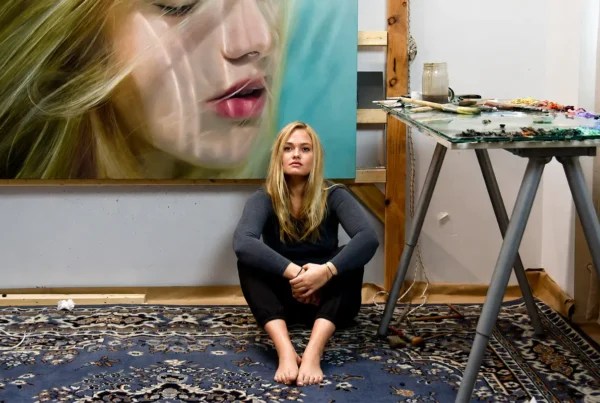
Yung-Hsin (Gin) Ko
Photo by Xon Young Bae
Like A Moth to the Flame
By Gin Ko
Gin Yung-Hsin Ko: Building Meaning Through the Body
A resistance to predetermined answers continues to shape Ko’s artistic practice. She is less interested in things that are simply beautiful or “correct” than in contradictions, unresolved sensations, and images that resist easy interpretation. Theatre offers an ideal structure for that curiosity because stories, bodies, objects, sound, and space can test questions rather than resolve them. Costume became her natural medium because it combines conceptual inquiry with bodily experience and the physical process of making.
Ko does not define her work through a fixed visual signature. Instead, she follows a recurring method of attention that begins with the performer. How does a character stand, move, or breathe? What kind of weight or restriction does the body carry? What happens to a silhouette once it begins moving, or when a material refuses complete control? From those questions, she develops the colors, forms, textures, and construction logic appropriate to each project. Her recurring concerns include the boundary between familiar and strange, cultural and personal memory, and the friction between careful construction and instability.
Craft gives these ideas a physical language. At a moment when visual culture can feel increasingly immediate and digital, Ko is drawn to evidence of touch and duration: a pleat that appears to hold memory, linen that records the wrinkles of a moving body, or crystals that respond to shifting light. Pleats as Spatial Memory makes this interest explicit. Through textiles, sculptural form, pleated structures, and garment based installation, the work considers pleating as a record of movement, tension, and time. Its selection for the Evanston History Center’s reFashioning History Exhibition encouraged Ko to think about costume not only as character design, but also as an independent material and spatial practice.

Frida Libre
Photo by Justin Barbin
From Kandinsky to Everyday Wear
Ko’s references extend well beyond costume history. Theatre trained her to look across literature, music, painting, architecture, photography, social history, and ordinary dress, gathering observations without ranking the museum object above the practical alteration of a work uniform. Wassily Kandinsky remains an important influence because of his connections among color, form, music, and inner experience. His work reinforced her belief that visual elements can communicate without representation. In costume, she translates that principle into questions of material, silhouette, repetition, and the rhythm created when a garment moves with music or emotion.
Leonor Fini offers another point of reference, particularly through figures whose identities emerge from costume, posture, bodies, and uncanny environments. Ko responds to Fini’s combination of opulence and unease, and to the possibility that clothing can make a character less legible rather than reducing them to a recognizable type. Adolphe Appia’s thinking about body, space, music, and light further shaped her approach to the stage. Together, such influences support a conception of design in which the performer is not surrounded by decorative imagery but participates in an environment where material, light, space, and body continually affect one another.
Everyday experience can be just as influential. Ko notices worn garments, fabric altered by years of use, and the practical ways people modify clothing for work or daily life. Relocating from Taiwan to the United States made once ordinary details newly vivid: food, smells, textiles, furniture, streets, and ways of dressing could become charged with memory through distance. Collaboration adds another source of change. Directors, choreographers, performers, lighting designers, drapers, craftspeople, and technicians may discover possibilities she did not anticipate. Ko sees this exchange not as a dilution of authorship, but as one of theatre’s strengths, allowing a work to become more layered through multiple forms of knowledge.

Study of Pleats
Photo by Sasha Pasechnik
CINCH Film Costume Design BTS
Costume Design by Gin Ko
Photo by Alex Valderana
Gin Yung-Hsin Ko: Material, Migration, and the Unresolved
The relationship between memory and material reaches a particularly personal form in Unfinished Island Songs, developed with choreographer Chih-Jou Cheng. Ko served as both costume designer and co-producer, considering not only individual garments but the way audiences enter and sense the theatrical world. The work approaches Taiwanese immigrant experience through embodiment rather than treating belonging as an abstract theme. Bodies stumble, adapt, work, remember, and love, while Taiwanese objects and sensory details help evoke everyday memory without turning Taiwan into a collection of simplified cultural symbols.
Her material choices were crucial to that approach. Instead of the lightweight Lycra and highly elastic fabrics common in contemporary dance, Ko selected cotton and linen for their weight, resistance, and capacity to wrinkle. The fabrics retain evidence of where bodies have been. In collaboration with lighting designer Seojung Jang, those qualities became especially visible as light revealed folds, tension, and changing silhouettes during movement. Migration and memory therefore are not illustrated on the costume surface. They become active through the dancers, while each performance leaves subtle changes in the material itself.
That openness also defines Ko’s daily process and the direction she wants to pursue. Research, reading, fittings, drawing, sourcing, meetings, draping, material experiments, and repetitive handwork continually alternate with practical decisions about how a performer can breathe or dance. She gathers historical and social context before settling on a visual direction, then uses sketching and fitting to test rather than merely execute ideas. Her independent work is increasingly focused on psychological responses that resist immediate explanation: the moment a familiar body becomes unsettling, or a material feels seductive and disturbing at once. She wants to bring costume, craft, body, and space together in experiences that remain beautiful, strange, ambiguous, or uncomfortable, allowing viewers to stay with the instant when familiarity begins to shift.