“Truth over ego, growth over comfort, spirits over prestige”
Clouds, Defiance, and the Making of an Independent Vision
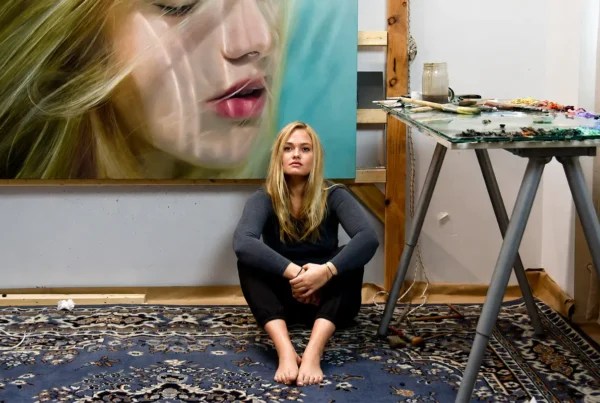
Roxy Peroxyde presents herself with striking brevity, saying that the background shaping her practice is mostly clouds. That image offers an immediate key to understanding her work. Clouds suggest atmosphere, movement, instability, and a space between the earthly and the imagined. They also appear repeatedly within the visual language associated with her paintings, where softness and spectacle often frame figures charged with emotional intensity. Born Roxanne Sauriol Hauenherm in Montreal in 1987, the German-Canadian artist has built an international reputation through photorealistic oil paintings that feel both timeless and unmistakably current. Her rise did not depend on institutional pathways alone, but on a determined cultivation of skill and concept. This independence remains central to her identity. Rather than treating painting as a static tradition, she approaches it as a living form capable of absorbing contemporary anxieties, beauty rituals, internet culture, and private symbolism. The result is a body of work that feels suspended between heaven and nightlife, confession and performance, memory and projection.
Her self-defined spirit is equally revealing. Asked how she became an artist and what defines her style, she answered, “I am ungovernable, the zeitgeist.” Few statements summarize a practice so efficiently. Ungovernable implies resistance to categories, institutions, expectations, and polite limitations. The invocation of the zeitgeist places her within the emotional weather of the present era rather than outside it. She paints women who carry the pressures of visibility, identity, desire, and contradiction that define contemporary life. Yet these figures are not passive examples of social commentary. They confront the viewer, often with expressions that imply awareness, fatigue, amusement, contempt, or command. Through them, Peroxyde transforms portraiture into psychological theater. Her references to historical painting sharpen this effect, because she places modern tensions inside visual formats once used to glorify saints, nobility, or idealized femininity. This collision of eras allows her work to question what has changed and what has merely changed costume.
The artist’s biography also reflects a practical forcefulness that parallels her imagery. She is widely recognized as self-taught, developing technical command through persistence rather than relying solely on academic systems. That path matters because it helps explain the unusual blend of reverence and irreverence in her paintings. She clearly values discipline, finish, and historical craft, yet she refuses to treat inherited standards as sacred objects beyond challenge. This gives her canvases their peculiar charge. They are polished but unruly, elegant yet confrontational. Even the chosen name Roxy Peroxyde carries an attitude of performance and transformation, suggesting glamour with a chemical edge. Her career demonstrates that mastery and rebellion do not cancel one another. In her hands, they become partners. What emerges is an artist who can honor the long history of oil painting while also exposing its myths, updating its symbols, and bending its authority toward voices that were often ornamental in earlier centuries rather than fully empowered participants.

Roxy Peroxyde: The Sweet Surface and the Sharp Interior
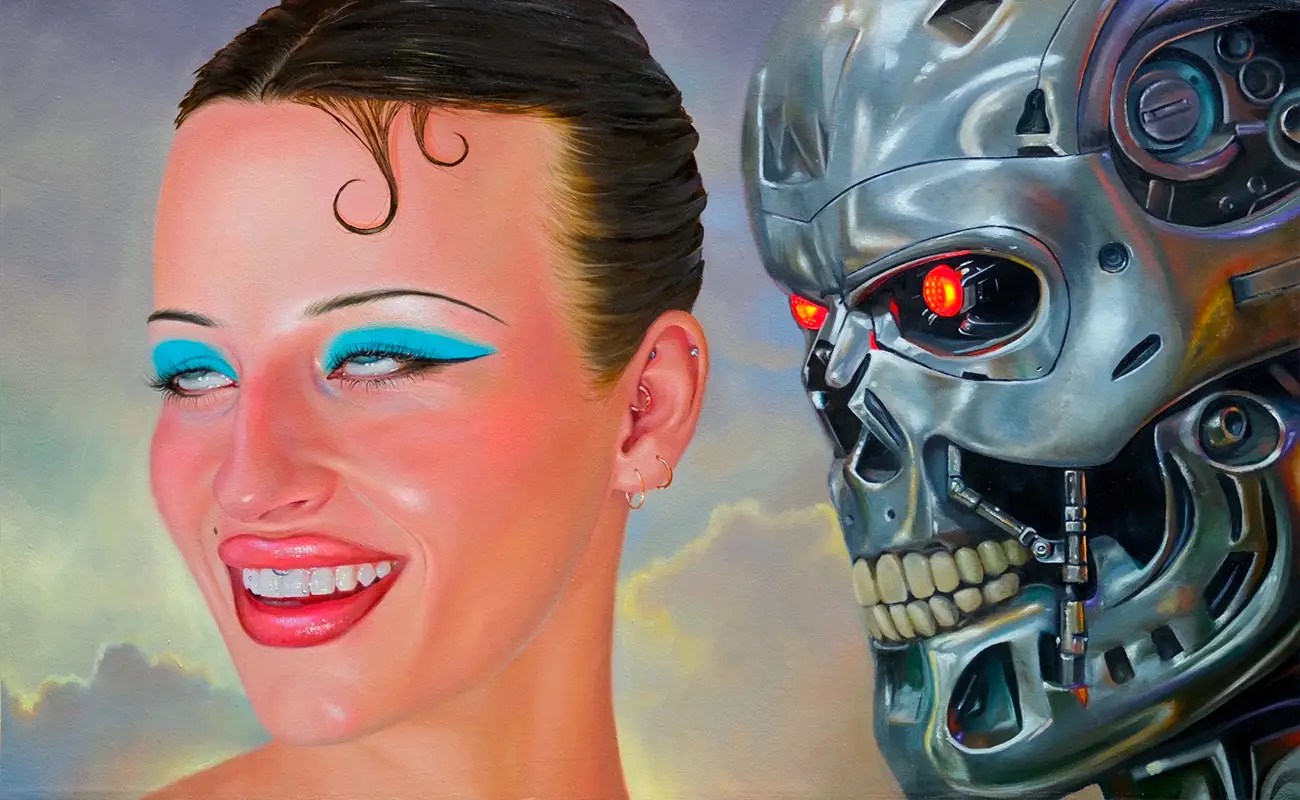
At first glance, many of Peroxyde’s paintings seem seductively straightforward. The colors glow with cosmetic intensity, skin appears luminous, fabrics shine, and compositions possess the smooth certainty of carefully staged images. Yet she has made clear that this apparent simplicity is strategic. Her hyper-saturated palette functions as a sugar coating, inviting the eye before deeper tensions emerge. Beauty becomes a lure rather than a destination. The viewer enters through pleasure and remains because something unresolved begins to stir beneath it. This structure is one reason her work can appeal simultaneously to admirers of technical painting and audiences drawn to contemporary visual culture. It is accessible on contact, but increasingly complex with attention. The immediate impression of glamour gives way to questions about power, self-display, longing, ritual, and performance. In this sense, her paintings operate almost like psychological traps, where delight opens the door and discomfort quietly locks it behind the observer.
Titles and subjects intensify this strategy. Peroxyde often uses women as central vessels for autobiographical and cultural narratives, allowing personal experience to intersect with collective symbolism. Her figures can appear saintly, fashionable, exhausted, seductive, defiant, or emotionally unreadable, sometimes all at once. Such ambiguity is essential to the work. Rather than offering stable identities, she presents femininity as something continually negotiated within social systems and inner life. Religious references become especially potent tools here. Halos, clouds, devotional poses, and ceremonial atmospheres recall traditions that historically shaped ideals of womanhood. By reworking those signals within contemporary aesthetics, she invites scrutiny of how old expectations survive in new forms. A modern accessory may replace a sacred object, yet both can function as badges of belonging, status, or submission. Her paintings ask whether culture has evolved in substance or merely changed wardrobe, language, and lighting.
This tension between visual pleasure and intellectual unease is one of her most defining achievements. Many artists choose either critique or seduction, but Peroxyde insists on both. She understands that viewers often lower their guard when confronted with beauty. Once attention is secured, she can introduce contradictions that complicate the experience. A flawless face may hold an unreadable stare. Luxurious color may frame themes of spiritual rupture or alienation. Humor may coexist with menace. Even accusations of superficiality become part of the conversation, since her surfaces knowingly mimic the polished values of image-driven culture. She uses that language to expose its limitations from within. Consequently, her work does not reject glamour or style. It weaponizes them. What seems decorative becomes analytical, and what seems smooth becomes unstable. This ability to reverse first impressions gives her paintings lasting force long after the initial visual impact has passed.

Icons Recast for a Restless Century
Peroxyde is frequently associated with contemporary reinterpretations of historical art, and this connection helps explain her broad appeal. She borrows the gravity, structure, and authority of classical portraiture while replacing inherited passivity with unmistakably modern agency. In works that echo familiar masterpieces, the old arrangement remains recognizable enough to trigger memory, yet the emotional center has changed. Subjects who once embodied quiet virtue or distant idealization become self-aware figures grounded in the present. Jewelry, beauty styling, current attitudes, and contemporary codes of status enter scenes once governed by aristocratic or devotional decorum. This shift is not mere novelty. It exposes how representation has long shaped who is admired, who is silent, and who gets to command the frame. By inserting contemporary women into those visual lineages, Peroxyde does more than quote art history. She renegotiates its terms and redistributes its power.
Her often-cited contemporary responses to canonical images reveal how humor and seriousness can coexist. A reference to Vermeer may become an opportunity to exchange modest mystery for unapologetic presence. What was once quiet observation can become direct self-possession. These gestures are witty, but they are also critical. Peroxyde suggests that the museum canon, for all its beauty, often encoded social hierarchies beneath its polish. By revisiting those compositions with women who appear alert to the act of being seen, she turns spectatorship into a contested space. The viewer no longer consumes the image innocently. Instead, the subject seems to understand the gaze and answer it on her own terms. This reciprocal tension gives her portraits unusual energy. They are less about frozen likeness than about a live negotiation between image-maker, model, tradition, and audience.
Color plays a decisive role in this historical reconfiguration. Rather than imitate the subdued palettes often associated with older European painting, Peroxyde embraces synthetic blues, candy pinks, intense yellows, cosmetic reds, and glowing flesh tones. These hues feel closer to screens, nightlife, advertising, and beauty counters than to candlelit interiors. That choice is conceptually important. It places the authority of classical composition inside the sensory language of the present day. The result can feel dreamlike, seductive, or slightly dangerous, as if reverence has been exposed to electricity. Her paintings remind viewers that every era has its own systems of illusion. Oil glazing once performed a kind of wonder; digital filters now do something similar. Peroxyde binds these histories together, showing that image culture did not begin with smartphones and did not end with museums. It simply keeps changing masks.

Roxy Peroxyde: Discipline, Mystery, and the Next Unspoken Work
Despite the theatricality of the finished paintings, Peroxyde describes a surprisingly grounded daily rhythm: she wakes up, works, then answers emails. That simple sequence reveals the labor behind images that can appear almost magically complete. The contemporary art world often romanticizes inspiration, yet her statement emphasizes routine, endurance, and administration alongside creation. A professional practice requires more than ideas. It demands consistency, correspondence, scheduling, production, and the management of public interest. This practical structure may also help explain how she sustains such polished output. Precision in painting usually grows from repeated habits rather than sporadic bursts of genius. By reducing her schedule to a blunt sentence, she cuts through mythology and presents art-making as work in the strongest sense of the word. The glamour belongs to the canvas. The studio depends on discipline.
Her known process further supports this view. Conceptual frameworks reportedly begin the journey, followed by careful selection of models capable of carrying the emotional and intellectual weight of a theme. This approach places embodiment at the center of meaning. The model is not simply a face to copy but an active presence within the architecture of the image. Through that relationship, Peroxyde explores shared and personal experiences of womanhood while preserving the complexity of individual presence. Such a method also explains why many of her figures feel psychologically charged rather than merely decorative. They seem to inhabit roles while simultaneously resisting them. In this sense, the artist-muse dynamic becomes something more reciprocal and contemporary than the historical stereotype. It becomes a site of collaboration, projection, negotiation, and lived recognition translated through paint.
When asked what project she is eager to realize next, Peroxyde answered that she signed an NDA and cannot say. Even this refusal feels aligned with her artistic identity. Mystery, withholding, and controlled revelation are already central to her paintings, where surfaces disclose only part of what they contain. The hidden future project becomes an extension of that logic. Audiences are offered anticipation instead of information, a blank space charged with possibility. It also suggests an artist in motion, one whose trajectory continues beyond established signatures and familiar themes. Given her history, the next work is unlikely to be a repetition. She has built a career on friction between eras, symbols, and emotional registers. Whatever remains undisclosed now will likely continue that pattern, using beauty to invite, tension to unsettle, and technical command to make contradiction visible.