Where Memory Takes Visible Form
Memory rarely arrives as a single image. It comes in fragments, in stories heard more than once, in the gestures of relatives, and in symbols whose meaning changes with each encounter. Ronald Cadet gives that unstable inheritance a notably physical presence. His paintings assemble bodies, faces, architectural shapes, color fields, and spiritual emblems into crowded visual encounters. Some figures are carefully modeled, their expressions defined by light and shade, while others overlap translucent planes or dissolve into gestural passages. The movement between figuration and abstraction is not merely a stylistic flourish. It makes a persuasive analogy for recollection itself, which can hold one detail sharply in focus while leaving its surrounding circumstances uncertain. Cadet identifies his Haitian origins and the cultural history of Haiti as central to his practice, yet the paintings resist the role of straightforward historical illustration. Their purpose is less to certify a particular event than to make the persistence of experience felt. Viewers must negotiate a picture in which no single voice has complete possession of the past.
In Croyance et Esperances, a woman in a vivid orange-red dress rises above a pale horse, while an assembly of darker-skinned faces fills the space below. The vertical format emphasizes the distance between these presences, but the picture also brings them into contact through interlocking limbs, rectangles, and rounded shapes. A small Haitian flag near the lower edge provides a recognizable national sign without making the surrounding figures reducible to a patriotic allegory. Some faces confront the spectator; others turn inward or appear suspended between states of attention. The changes in scale prevent the gathering from becoming a conventional group portrait. Instead, it resembles a set of memories pressing against one another for visibility. The composition is not free of tension. Its elevated figure and clustered faces introduce an implicit hierarchy, leaving open the question of whether the arrangement represents protection, aspiration, distance, or unequal power. That ambiguity is among the painting’s most productive qualities, because it prevents remembrance from settling into reassurance.
Cadet describes an approach shaped by ancestral traditions, oral histories, and philosophical reflection, while naming his father, Fritz Cadet, and his aunt, Chantal Pierre, among the personal figures connected to his artistic formation. Such references give the recurring theme of inheritance an intimate scale without turning the paintings into autobiography by other means. Across the body of work, the surface appears alternately smooth, fractured, and heavily worked, reinforcing the idea that remembrance involves both preservation and alteration. His stated materials include acrylic, oil, plaster, and fiberglass, alongside canvas and board; he also works across painting, sculpture, and mixed media. It would be too simple, however, to assign a specific material process to every visible effect. What matters formally is how a translucent curve can coexist with a dense-looking accumulation of color, or how a face can seem to surface from surrounding disorder. Material richness becomes a language for histories that cannot be restored intact, only repeatedly approached through acts of looking and making.

Ronald Cadet: The Body as a Changing Landscape
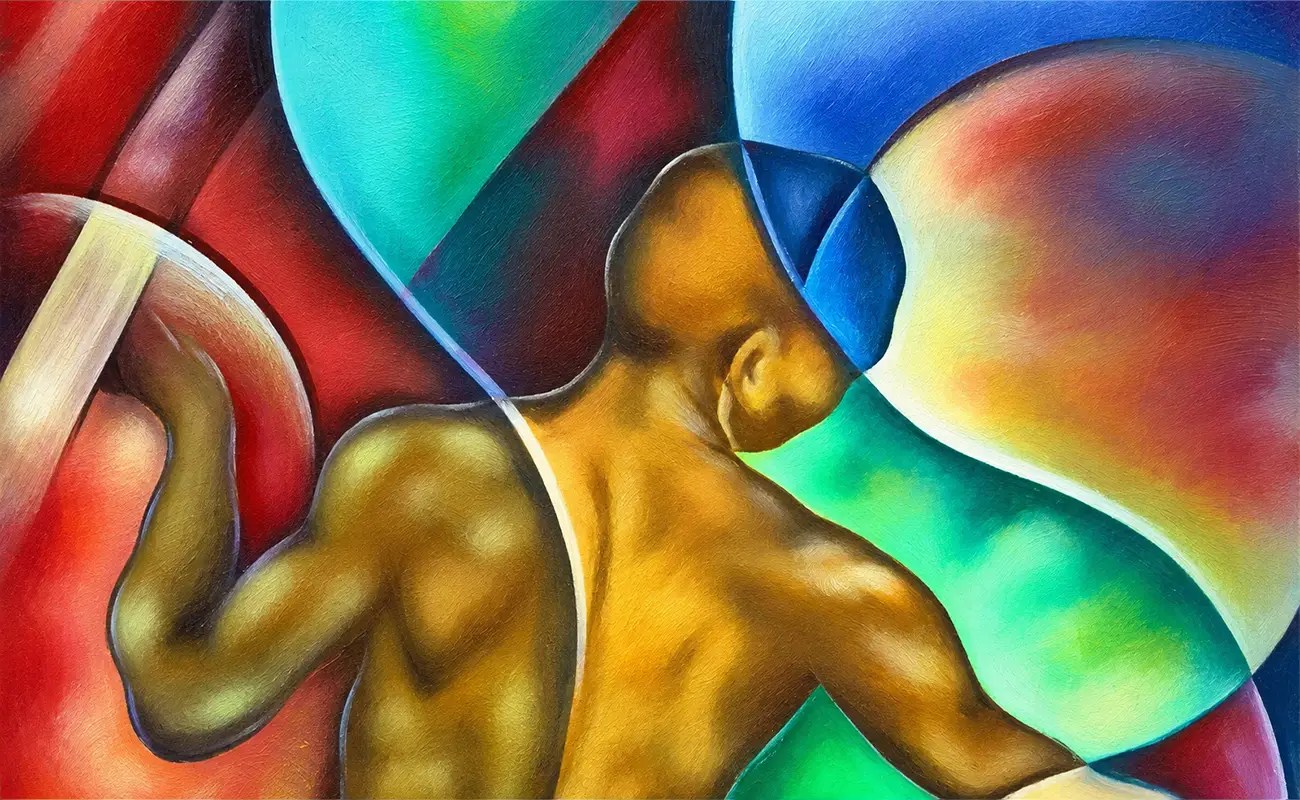
The human figure is one of Cadet’s most reliable anchors, even when anatomy appears to resist its usual limits. In a painting signed with his name and the year 2020, a muscular figure turns across a field of overlapping red, green, blue, and violet forms. The contours of the body are legible, yet colored bands move through its limbs and torso, partly concealing where flesh ends and surrounding space begins. In Les Trois 3 Couleurs, figures and a guitar participate in a similarly fluid arrangement, with large curved planes threading through skin, fabric, and background. These works draw on the visual possibilities of modernist fragmentation without requiring a direct lineage to any single movement. The body is never simply broken into decorative pieces; its interrupted silhouette makes visible the pressure exerted by environment, memory, and sensation. Space ceases to function as a neutral container. It presses, stretches, and occasionally absorbs the figures occupying it.
Initiations offers another variation on this uncertain relationship between body and setting. Several people, including a smaller reclining figure and a watchful face above, are contained within intersecting circles and curved color fields. A blue-clothed central figure creates a subdued focal point amid forms that could be read as sheltering, enclosing, or separating. What initially looks like a domestic or communal scene becomes difficult to map as a continuous physical space. Cadet uses that difficulty to keep the relationships between his figures open rather than narratively resolved. The painting’s partial concealments and shifts in proportion suggest that intimacy can also involve opacity: people remain close without becoming fully knowable to one another. This is consistent with his stated interest in the emotional and psychological presence of history, though the image need not be tied to a particular episode to carry such associations. Its relative restraint is especially significant beside the more exuberant compositions elsewhere in his practice, demonstrating that densely layered meaning does not always require maximum pictorial intensity.
Elsewhere, a reclining woman in pale blue occupies the center of a scene surrounded by winged children, percussion instruments, vessels, and luminous color. The body is rendered with an almost theatrical attention to drapery and light, while the smaller figures move in different rhythms around her. In a related composition, a woman dressed in blue rests amid drums, jars, leafy forms, and miniature musicians whose wings make ordinary scale and gravity irrelevant. Their surfaces appear charged with splashes, cracks, and gilded marks, giving the impression of an image continually being formed. These pictures succeed through their conviction that pleasure, spirituality, and vulnerability can share the same visual field. Yet their abundance also tests the balance between emphasis and distraction. At moments, the bravura of texture and ornament competes with the quieter expressions of the central subjects. The resulting tension is not necessarily a failure; it is a visible question within the work about whether the complexity of experience is best conveyed by accumulation or by allowing an image room to breathe.

Signs, Spirits, and the Architecture of Encounter
Across several compositions, fine white diagrams hover over more turbulent passages of paint. Their crossed lines, arcs, hearts, and radiating points evoke the visual logic of Haitian Vodou vévé signs, although the images alone cannot establish a precise ritual identification for each symbol. The distinction matters. Cadet approaches spirituality, by his account, not as fixed doctrine but as a question about connection, transformation, and unseen forces. A large central face divided between fiery reds and cooler blues appears beneath a canopy of opposing winged figures, with celestial spheres positioned in the upper corners. The organization suggests a moral or spiritual confrontation, but the sharp division between dark and light is complicated by the way both sides share gestures, dramatic expressions, and bodily intensity. Rather than providing a diagram of good against evil, the composition can be read as exposing the instability of such categories. Its center is a human face, not an abstract emblem, so cosmic conflict remains inseparable from lived experience.
One particularly elaborate painting carries the words “Michael Arcangel Papa Legba The Gate Keeper” near its lower edge. Its winged standing figure holds a staff above a small dark silhouette passing toward an illuminated doorway, while larger faces flank the scene and ritual-looking vessels occupy the foreground. Even without treating every sign as an illustration of established belief, the threshold is a compelling organizing device. It separates an exterior world of accumulation from an interior passage whose destination remains unseen. The conjunction of an angelic figure, a named gatekeeper, and repeated linear emblems creates a visual conversation between spiritual vocabularies rather than a neatly resolved theological statement. Such combinations belong to the work’s larger method of refusing a single interpretive authority. They also demand cultural care from the viewer. Sacred references should not be reduced to exotic decoration merely because they appear amid highly saturated color and fantastical imagery. Their formal position suggests an inquiry into who may enter, what must be carried forward, and how connection is mediated.
Music gives this symbolic world another kind of structure. In an incandescent orange composition, a muscular figure reaches upward while winged children play horns, a drum, and smaller instruments around three presiding women. Percussion and movement are not incidental props here; they organize the picture through repeated curves, diagonal arms, and circulating ribbons of green. The eye moves almost rhythmically from one performer to another before returning to the figure at the center. Similar instruments recur beside reclining women, where jars, beads, foliage, and embroidered-looking markings give the scenes a sense of gathering or ceremony. The imagery can suggest communal continuity, but it avoids becoming a record of a specific rite. Cadet’s formal strategy is to translate sound and collective participation into spatial relationships, using repetition to give crowded scenes coherence. The challenge is that celestial wings, ritual signs, and ornamental textures can sometimes become a shared visual shorthand, making distinct figures feel interchangeable. The most affecting passages are those in which a posture or gaze interrupts the spectacle and restores a sense of individual presence.

Ronald Cadet: Beyond the Singular Story
The question running through Cadet’s practice is not simply how a personal past can be remembered, but how a culture can be represented without being confined to the expectations of outsiders. He explicitly resists reductive accounts of Haiti, emphasizing artistic inheritance, intellectual history, resilience, and the possibility of cultural connection. The paintings respond through their refusal to present identity as a fixed emblem. A flag may appear beside a reclining body; a personal expression may emerge beneath spiritual geometry; a recognizable figure may dissolve into an unstable field of color. These juxtapositions locate cultural identity in ongoing negotiation rather than in a single picturesque image. The approach recalls the storytelling ambition of narrative painting and the dramatic compression of mural art, while the floating bodies and altered proportions invite comparison with surrealist strategies. Such associations describe formal affinities, not documented influences. His ambition is to let visual excess and intimate memory coexist, allowing history to be experienced as pressure, presence, and possibility.
That ambition also creates a productive difficulty for interpreting the work in contemporary gallery or institutional settings. The highly finished fantasy-like scenes, with their intricate wings and gleaming surfaces, invite immediate visual engagement. The flatter, more ambiguous figurative paintings ask for slower attention and greater tolerance of unresolved relationships. Placed together, the two approaches can seem to speak different pictorial languages. A viewer may wonder whether the accumulation of symbolic detail sharpens the central argument or makes it too easy to consume the work as spectacle. This is not a demand for a uniform signature style. Rather, it points to the importance of the artist’s recurring concerns in sustaining coherence across differing visual modes. The strongest connections are made through thresholds, intertwined bodies, recurring circles, and the movement between visibility and concealment. In that sense, Cadet’s relevance lies less in any easily marketed image of Haitian spirituality than in his insistence that cultural memory requires multiple, sometimes contradictory forms of representation.
The achievement of Ronald Cadet’s art is its determination to hold conflicting states together. A figure can appear protected and constrained by the same surrounding forms; a spiritual presence can be exalted while remaining disturbingly human; a scene can communicate celebration without denying histories of loss. These contradictions help give the paintings their emotional weight. His statements about beauty emerging from struggle and memory becoming strength gain substance when read against visual decisions that refuse simple consolation. At his most compelling, Cadet does not merely adorn the past with symbols. He places signs, bodies, and competing pictorial registers in relationships that require active interpretation. Some compositions risk overwhelming their central ideas through sheer density, but even that risk testifies to an urgent wish to make inherited experience visible. The work ultimately presents remembrance as a shared and unfinished act, one in which personal lineage, Haitian cultural identity, and wider human questions remain in motion rather than arriving at a final, unchallenged meaning.