From Image to Question
Pat Steir (1938–2026) built a six-decade practice around a persistent question: how can a painting be deliberately constructed while remaining open to forces the artist does not fully control? Born in Newark, New Jersey, she studied painting at Pratt Institute from 1956 to 1958, where Richard Lindner and Philip Guston were among her teachers, then studied art and philosophy at Boston University before returning to Pratt and earning a BFA in 1962. That combination of studio training and philosophical inquiry became central to a career that repeatedly tested the boundaries between image and mark, intention and accident, representation and abstraction.
Her early professional life moved between art, publishing, and teaching. Steir worked as an illustrator and later as an art director at Harper & Row, taught at Parsons and the California Institute of the Arts, and participated in the intellectual networks surrounding conceptual art in New York. She was also a founding board member of Printed Matter and of the feminist journal Heresies, while working as an editor with Semiotext(e). During the 1970s, her drawings and paintings often combined words, signs, grids, and recognizable images. The crossed-out rose paintings made in the middle of that decade are especially revealing: a flower appears, then is negated by a large X, leaving figuration and cancellation active at the same time.
Steir also moved beyond the framed object through wall drawings and room-scale installations, treating line and light as elements that could reorganize a viewer’s sense of space. Her interest in the instability of style became explicit in The Brueghel Series (A Vanitas of Style), made from 1982 to 1984. The work consists of sixty-four panels based on a seventeenth-century still life by Jan Brueghel, with each panel translated through a different artistic style. Rather than establishing a single signature look, Steir used the work to examine how styles carry meaning, how they age, and how the history of painting can be treated as material.

Pat Steir: Building Chance into the Painting
A decisive shift came through Steir’s friendship with composer John Cage, whom she came to know while working at Crown Point Press in the late 1970s. Cage’s use of chance and non-intention offered a model for making work through systems that establish conditions without predetermining every result. Travel in Asia deepened that direction. Steir became closely engaged with Japanese woodcuts and Chinese literati landscape painting, particularly the traditions of mountain-and-water painting in which nature is not simply copied from direct observation. She described being drawn to the processes and philosophical attitudes behind these works, including the possibility of allowing experience, memory, and natural forces to shape an image.
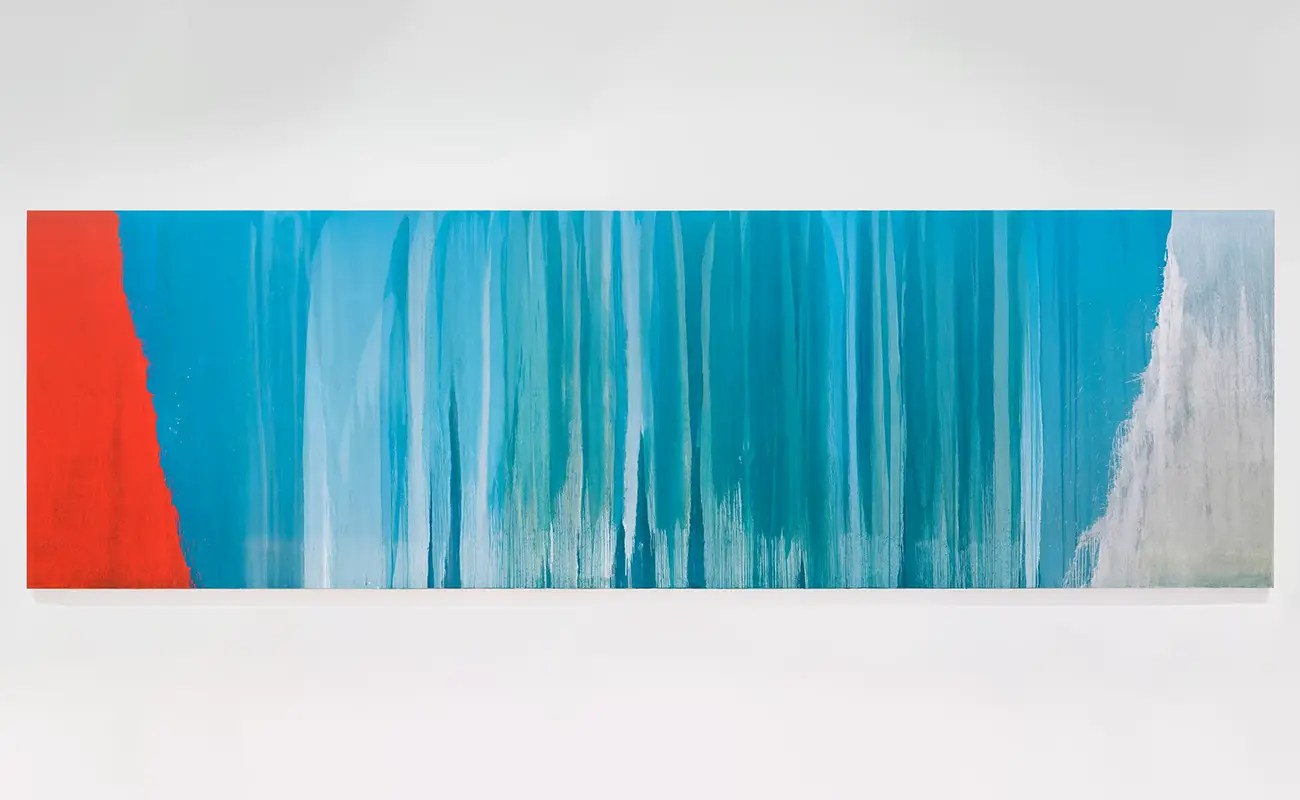
By the late 1980s, that thinking converged with her study of the brushstroke. Steir had been making wave images, drawing on sources that included Hokusai and Courbet, when she began to treat the drip itself as a bridge between abstraction and figuration. A descending stroke could carry the history of gestural abstraction and, simply by continuing downward, also resemble falling water. The Waterfall paintings grew from that insight. Steir poured, flung, brushed, and released thinned oil paint onto large primed canvases so that the liquid could travel across the surface instead of immediately soaking into it. Gravity became an active agent in the image.
The method was never a surrender of all decision making. Steir chose the dimensions of the canvas, the ground color, the placement of marks, the viscosity and opacity of the paint, and the sequence of actions. In many later works she also used grids as quiet scaffolds, sometimes visible and sometimes submerged beneath subsequent layers. Once the paint was released, however, its exact path remained partly outside her command. This structure allowed planning and uncertainty to coexist. The painting was designed to produce an event, then to preserve the evidence of that event in rivulets, splashes, veils, and accumulated layers.

Gravity, Water, and the History of Seeing
The Waterfall works are often described through their resemblance to landscape, but Steir’s process complicates that description. The falling paint does not merely depict water from a distance. Its liquid behavior generates the image that viewers read as water. On dark grounds, pale streams can seem to emerge from deep space; on colored grounds, the cascades press forward and interact more immediately with the surface. The result is both material and pictorial at once. A mark is visible as paint, as a record of motion, and as an evocation of rain, mist, current, or falling light.
Scale intensified that ambiguity. Steir frequently worked on canvases large enough to exceed a comfortable field of view, an approach she connected to the spatial experience of Chinese landscape painting and to the idea of making an image feel like an opening rather than a contained scene. Her large paintings do not require a central viewpoint. The eye can follow separate streams, shifts in density, or changes in color across a broad surface. This slows looking and makes time part of the work, because the paintings reveal themselves through movement from one passage to another rather than through a single focal image.
Late projects expanded this language without abandoning its underlying rules. For Color Wheel at the Hirshhorn Museum and Sculpture Garden, Steir made thirty large paintings that extended nearly four hundred linear feet around the museum’s circular interior, moving through a spectrum of hues and complementary relationships. In the Painted Rain works of 2022 and 2023, blue became a dominant field punctuated by other colors, while horizontal bands of paint interrupted the downward flow. These paintings began with green Verdaccio underpainting and a chalk grid, then developed through streaming, pouring, and layering, showing how a disciplined structure could continue to generate different visual conditions.

Pat Steir: Drawing, Printmaking, and Space
Drawing remained fundamental throughout Steir’s career rather than serving only as preparation for painting. The 2010 RISD Museum exhibition Drawing Out of Line traced four decades of work, from early word-and-image drawings and serial studies of line to large wave drawings, waterfall drawings, and later gestural fields crossed by pastel grids. These bodies of work show how repeatedly she returned to line as both an object and an action. A line could describe, divide, cancel, map, or simply record movement. Her wall drawings extended the same inquiry into architecture, making the surrounding room part of the conditions through which a mark was perceived.
Printmaking offered another way to test control, repetition, and variation. Steir began working with Crown Point Press in the late 1970s and developed an extensive body of prints using processes including aquatint, drypoint, etching, woodcut, and direct gravure. She participated in Crown Point’s programs in Japan and China, experiences that intersected with her growing interest in East Asian art. Prints such as Rainclouds, The Direction of Water, and later Mixed Marks and Alphabet projects translated her concern with fluid marks, grids, and layered surfaces into procedures that depend on plates, paper, pressure, and collaboration with printers.
Major commissions eventually allowed these ideas to occupy entire architectural settings. Silent Secret Waterfalls: The Barnes Series, presented in 2019, comprised eleven seven-foot oil paintings installed across two walls of the Barnes Foundation’s Annenberg Court, the first installation of paintings created for that space. Her work also entered major public collections including the Museum of Modern Art, the Whitney Museum of American Art, the National Gallery of Art, the Guggenheim Museum, Tate, and the Metropolitan Museum of Art. Across those contexts, Steir’s practice kept returning to a precise tension: the artist establishes the field, but paint, gravity, time, and the viewer complete what happens within it.