Color as Event, Surface as Memory
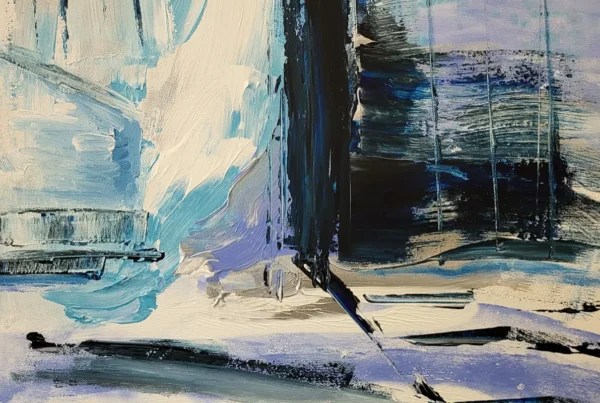
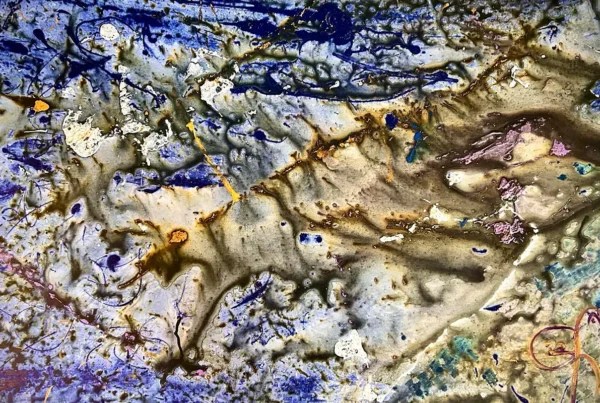
The first impression of Nada Kelemen’s submitted paintings is one of chromatic abundance governed by physical urgency. Across the vertically oriented canvases, acrylic and mixed media are applied through brushing, scraping, dragging, pouring, and direct contact, producing surfaces that register painting as an unfolding event rather than a polished image. Vermilion fields are interrupted by yellow, green, and silver fragments in Awakened Traces; pale grounds support networks of fluorescent pink and blue in Birth of Light; turquoise expanses carry flashes of cream, orange, and metallic gold in Breath of Water. Elsewhere, deep cobalt or black becomes a dramatic stage for pale smears, acid accents, and restless ribbons of pigment, as seen in It Was Always Here, Inner Ocean, and Space Storm. These shifts in palette are substantial, yet the works remain connected by Kelemen’s commitment to layering and by her resistance to conventional figure-ground separation. Marks rarely sit passively on top of a stable background. They seem to emerge from previous actions, partly concealing and partly exposing what came before. This gives the canvases an archaeological character, although their significance lies less in recovering a buried story than in making time visible through accumulated decisions.
Kelemen’s technique is most convincing when the behavior of paint becomes inseparable from the composition. The palette knife appears to create broken planes, compressed ridges, and blunt-edged passages, while brushes generate both sweeping movement and short, insistent repetitions. Poured or flicked lines introduce a contrasting velocity, particularly in It Was Always Here, where suspended threads of white, pink, green, and gold cross heavier masses and falling drips against a cobalt ground. In Birth of Light, dense fluorescent-pink and blue clusters spread across a silver-gray field like vegetation without becoming descriptive, and the scattered black forms provide crucial interruptions within an otherwise airy composition. Space Storm operates differently. Charged with hot pink, white, and small areas of green and orange against black, its broad, folded strokes create a compressed, almost nocturnal intensity, making the surface feel less atmospheric and more bodily. These works demonstrate that Kelemen does not rely on one signature gesture. Her visual identity emerges through the interaction of varied marks, recurring chromatic contrasts, and a persistent sense that every layer remains active within the final image.
Compositionally, the paintings favor distributed attention over a single focal point. The eye is encouraged to move across fields of incident, following changes in density, shifts of temperature, and the friction between opaque deposits and thinner passages. This approach aligns Kelemen’s practice with traditions of all-over abstraction, gestural painting, and European lyrical informality, yet her canvases often retain subtle internal hierarchies. In Breath of Water, pale and metallic clusters form a loose constellation across the central turquoise field, while darker fragments near the edges prevent the atmosphere from dissolving into uniformity. Inner Flower gathers its softer whites, greens, and pinks into a luminous central expansion, creating the impression of energy radiating within a saturated yellow environment. By contrast, works such as Breath of Fog and Touch of the Hidden establish rhythm through vertical abrasions and repeated broken strokes within muted pink, beige, gray, and mineral-toned compositions. Their restraint reveals how much Kelemen’s stronger paintings depend upon calibrated variation. Her surfaces are not simply busy. At their best, they are structured through intervals, pauses, and zones of resistance that allow the viewer to experience color as both sensation and material history.

Nada Kelemen: Intuition Held by Structure
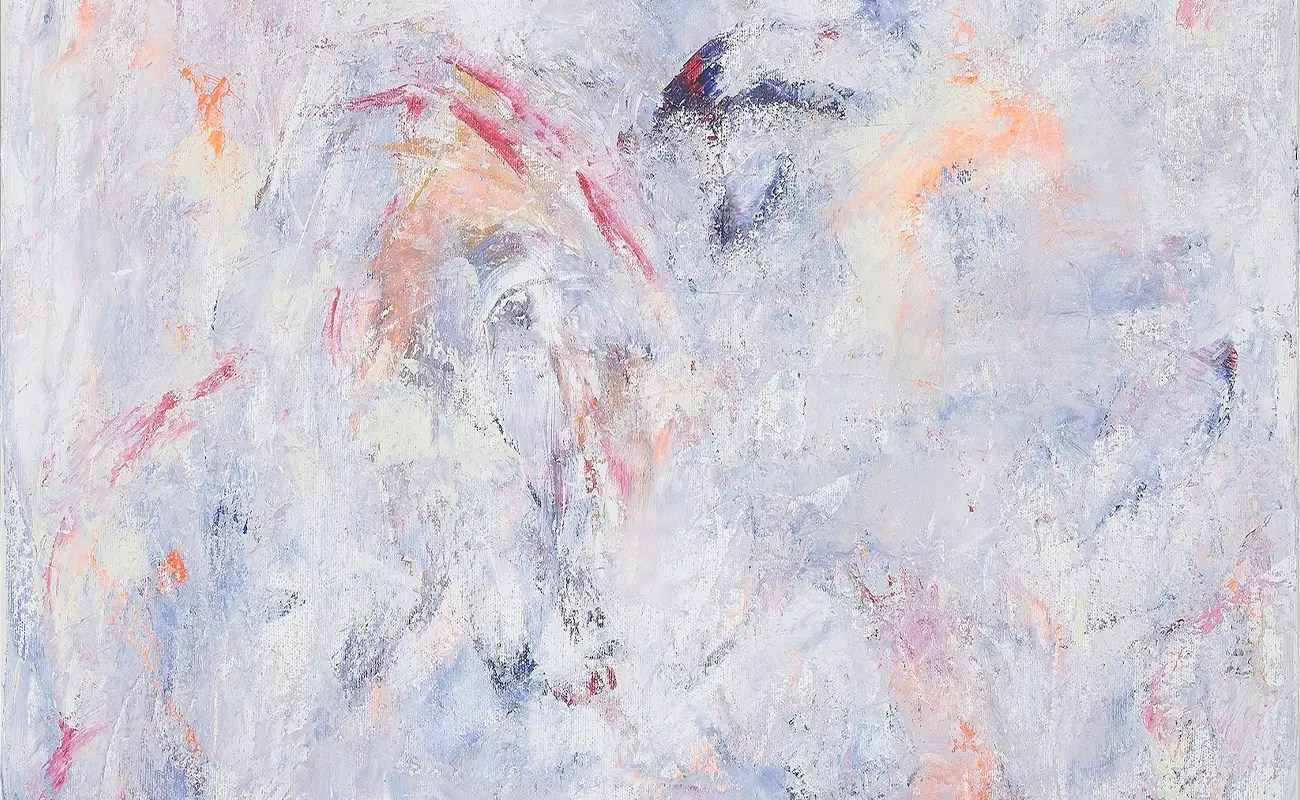
Kelemen describes her process as intuitive, with each new layer responding naturally to the one beneath it. The submitted paintings support this account, but they also show that intuition in her practice is not equivalent to improvisation without limits. Repeated compositional habits provide an underlying framework: vertical orientation, all-over activation, recurring edge pressure, intermittent clusters, and a preference for balancing broad chromatic fields with smaller disruptive accents. Even the most spontaneous-looking works suggest cycles of concentration, action, observation, correction, and renewed intervention—a relationship between attention and gesture that gains additional context from Kelemen’s sustained study of Japanese calligraphy. These material decisions are not treated as ends in themselves, but as a means of bringing the painting toward a particular internal condition. For Kelemen, completion arrives when the accumulated colors, layers, and rhythms begin to resonate as a unified presence, and the work appears to acquire an energy that is no longer reducible to the sequence of actions that produced it. Touch of Invisible, for example, is densely worked through small curved strokes and layered scumbles, but darker violet, blue, brown, and white passages establish uneven zones of emphasis across its pale lavender field. The surface appears atmospheric from a distance, then becomes emphatically physical at closer range. This oscillation between immersion and material specificity is central to Kelemen’s visual language. Viewers initially encounter a climate of color, then discover the decisions that produced it. Such duality gives the paintings durability, since their impact does not depend solely on the immediate appeal of a palette or the theatricality of a gesture.
The relationship between spontaneous expression and compositional discipline varies across the series, and that variation offers both strength and challenge. Inner Ocean, filled with cobalt, turquoise, pink, green, cream, and dark brown, achieves a persuasive balance because its dense passages are distributed unevenly, allowing visual pressure to build and recede. Scraped rectangles and vertical strokes create a loose architecture beneath the color, while brighter accents function as rhythmic cues rather than isolated decoration. It Was Always Here takes a more overtly performative direction. Its open dark-blue ground gives individual drips, poured lines, and sweeping gestures room to register, but the central accumulation risks becoming overloaded because several modes of mark-making compete for authority. This tension is productive to a point, since it communicates instability and transformation, yet selective subtraction or stronger intervals of unmarked space could intensify the painting’s internal logic. Kelemen’s instinct is generous and additive. The next level of refinement may depend on identifying when a surface has reached sufficient complexity, allowing fewer gestures to carry greater emotional and structural weight.
The quieter paintings clarify this issue further. In Whisper of the Earth, broad pale gray-white veils soften earlier traces of coral, blue, pink, and ochre until only fragments remain visible. The result is meditative, but not empty. Buried arcs and darker interruptions imply movement held beneath a cool, luminous skin. Touch of the Hidden uses beige, blush, green, and gold alongside vertical drag marks and rough metallic passages to create a weathered, mineral atmosphere. Here restraint produces an ambiguous space that can evoke eroded walls, mist, sediment, or memory without settling into representation. These works indicate that Kelemen’s language becomes especially distinctive when the process includes concealment as well as addition. By allowing some gestures to disappear, she creates psychological depth and gives the viewer space to complete the image. The emotional force of abstraction often depends on what is withheld. Kelemen’s practice is therefore strongest not when intuition is displayed as unrestricted energy, but when instinct is tested against pause, revision, and the disciplined acceptance of partial visibility.

Nature, Consciousness, and the Open Image
Kelemen identifies nature, music, silence, and human consciousness as primary sources of inspiration, and these references operate through rhythm rather than depiction. No submitted canvas presents a recognizable landscape, body, or botanical subject, yet many works carry associations with growth, weather, water, erosion, and organic movement. Birth of Light, with its fluorescent pink and blue spreading across silver-gray, resembles a field of blossoms, branching systems, or cellular proliferation, but its marks remain unstable enough to prevent illustration. Breath of Water may suggest reflected light or submerged mineral deposits, while the muted vertical surfaces of Breath of Fog and Touch of the Hidden recall rain, bark, aged plaster, or atmospheric veils. Such correspondences arise from the behavior of color and texture rather than from symbolic objects. This distinction is important because it preserves the openness Kelemen values. Nature appears not as scenery but as a model of continuous transformation, where forms emerge, overlap, decay, and reappear. Her paintings translate that principle into material processes, making the canvas a site where change is not represented from a distance but enacted through successive layers.
Music provides another productive framework for understanding the series. Kelemen’s marks can be read as units of duration, intensity, and tempo. Long vertical drags operate like sustained tones, abrupt scrapes create percussive breaks, and repeated clusters establish visual refrains. Awakened Traces, with its red-orange field and yellow, green, and silver fragments, has a heavy, heated rhythm, repeatedly punctured by brighter shapes that rise and recede like emphatic chords. Inner Flower works through a different register. Its pale central turbulence and dispersed touches of green, coral, and white create a higher, more expansive tonality, while the surrounding yellow holds the composition within a continuous vibration. Silence enters through subdued passages, erased marks, and areas where color approaches near-monochrome. These quieter intervals are not merely background. They shape the viewer’s awareness of the denser sections, much as silence gives musical sound its contour. Kelemen’s interest in music is therefore legible through pacing and recurrence, not through direct analogy. Rhythm also functions as a vehicle of resonance, allowing the paintings to affect the viewer through changes in intensity, suspension, repetition, and release before any conscious interpretation has been formed. Her most resonant canvases organize visual sensation in time, asking the viewer to look slowly despite their immediate chromatic impact.

Another relevant dimension of Kelemen’s gestural language is her sustained engagement with Japanese calligraphy. For approximately five years, she has studied at the IROHA school in Prague with Petra Vitásková, who herself studied Japanese calligraphy in Tokyo, and Kelemen has participated in several exhibitions with the school. This practice offers useful context for the concentration, spatial awareness, and sensitivity to movement evident in her paintings. The connection should not be understood as a direct transfer of calligraphic forms into abstraction; rather, it appears in the way a gesture can function simultaneously as physical action, rhythmic event, and carrier of emotional intensity. Calligraphic practice places particular emphasis on the relationship between movement and stillness, mark and surrounding space, intention and immediacy—concerns that resonate strongly with Kelemen’s own handling of line and brushwork. Her sweeping strokes, interruptions, and intervals can therefore be understood not only through the history of gestural abstraction, but also through a parallel discipline in which the quality of a line depends upon concentration, bodily movement, and the state of mind from which it emerges. This additional context helps clarify why gesture in Kelemen’s work often carries significance beyond its descriptive or decorative function: the mark becomes a record of attention as much as an element of composition.
The connection to human consciousness is similarly indirect and perhaps more compelling for that reason. Kelemen’s layers can be interpreted as structures of memory, perception, and emotional revision. Earlier gestures remain partly accessible but cannot be fully recovered, mirroring the way experience persists through fragments rather than complete narratives. Space Storm intensifies this psychological dimension. Its twisting hot-pink, white, green, and orange strokes appear to fold, collide, and recoil within a black field, generating a sense of agitation that is simultaneously seductive and unsettled. In contrast, Touch of Invisible and Whisper of the Earth evoke states of suspension, where distinctions between foreground and background soften and perception becomes uncertain. These emotional differences show that Kelemen’s abstraction is not tied to a single mood. Her visual language can accommodate exuberance, disturbance, contemplation, and release. The absence of fixed narrative gives viewers interpretive freedom, but freedom does not mean neutrality. Color, scale, density, and gesture guide the emotional encounter. The paintings remain open, yet they possess distinct psychological temperatures that shape how each viewer enters and inhabits them. Within this openness, Kelemen seeks a form of inner resonance rather than the communication of a prescribed message. What she experiences as a radiance emanating from the completed painting may be understood critically as its capacity to generate an affective presence that exceeds its visible materials. The response it awakens will necessarily differ according to each viewer’s memories, sensitivity, and state of mind, but that variability is integral to the work rather than evidence of indeterminacy without purpose.

Nada Kelemen: Contemporary Position and Future Stakes
Kelemen’s work belongs to a broad contemporary return to materially assertive abstraction, particularly painting that values touch, process, and embodied decision in an increasingly screen-based visual culture. Her practice enters into conversation with postwar gestural abstraction, lyrical abstraction, color-field painting, and European informal traditions without appearing dependent on a single historical model. The submitted body is distinguished by the range of its chromatic identities, from saturated primary fields to restrained mineral palettes, and by its insistence that physical layering can carry conceptual significance. Kelemen’s stated participation in international exhibitions, curated projects, and recent recognition through the Atlante dell’Arte Contemporanea, the Segno d’Oro – Rembrandt award, and the Olympus Art Awards provides an institutional context for this development. Within such settings, her paintings can communicate effectively across linguistic and cultural boundaries because their primary content is sensory, temporal, and affective. Their accessibility is a strength, though their seriousness depends on maintaining tension between immediate visual pleasure and the slower experience of discovering how each surface has been constructed.
From a curatorial perspective, the work would benefit from presentation in carefully selected groups rather than as an undifferentiated display of stylistic range. Inner Ocean, Breath of Water, and Birth of Light could form one chromatically expansive sequence concerned with water, light, growth, and atmospheric movement. Breath of Fog, Touch of Invisible, Touch of the Hidden, and Whisper of the Earth could establish a quieter group centered on erosion, memory, concealment, and partial erasure. Awakened Traces, Inner Flower, It Was Always Here, and Space Storm would offer a more dramatic progression through heat, radiance, turbulence, and nocturnal compression. Such groupings would make the coherence of Kelemen’s practice easier to recognize while preserving the individuality of each work. They would also support stronger institutional interpretation, since viewers could trace how similar techniques generate different emotional conditions. In market contexts, the vivid color and tactile surfaces have immediate appeal, yet long-term distinction will depend on articulating the conceptual stakes of each series. Clear documentation of process, chronology, and thematic development would help galleries and collectors understand the work as an evolving inquiry rather than a collection of independent aesthetic statements.
Kelemen has already established a recognizable visual foundation: layered acrylic and mixed media, vigorous chromatic relationships, tactile surfaces, and compositions that resist predetermined stories. The principal challenge now is not to make the work more elaborate, but to sharpen the necessity of each decision. Several paintings demonstrate that her strongest results occur when abundance is countered by restraint, when a dominant field is interrupted by a limited number of decisive events, or when earlier gestures remain only partially visible. Continued attention to scale relationships, spatial intervals, and the distinction between structural marks and decorative accents could deepen the authority of the series. Greater differentiation between bodies of work may also strengthen her contemporary position, allowing one group to explore atmospheric erasure while another pursues concentrated gestural conflict. Such development would not require abandoning intuition. It would clarify intuition through stronger editing and more deliberate serial thinking, concentrating the internal resonance by which Kelemen recognizes that a painting has reached completion. The submitted paintings succeed in communicating a compelling emotional range and a coherent commitment to transformation, while their future potential lies in converting that coherence into an even more exacting and unmistakable artistic position whose presence can be felt without restricting the viewer to a single interpretation.