“I document the physical aspects, but reveal more to the viewer than what is on the surface level.”
Windows of Memory and the Language of Sacred Space
Michael Aldag builds an artistic practice where architecture, belief, and cultural change meet in striking ways. Stained-glass imagery, devotional symbols, and the physical presence of church buildings appear throughout his work, not as decoration but as carriers of meaning. He uses these visual forms to ask what spirituality looks like in the present era and whether society still hears voices that once shaped public life. His art considers the prophetic role of imagery, examining how buildings and symbols continue to communicate long after congregations have dispersed. Rather than presenting religion only as doctrine or ritual, he approaches it as a living conversation written into walls, windows, stone, and neighborhoods. This gives his work unusual emotional reach, because viewers encounter familiar structures while also confronting deeper questions about memory, purpose, and community. Through that balance of recognition and reflection, Aldag has created a body of work that feels both regional and widely relevant, rooted in place yet resonant far beyond Southern Illinois.
The direction of this practice began during his years as a student at the Columbus College of Art & Design. On his regular walk from his apartment to campus, he passed a commanding structure built in 1898 for the First Baptist Church of Columbus, Ohio. The building had once been a center of worship, but the congregation later relocated because of financial pressures. Its former sanctuary was then transformed into a bar and nightclub. That dramatic change left a lasting impression on him. The shift from sacred gathering place to entertainment venue became a vivid metaphor, almost a modern parable, about changing values, urban development, and the unstable life of institutions. Many artists remember a studio lesson or a museum visit as the spark that shaped their future work. For Aldag, it was a city street and a repurposed church that revealed how architecture can hold stories of devotion, loss, reinvention, and contradiction all at once.
From that formative experience, he expanded the theme across multiple disciplines. Drawing, painting, and mixed media each offered ways to investigate the tension between sacred inheritance and contemporary life. Yet photography eventually became central because it allowed him to engage directly with the physical evidence of change. A camera could record weathered brick, boarded windows, altered entrances, or remaining crosses with clarity, while still leaving room for interpretation. His studio training remained important, influencing how he composes images, handles light, and thinks about surface. Even when working with a lens, he approaches the final piece with the sensitivity of someone trained in traditional fine art methods. That combination helps explain why his photographs feel more layered than simple documentation. They register actual places, but they also carry atmosphere, symbolism, and emotional weight. In Aldag’s hands, a building becomes more than a structure. It becomes testimony.

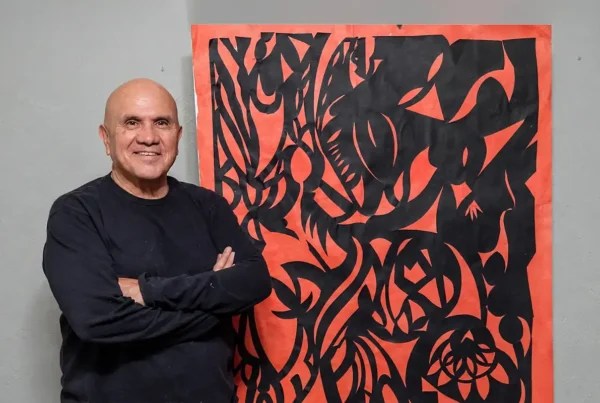
Aldag with one of his photographs
Convert (Temple A.D. 1898)
mixed media
9 x 6 x 2 inches (closed)
2009
Michael Aldag: Temple and the Vanishing Congregation
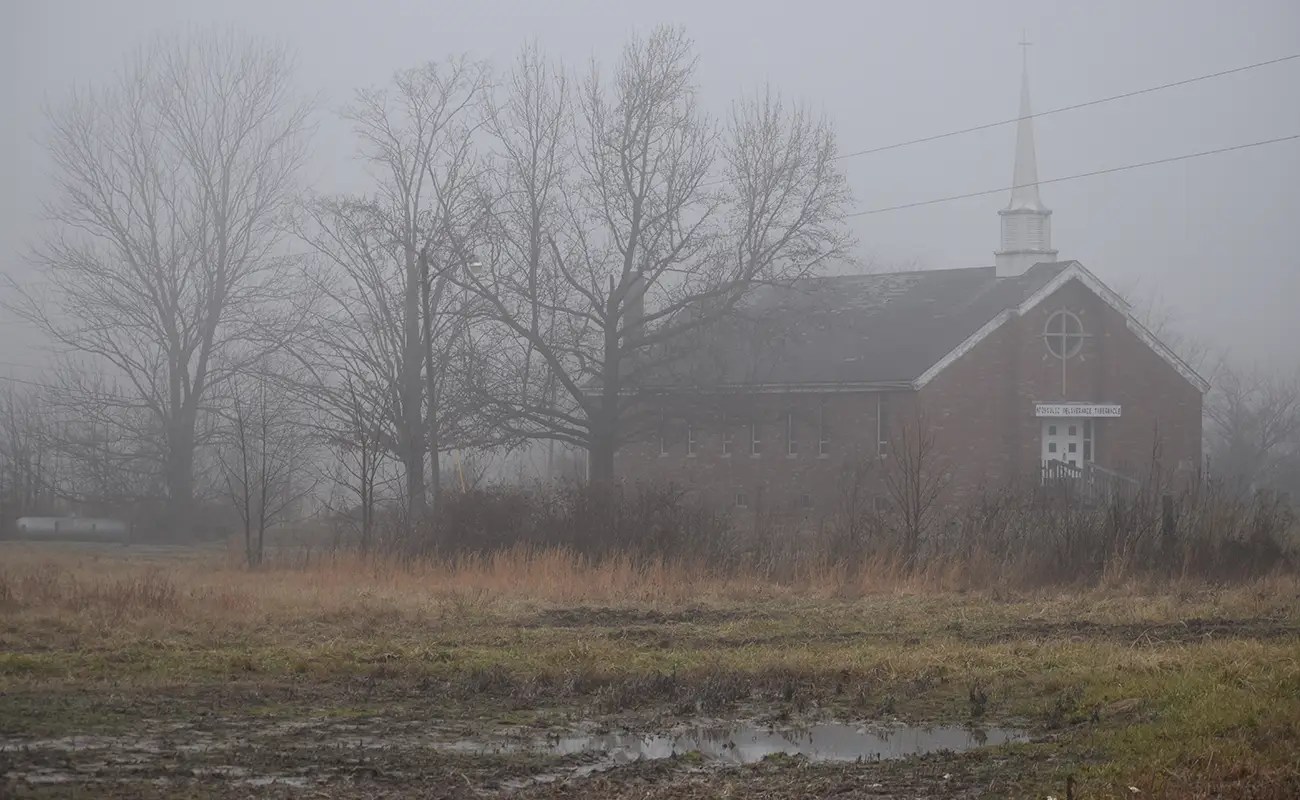
Among Aldag’s most significant projects is Temple, an ongoing photographic series centered on former church properties in Southern Illinois. These are buildings once used by Christian congregations for regular worship but no longer serving that purpose. Some stand empty. Some have been adapted for entirely new functions. Others remain intact yet disconnected from their original role. Aldag has photographed more than sixty such sites across numerous towns in this Bible Belt region, creating a visual archive of changing religious landscapes. The project is not limited to nostalgia or preservation. Instead, it invites viewers to consider what happens when places built for collective faith become uncertain, commercialized, abandoned, or transformed. Every façade, tower, and doorway suggests another chapter in the story of American civic life. Because churches often functioned as neighborhood anchors, their decline can reflect shifts in economics, migration, demographics, and identity. Temple therefore operates simultaneously as art, record, and cultural inquiry.
The statistics surrounding religious affiliation in the United States sharpen the significance of the series. In 1937, Gallup reported that 73 percent of U.S. adults belonged to a church, synagogue, or mosque. By 2020, that figure had fallen to 47 percent. Research from Pew in 2024 found that roughly 28 percent of adults identified as religiously unaffiliated, describing themselves as atheist, agnostic, or nothing in particular. Pew also noted that while about 90 percent of adults identified as Christian in the early 1990s, the figure is now closer to two-thirds. Aldag does not need to preach these numbers. He shows their visible consequences through streetscapes and structures. Closed sanctuaries, neglected masonry, and repurposed fellowship halls become material evidence of broad social transition. The data and the photographs reinforce one another, allowing viewers to see how national trends settle into local streets and everyday environments.
The title Temple carries special force because it suggests reverence while also acknowledging fragility. Many of the photographed buildings were designed to inspire permanence through stone walls, bell towers, stained glass, and formal entrances. Yet permanence is never guaranteed. Congregations shrink, maintenance costs rise, neighborhoods change, and ownership shifts. Aldag’s images reveal how grand intentions can meet practical realities. Some former churches become residences, schools, or businesses, extending the life of the structure in new ways. Others decline slowly under weather and neglect. Neither outcome is presented with cheap sentimentality. Instead, he allows viewers to wrestle with mixed emotions: admiration for craftsmanship, sadness for loss, curiosity about reuse, and reflection on what communities choose to sustain. In this sense, Temple is less about endings than transformation. It asks whether sacred meaning disappears when a building changes purpose, or whether traces of it remain in stone, light, and memory.

Church at 10:30
photographic print on paper
20 x 30 inches
2020
Missing the Mark
photographic print on paper
18 x 12 inches
2025
Titles, Materials, and the Art of Witness
Aldag gives close attention to titles, understanding that language can widen the emotional and intellectual reach of an image. In his practice, a title is not a label added after the fact but an active component of meaning. Some titles reference the location or the former congregation connected to the site. Others draw from hymns or scripture, linking present-day scenes with inherited traditions. This strategy encourages viewers to look beyond surface appearance. A vacant building may seem silent until a biblical phrase or remembered song reframes it as part of a larger cultural narrative. Titles can introduce irony, sorrow, dignity, or hope without altering the image itself. They also echo the artist’s interest in prophetic speech, where words reveal what routine observation overlooks. By pairing photographs with carefully chosen names, Aldag transforms ordinary documentation into layered commentary. The result is work that can be approached visually first, then reconsidered through the added resonance of language.
One of the clearest examples is Stones Cry Out (2020), a photographic print on paper measuring 24 by 20 inches. The work depicts the former home of First Presbyterian Church in Mount Vernon, Illinois. The substantial facility is marked by a large carved image of Jesus Christ set into a massive stone wall approximately twenty-eight feet high and twenty feet wide. Membership decline placed increasing pressure on the congregation’s ability to maintain the property, and in 2020 the church sold the building it had occupied since 1949. It is now used by the YMCA of Jefferson County as a fitness center. Aldag titled the photograph after the words of Jesus in Luke 19:40: if the people keep quiet, the stones will cry out. Captured on a rainy day, the soaked stone appears almost tearful. Through weather, title, and subject, the image becomes a meditation on witness, change, and the persistence of memory.
His handling of materials further distinguishes the work. Though rooted in photography, Aldag approaches each finished piece as a singular art object, much as a painter or draftsman would. He favors minimal editing, preserving the integrity of the original scene while relying on composition, timing, and tonal control to shape impact. Prints may appear on metal, paper, glass, or fabric, with each surface altering how light, texture, and mood are experienced. Metal can intensify clarity and hardness, paper can emphasize subtle gradation, glass can echo the luminous associations of stained windows, and fabric can introduce softness and vulnerability. This willingness to vary supports the idea that every image carries its own story and deserves its own physical presence. Rather than mass-produced reproductions, these works function as carefully considered pieces whose materials participate in the narrative of endurance, erosion, and remembrance.

Old Country Church
photographic print on metal
20 x 30 inches
2020
Stones Cry Out
photographic print on paper
24 x 20 inches
2020
Michael Aldag: Midwestern Light, Public Recognition, Enduring Voice
Observers have compared Aldag’s photography to that of Ansel Adams, particularly in his black-and-white images. The comparison reflects compositional discipline, sensitivity to tonal contrast, and an ability to make architecture feel monumental. Aldag himself has noted parallels between Adams’s Church, Taos Pueblo, New Mexico (1941) and his own Quiet Bell (2025). Yet the distinction between the two artists is equally important. Adams became closely associated with the landscapes and structures of the American West, while Aldag concentrates on Midwestern sites shaped by different histories, climates, and communities. His chosen subjects are less about frontier grandeur and more about civic memory, regional faith traditions, and the ordinary streets where social change quietly unfolds. By applying a classic photographic seriousness to overlooked buildings, he grants them renewed significance. The comparison to Adams therefore highlights craft, but Aldag’s voice remains distinctly his own.
His preference for black-and-white imagery serves expressive goals beyond style. Removing color can simplify a scene, directing attention toward line, texture, shadow, and structure. In Aldag’s case, monochrome also helps evoke a reflective tone suited to former sanctuaries and aging church properties. Weathered stone, clouded skies, empty windows, and worn entrances gain added gravity when rendered through contrast rather than bright color. The visual restraint encourages contemplation rather than distraction. It also places emphasis on enduring forms, allowing a bell tower or carved figure to stand out against time’s visible marks. This approach aligns with the themes of Temple, where absence and continuity often coexist. A congregation may be gone, but the architecture remains to speak in another register. Through black and white, Aldag turns that quiet speech into something viewers can feel with unusual immediacy.
Aldag’s career includes meaningful public recognition and deep regional connection. Born and raised in Southern Illinois, he has described art as a lifelong passion and an early means of expression, especially as an introverted child who found images more effective than words. He earned a BFA from the Columbus College of Art & Design and has been an active member of the Illinois Art League since 2009. His work is held in private collections as well as the permanent collection of the Ella Elizabeth Hise Museum of Regional Art. Temple has appeared as a solo exhibition, while individual photographs have been selected for juried group exhibitions and honored in competitions. He has also served as a judge for art events, including the Cedarhurst Biennial in 2025 at Cedarhurst Center for the Arts. Named an Esteemed Listee in the 2023 Marquis Who’s Who in America registry, Aldag continues to build a practice where local history and larger questions meet.