The Poetics of Assembled Humanity
Marc Janssens stands as a compelling presence in contemporary sculpture, shaping figures that linger in the imagination long after the first encounter. Born in Belgium in 1969 and working from Meerhout, he has cultivated a visual language that merges emotional depth with material experimentation. His sculptures often present solitary human forms that appear vulnerable yet quietly resilient, inviting viewers to confront themes of loss, memory, childhood, and farewell. Through ceramics combined with iron, wood, bronze, paper, polyester, and reclaimed objects, he constructs characters that seem suspended between dream and reality. Their gestures are understated, yet their psychological charge is unmistakable. Collectors both in Belgium and abroad have increasingly embraced his work, drawn to its universal resonance and understated intensity. Each figure carries the weight of lived experience, transformed into sculptural poetry that feels at once intimate and expansive.
The foundation of this distinctive practice lies in Janssens’ extensive artistic training. During the late 1980s he studied plastic arts at SISA in Antwerp, later continuing at St. Lucas in applied graphics. His education expanded further at the Academy for the Arts in Mol, where he focused on sculpture and ceramics. Before dedicating himself entirely to sculpting, he worked as a graphic artist, silkscreen printer, and teacher in creative techniques. This varied background sharpened his sensitivity to line, surface, and composition, qualities that now permeate his three dimensional work. The transition from graphic design to sculpture did not mark a rupture but rather an evolution, allowing him to translate his graphic precision into tactile form. Over time, his focus shifted entirely toward sculpting, and this commitment has shaped an oeuvre that continues to gain international attention, including invitations to work abroad such as at the Ceramic Art Institute in Jingdezhen, China.

Material Alchemy and the Expressive Surface
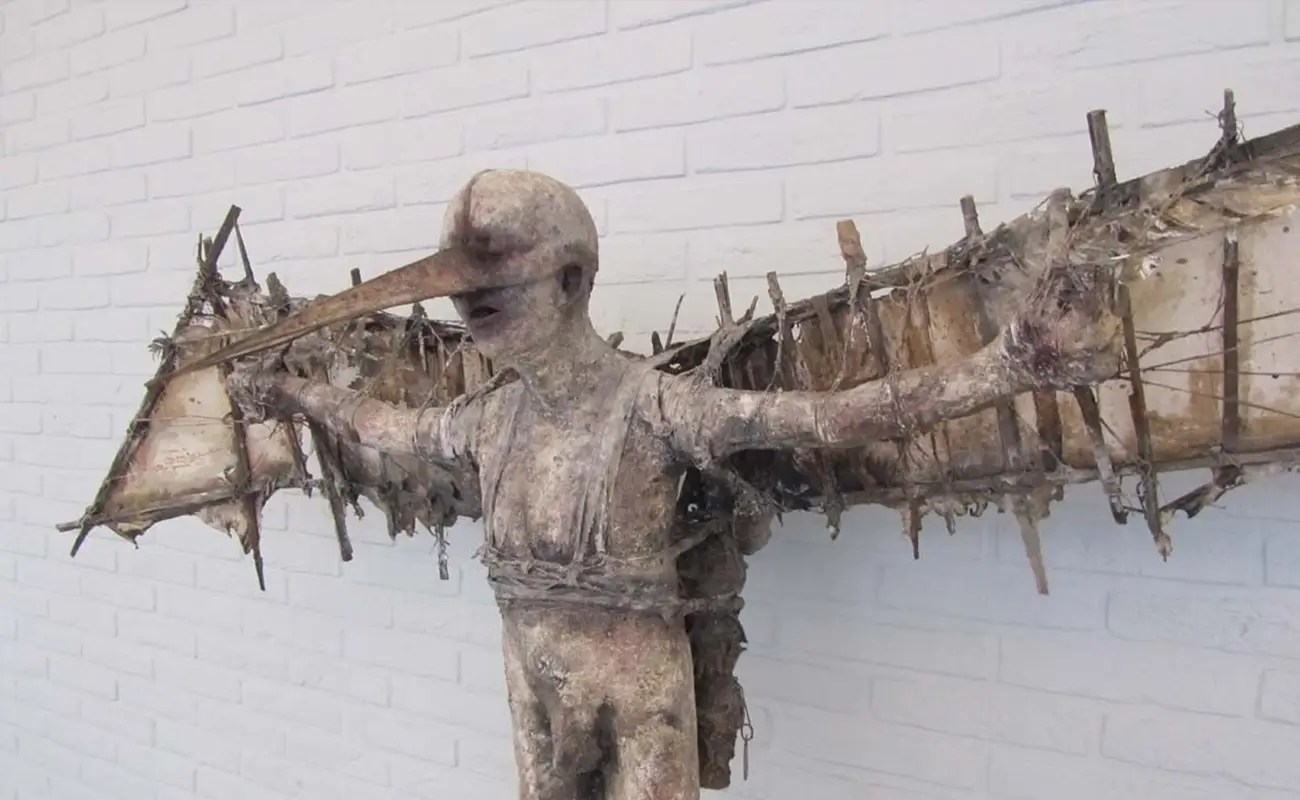
In Janssens’ sculptures, diverse materials converge to create cohesive and emotionally charged wholes. Iron merges with ceramics, weathered wood supports fragile torsos, and iron wire extends into curious mechanical appendages. These elements do not simply coexist but interact, suggesting a subtle mutation in which human and object intertwine. His figures frequently appear equipped with imaginary tools or prosthetic devices that hint at a desire to transcend human limitation. Yet rather than presenting heroic transformation, these additions emphasize fragility and naïveté. The mechanical components feel provisional, almost improvised, as though constructed from memory or necessity. Through this interplay, Janssens suggests that humanity is inseparable from the objects it creates and depends upon. The fusion of organic and constructed forms becomes a metaphor for adaptation, struggle, and quiet perseverance.
Surface treatment plays a crucial role in amplifying this emotional narrative. Janssens applies numerous layers of paint, building depth through successive applications before softening the uppermost tones into muted, matte hues. The result is a skin that appears worn by time, imbued with a patina that evokes age and endurance. Rust colored iron, subdued ceramics, and distressed wood generate an atmosphere that feels both nostalgic and immediate. This aesthetic of weathering is not decorative but conceptual, reinforcing the idea that time itself shapes identity. In works such as Favela, where a stooping ceramic man carries a wooden house on his back, the aged materials heighten the sense of burden and memory. The subdued coloration and textured surfaces intensify the emotional impact, ensuring that viewers respond not only intellectually but viscerally to the figure’s quiet determination.

Marc Janssens: Figures at the Edge of Transformation
Central to Janssens’ artistic vision is the human figure, often portrayed in a state of subtle distortion or hybridization. These characters may sprout wings resembling thin membranes, display fine mechanical fingers, or incorporate miniature engines that appear dust covered and corroded. Such details introduce a dreamlike quality in which mutation is guided by poetic intuition rather than science. The figures sometimes resemble small, upright monsters, fused with airplanes that will never ascend or outfitted with artificial limbs that promise movement yet remain uncertain. This imaginative transformation does not erase their humanity; instead, it underscores their vulnerability. The tension between aspiration and limitation animates each piece, suggesting an internal struggle between desire and reality. Through these surreal modifications, Janssens offers a meditation on the human condition that feels both personal and collective.
Despite the presence of absurd or fantastical elements, tenderness remains a defining characteristic of his work. Humor appears in subtle gestures, in the awkwardness of a figure attempting to animate a strange prosthesis, or in the unexpected pairing of doll like bodies with butterfly forms. Even when his sculptures evoke monsters that seem to have escaped from ancient rituals, they retain an air of gentleness. Their exaggerated features and simplified anatomies lend them a universal quality, freeing them from specific identities and allowing viewers to project their own experiences onto them. The singular form of each figure strengthens this universality, transforming individual characters into archetypes of longing, resilience, and quiet rebellion. Through this balance of fantasy and intimacy, Janssens creates sculptures that are both accessible and profoundly layered.

Memory, Time, and the Worn Beauty of Objects
Recurring motifs in Janssens’ oeuvre revolve around wear, erosion, and the passage of time. Many of his figures appear dressed in unexpected uniforms or harnesses, their surfaces marked by imagined histories. The charm of these sculptures often arises from this sense of having endured. Rather than presenting polished perfection, Janssens celebrates the beauty of what is used and altered. Weathered wood, oxidized metal, and softly abraded ceramics suggest that time has touched each component with care. This sensitivity to aging materials aligns with his broader exploration of memory and farewell. His sculptures do not dramatize loss through overt gestures; instead, they communicate through stillness and restraint. Viewers encounter forms that seem to carry invisible stories, their quiet presence evoking shared human experiences of change and impermanence.
International recognition has further expanded the reach of his poetic vision. Invitations to work in different cultural contexts, including his recent engagement at the Ceramic Art Institute in Jingdezhen, reflect a growing appreciation for his distinctive approach to sculpture. While rooted in his Belgian background and education, his themes transcend geography. The fragile bodies he creates, striving to surpass their own limitations with improvised mechanical aids, speak to universal tensions between individuality and societal expectation. Living and working in Meerhout, he continues to refine this language of mutation and memory. Through layered pigments, hybrid forms, and the evocative union of man and object, Marc Janssens shapes a body of work that transforms vulnerability into enduring artistic presence.
You can visit Marc’s Instagram at: marc_janssens_sculptures