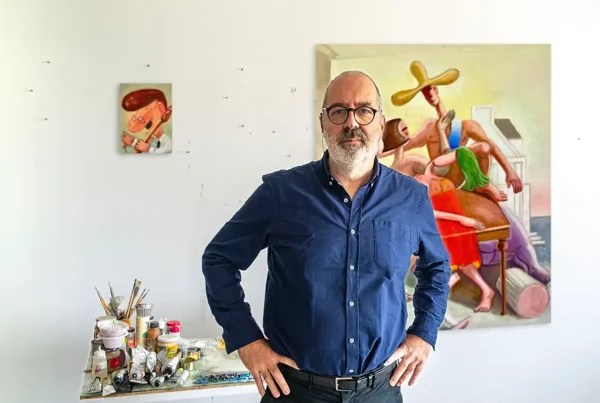
“Before calling myself an artist, I define myself as a man, a person who becomes aware of a hidden dimension of things.”
Childhood Soil and the Search for What Sustains
Marco Grechi’s artistic language begins far from academies and formal studios, in the landscapes of northern Italy near Lake Garda, where daily life offered him a first education in attention. His early years were shaped by studies in agriculture and theology, two disciplines that ask different yet related questions about growth, nourishment, purpose, and continuity. That pairing helps explain why his work often feels grounded while also reaching toward unseen meanings. Long before he identified himself with any artistic role, he was already studying how life takes form and how fragile balances are maintained. Summer afternoons marked by silence and stillness became formative experiences, not because of grand events, but because ordinary surroundings revealed hidden richness. In that atmosphere, the natural world was not scenery but collaborator. The values of patience, observation, and care emerged early, later becoming essential to his practice. Grechi’s art can therefore be understood as an extension of childhood curiosity joined to adult reflection, where material presence and spiritual inquiry remain closely connected.
Those early memories carry remarkable continuity with the surfaces and substances that define his mature work. As a child, Grechi recalls kneading sand with leaves and twigs, shaping temporary forms from what was immediately available. Such play now appears almost prophetic. The gestures of pressing, mixing, shaping, and testing resistance remain visible in the tactile character of his paintings and constructed surfaces. Instead of treating matter as passive, he approaches it as something responsive, capable of surprise. Childhood attention to ants, plants, ground textures, and the small dramas of a country house environment also trained his eye to notice systems that often escape quick observation. This sensitivity helps explain why his works frequently suggest networks, traces, paths, and organic structures rather than fixed representations. Even when the result is abstract, it carries the memory of lived contact with earth and movement. His visual language does not separate innocence from sophistication, because both are joined through sustained attention to how the world quietly organizes itself.
Grechi’s distance from an academic art background is equally significant. Without strict allegiance to inherited schools, he developed through experience rather than institutional doctrine. That independence allows his practice to remain open, exploratory, and resistant to formulas. He has described himself first as a man and a person before using the title of artist, which reveals a philosophy centered on being rather than branding. For him, making art is tied to becoming more aware of hidden dimensions within ordinary things. This perspective gives dignity to common materials and daily encounters, because each may contain unsuspected depth. Instead of pursuing prestige, he seeks forms of understanding. The result is work that often feels discovered rather than designed, as though it emerged from listening rather than imposing control. In a contemporary art culture often focused on labels, Grechi offers a different model: practice as witness, material as teacher, and creation as a path toward recognizing beauty in the balances that sustain everyday life.

Marco Grechi: Creation Through Destruction and Renewal
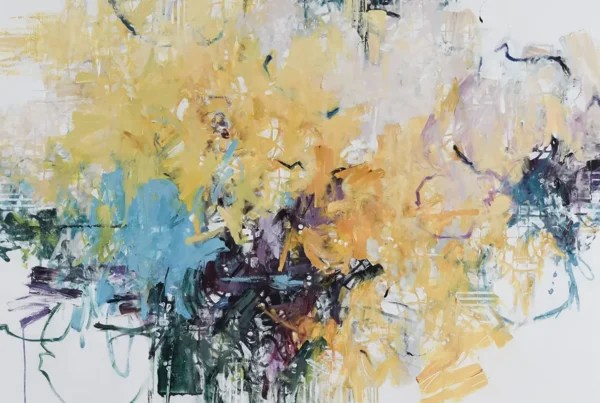
Grechi describes his process with a sequence of verbs rather than a fixed identity: he creates, destroys, kneads, and experiments. This statement is revealing because it places movement above conclusion. Art, in his case, is not a polished image reached through certainty, but a cycle of making, undoing, and remaking. Destruction is not failure within this method. It is a necessary stage that clears surfaces, tests conviction, and allows hidden possibilities to emerge. Such an approach gives his works their sense of accumulated history. Marks appear layered, interrupted, scraped back, and renewed, carrying evidence of time and revision. The viewer senses struggle not as drama for its own sake, but as honest contact between intention and resistance. This places Grechi within a broad tradition of materially driven abstraction while preserving his distinct voice. He does not seek purity or decorative finish. Instead, he values friction, accident, and the unpredictable intelligence of process. In his hands, instability becomes a source of visual truth.
His self-description as an empathetic artist in constant search deepens this understanding. Empathy suggests that creation is relational, not isolated. He does not imagine himself alone in front of mute matter. Rather, he acknowledges peoples and communities who build roads toward beauty, preserve it, damage it, and rebuild it. This recognition broadens the social dimension of his work. Every mark can be read not only as personal expression but also as participation in a long human effort to shape environments and meanings. Roads, pathways, scars, walls, and shelters all echo through his imagery because they belong to collective life. Search, meanwhile, implies that no final answer has been reached. The studio becomes a site of questioning rather than mastery. That openness gives his paintings emotional accessibility. Even when abstract, they feel inhabited by shared human conditions such as labor, memory, vulnerability, and renewal. Grechi’s empathy therefore functions both ethically and formally, allowing materials to carry traces of many lives.
This philosophy also explains why his art resists neat categories. Some works move toward figuration, others toward nonobjective composition, yet none seem interested in settling permanently on one side. Forms may appear as bodies, ruins, signs, architecture, landscapes, or all of these at once. Such ambiguity is not indecision but generosity. It allows viewers to enter through multiple experiences and associations. Grechi trusts perception to remain active rather than passive. A line can be read as road, vein, crack, or horizon. A dark mass can become debris, mountain, memory, or human presence. By refusing narrow definitions, he preserves the living tension between seeing and interpreting. This flexibility reflects the same create-destroy-renew rhythm found in his method. Meaning is not fixed at the moment of completion but continues changing through encounter. In that sense, each artwork remains open, carrying forward the artist’s search into the experience of anyone willing to look closely and stay with uncertainty.

Surfaces of Ash, Light, and Human Trace
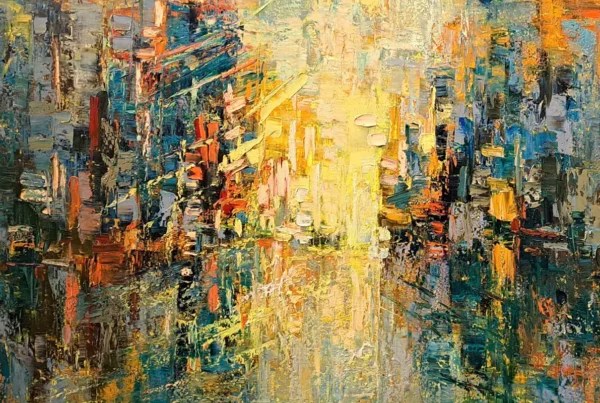
One of the most striking aspects of Grechi’s practice is the way surface becomes language. Tar-like blacks, granular textures, drips, abrasions, and thick worked passages do more than decorate a support. They communicate emotion, memory, and physical force. In many darker works, matter appears dense and resistant, almost as if pulled from excavation sites or burned structures. Blackened fields interrupted by flashes of blue or metallic glimmers can suggest nocturnal spaces, damaged walls, relics, or forms emerging from shadow. These paintings often carry an archaeological intensity because they appear weathered by time rather than newly made. Instead of smooth composition, the viewer encounters burial, exposure, accumulation, and scar. Grechi transforms the canvas into a place where history seems embedded in layers. This gives the work gravity without heaviness. Even the darkest surfaces remain active, charged by contrast and internal movement. Matter here is never static. It stores pressure, concealment, and the possibility of revelation.
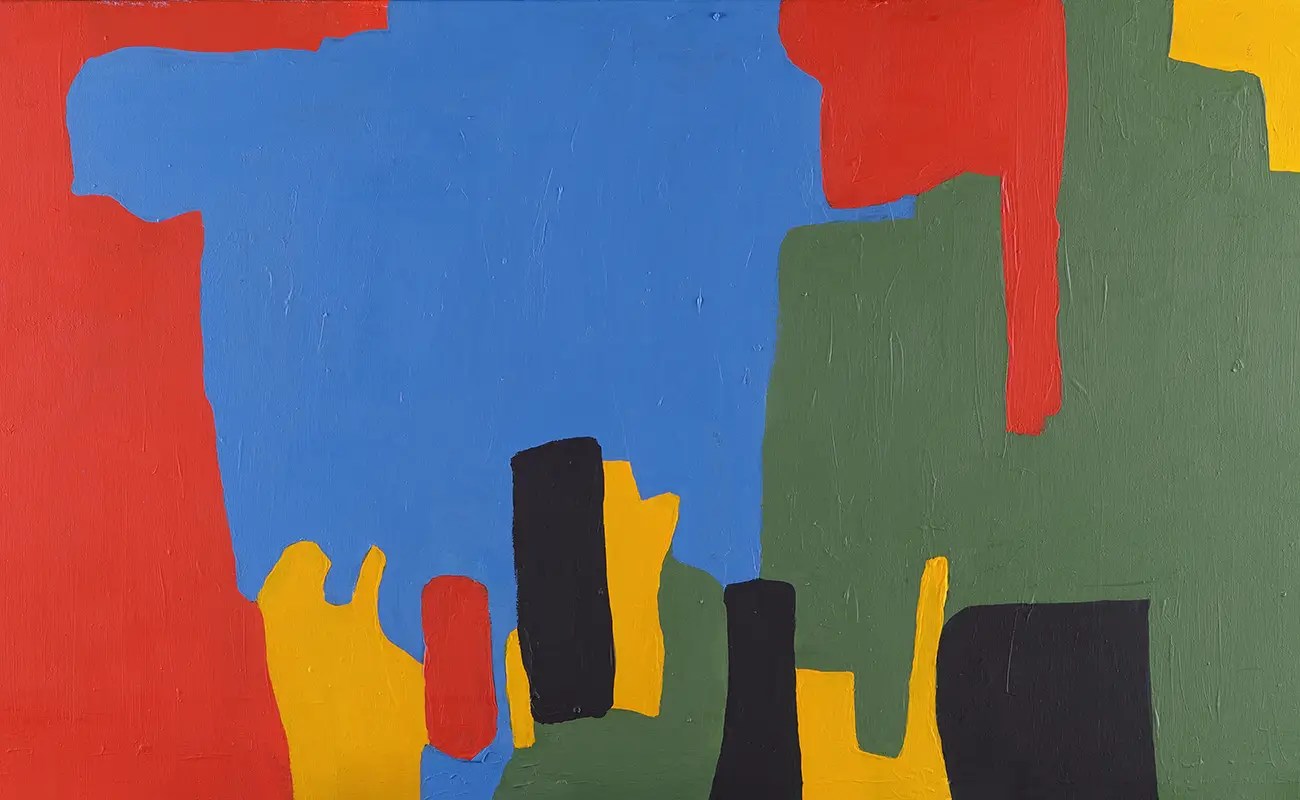
The brighter paintings reveal another register while maintaining the same tactile intelligence. In these works, color becomes more direct, with yellows, reds, pale blues, whites, and blacks arranged through bold simplified forms. Figures may reduce into signs, architecture into rhythm, and objects into emblematic silhouettes. Yet these compositions never feel merely graphic because the physical drag and weight of paint complicate flatness. Shapes stand with bodily presence, like markers or totems occupying space through assertion rather than illusion. Grechi demonstrates that brightness need not abandon seriousness. Playfulness can coexist with structural rigor and emotional depth. The chromatic shift also shows his refusal to be confined by one mood or one palette. Whether using darkness or light, he remains committed to transformation. Color in his work is not cosmetic. It acts as signal, pulse, interruption, or invitation. Through this varied vocabulary, he keeps abstraction connected to sensation and human scale.
What unites these contrasting modes is a sustained oscillation between recognition and uncertainty. Grechi does not illustrate scenes in a literal way. Instead, he allows fragments of the world to surface through marks and structures. Rough clusters may resemble earth, foliage, debris, or remembered places. Vertical passages can become roads, seams, boundaries, or traces of standing figures. Because no single reading dominates, viewers are encouraged to inhabit thresholds where image, object, and sensation overlap. This strategy gives the work unusual longevity, since each return can generate new associations. It also reflects his belief that beauty can be found in balances rather than absolutes. The paintings are neither entirely abstract nor entirely representational, neither purely raw nor polished. They remain in motion between categories. Such tension is central to their power. Grechi turns ambiguity into a form of clarity, revealing that lived experience itself is often composed of partial recognitions, shifting meanings, and things felt before they are named.

Marco Grechi: Perhaps It Was Life Beneath the Asphalt
Among the works Grechi identifies as especially meaningful, Forse era vita (Perhaps It Was Life) stands out as a concentrated statement of his artistic concerns. The title itself carries uncertainty and wonder, proposing a possibility rather than announcing a conclusion. This hesitation is important because it mirrors the way he approaches materials and perception. The piece employs tar, ink, and acrylic color, substances that might appear ordinary or industrial when considered separately. Yet Grechi insists that materials change once their potential is recognized. In his practice, matter is awakened through encounter. Tar becomes expressive rather than merely functional, capable of texture, depth, and symbolic charge. Ink sharpens movement and contrast, while acrylic introduces chromatic shifts and structural accents. Through their combination, the work turns humble elements into carriers of human resonance. The title invites viewers to ask what remains hidden under surfaces, what persists beneath hardened layers, and whether life can still be sensed where one expects only residue.
Grechi speaks of tar with fascination, noting its many possibilities for transformation and even suggesting that it could be sculpted. This is revealing because it collapses boundaries between painting and sculpture. The canvas is no longer only a plane for image but a site of incision, groove, thickness, and relief. He imagines the surface carved with channels as deep as a road, giving the work physical and metaphorical depth. Roads imply passage, labor, infrastructure, direction, and connection between distant points. They also imply wear, pressure, and repeated movement. By translating these associations into pictorial grooves, Grechi turns the support into a lived terrain. The viewer does not simply look at the image but senses pathways cut through resistance. Such handling confirms his larger commitment to letting substance itself become meaning. Texture is never secondary. It is where emotion and thought become tangible, where the hand’s action remains visible as a record of encounter with stubborn material.
The imagery of lines resembling asphalt roads and grooves recalling veins through muscle brings the work to its deepest register. Here infrastructure and anatomy meet. Human life and constructed surfaces become mirrors of one another. Beneath asphalt, one imagines buried histories, labor, movement, forgotten bodies, or the pulse of a city sustained by unseen systems. Beneath skin, veins carry nourishment through vulnerable flesh. By linking these forms, Grechi suggests that modern environments are inseparable from human experience, carrying traces of those who build, cross, repair, and endure them. This insight returns to his broader ethics of humble materials. Beauty is not reserved for refined objects. It can emerge from residue, imperfection, and common substances transformed through attention. Looking ahead, Grechi says he is less interested in predetermined forms or external judgment than in creating something new and listening to what matter communicates. Perhaps It Was Life therefore functions not as an endpoint, but as an ongoing conversation between substance, memory, and the hands of time.