“I am interested in finding the odd and extraordinary within ordinary environments.”
A Landscape in the Freezer
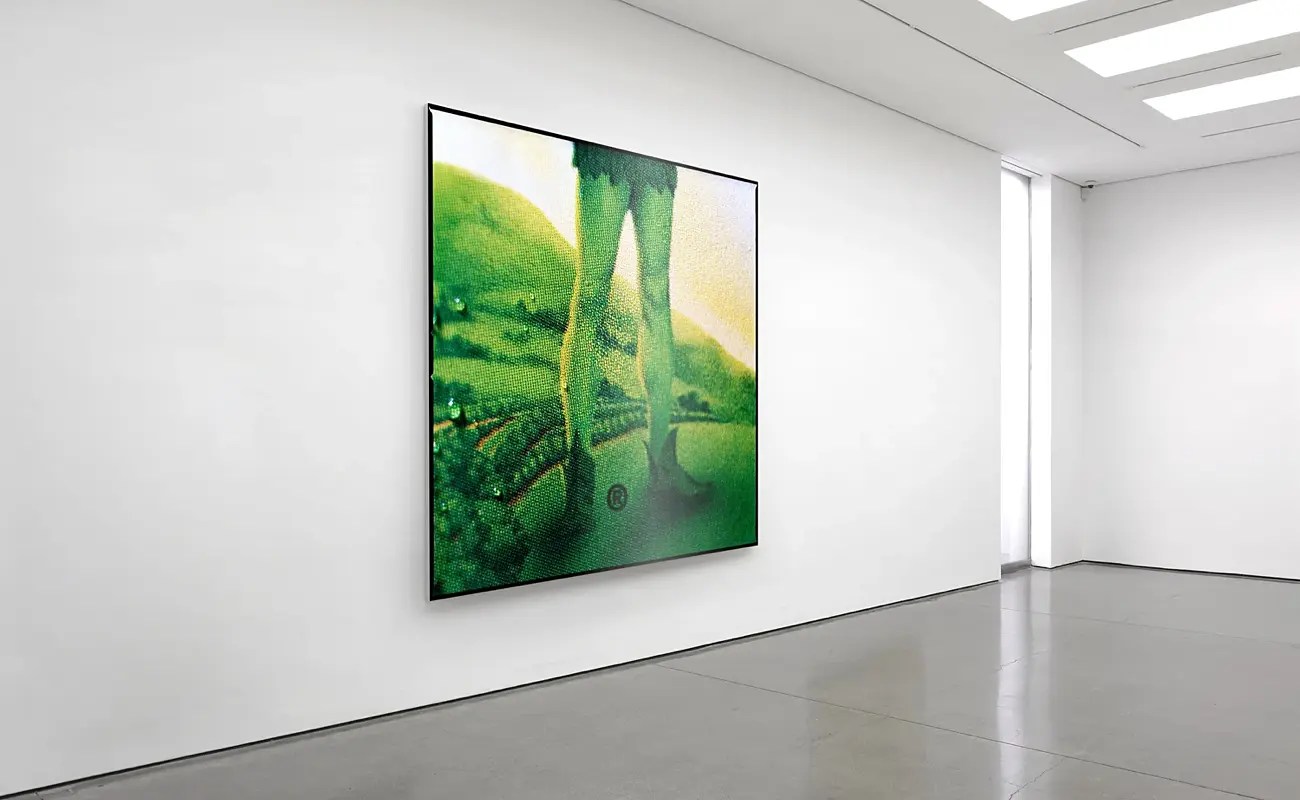
A green giant stands inside a landscape no larger than a box of frozen peas. In Joe E. Kim’s photograph, the figure appears imposing, even though the original image was printed on packaging taken from his own freezer. This peculiar shift in scale captures the impulse behind much of his fine art photography. Kim looks at things so frequently encountered that they barely register, then changes how we see them through framing, film, and the size of the finished print. A cheerful commercial illustration becomes a subject worth examining on its own terms.
His interest is not simply in making familiar objects look strange. The pictures carry signs of the real materials he photographs, including creases, condensation, and the optical changes produced by curved surfaces. Such details interrupt the smooth, idealized appearance of the advertising image. They also give viewers clues about how a seemingly vast landscape or oversized character came into being. Kim likes the uncertainty between the small item in front of the camera and the image that eventually confronts a viewer on the wall.
That attention to everyday imagery reflects a career spent working across commercial and personal forms of visual communication. Trained in illustration and photography, Kim works in advertising as a creative director while pursuing fine art photography independently. He knows the intentions behind a commercial picture, but his own camera gives him a way to approach it without a client’s brief. Rather than inventing an elaborate fictional world, he explores the visual material already passing through his daily life and asks how much it can change when looked at differently.

Joe E. Kim: The Life Behind the Lens
Born in Seoul, Korea, Kim has lived in Seoul, Toronto, and Los Angeles and now resides in the United Kingdom. Moving among these places has exposed him to different habits, objects, and visual cultures. He is drawn both to what remains recognizable across societies and to the small distinctions that make ordinary life feel particular to one place. This awareness informs his approach to photography, where a chance encounter with an image or object can become the starting point for a work.
Kim wanted to become an artist, but he also wanted to earn his living through art. That practical concern led him to study commercial art disciplines, including illustration and commercial photography, and subsequently into design studios and advertising agencies. He describes real satisfaction in creative direction, which has remained an important part of his working life. Yet professional assignments and personal images serve different purposes for him. The latter allow him to follow curiosity without first having to satisfy the requirements of a campaign or a customer.
He does not organize his life around constant photographic production. A weekday might involve a meeting with a client or a trip to buy groceries, and either could present something that deserves his attention. He photographs some subjects where he encounters them and takes other objects home to examine later. Travel provides further opportunities, but the basic method stays close to his actual experience. Kim wants the images to record a life he is genuinely living, not an artificial routine constructed solely to produce photographs.

The Making of Jolly Green Giant
The series American Portraits and Landscapes brings these interests together by treating the pictures printed on consumer packaging as photographic subjects. Landscapes designed to suggest abundance and friendly illustrated figures can acquire a different presence when separated from the rest of the package. Their original role is promotional, but Kim’s framing allows them to operate as portraits, settings, or unexpected combinations of the two. One of his favorite works from the series, Jolly Green Giant, makes this change especially clear.
For that photograph, Kim removed a box of frozen green peas from his freezer and focused on the giant pictured in the scenery printed on its surface. He used medium-format color negative film and later produced a traditional C-print on photographic paper. The composition excludes the character’s upper body, a deliberate crop that makes his height seem disproportionate to the surrounding landscape. It is possible to read the photograph as an image of a person and as an image of a place, although both originate from a small, mass-produced illustration.
Only after the film had been developed and the negative printed did Kim notice another detail. Moisture had formed on the cold box when it was removed from the freezer, and the film had preserved it. The condensation was not part of the illustration and was not a carefully planned effect. Kim welcomes this kind of accident, especially as a quality of working with analog photography. Here, the slight evidence of a real object and a real moment enters a scene that initially appears to belong entirely to the imagined world of food advertising.

Joe E. Kim: Between Two Kinds of Image
The same encounter between designed image and physical object occurs elsewhere in Kim’s work. A crease on a bag of chips alters the picture printed over it; the curve of a tiny hot sauce bottle creates a shallow depth of field that changes what the lens can hold in focus. These are not merely flaws to be corrected. He finds that they can contribute to a photograph’s character and sometimes become its most arresting features. By using macro lenses on small subjects and making prints large enough for a wall, he unsettles expectations about their size and importance.
Kim recognizes several productive tensions in these pictures: commercial imagery and fine art, the ordinary and the unusual, humor and seriousness, the microscopic and the monumental. His artistic references also cross those boundaries. He admires photographers Bernd and Hilla Becher, Candida Höfer, William Eggleston, and Richard Prince. Beyond photography, he is inspired by Bob Dylan’s ability to turn the life and times around him into music and words that feel both beautiful and forceful. Kim does not claim the same medium or style; what matters to him is the possibility of making an everyday experience newly vivid.
Living in the UK has given Kim another set of surroundings to observe. His next project will focus on British scenes and objects that seem distinctive to the culture, approached through the same attention he brings to groceries, packaging, and overlooked images elsewhere. He hopes these photographs will interest viewers within Britain as well as people encountering its daily visual culture from a distance. For Kim, the next subject need not announce itself as art in advance. It might appear during another unremarkable errand, quietly awaiting a change of perspective.