Geometry in Motion: Structure, Instinct, and Scale
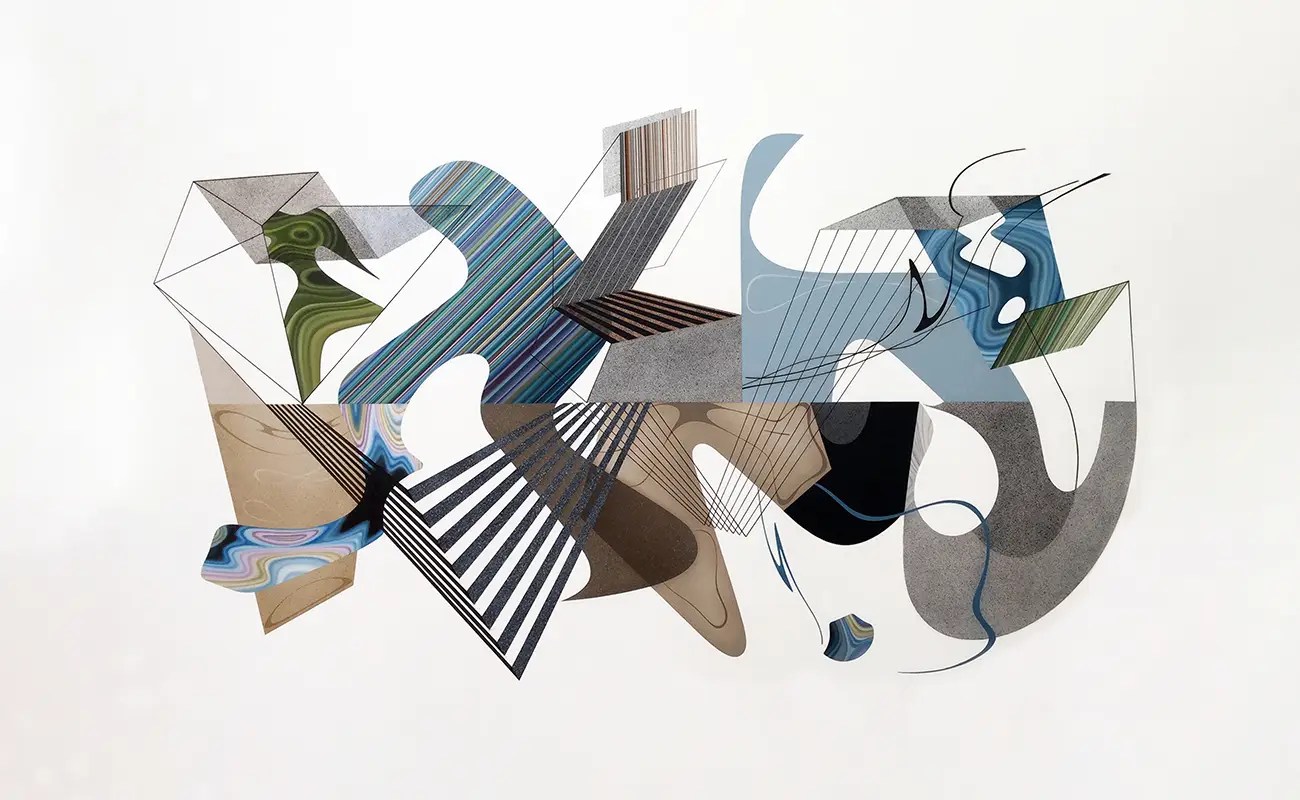
Inês Gato has developed an abstract language in which geometry, organic form, line, and chromatic modulation appear to be caught in a state of continual reorganisation. Large-scale compositions unfold across broad fields of linen, yet their visual authority does not depend on monumentality alone. They operate through tension: sweeping biomorphic shapes collide with taut networks of parallel lines, sharply angled structures interrupt marbled passages of colour, and open areas of ground prevent even the most intricate configurations from becoming completely enclosed. The result is an abstraction that rarely settles into a single spatial reading. Forms can resemble fragments of architecture, sections of an imagined organism, ribbons, membranes, conduits, or diagrams, but none becomes securely representational. Such instability is central to Gato’s significance as a painter. Her imagery belongs to a long history of abstraction concerned with rhythm and inner experience, while also reflecting a visual culture shaped by graphic design and digital image construction. Painting becomes neither an escape from structure nor a surrender to intuition, but a field in which control and uncertainty are continuously tested against one another.
The formal vocabulary changes considerably across the paintings, yet several persistent elements create cohesion. Some compositions are dominated by pale grounds and exceptionally fine linear systems that radiate, fold, or pivot around central points. Others are denser, with curving silhouettes, atmospheric grey or blue grounds, and intensely coloured forms whose striated surfaces resemble geological banding or magnified organic structures. In several works, sharp perspective-like constructions suggest folded planes or impossible architectural frameworks, while elsewhere sinuous black lines move across the surface with the freedom of improvised drawing. Gato frequently establishes a contrast between the apparent flatness of the support and pictorial devices that imply recession, volume, transparency, or projection. This opposition keeps the eye mobile. It also reflects her stated interest in proportional balance set against motion and transformation. The paintings are carefully organised without appearing static, and their most compelling passages occur where a precise compositional armature seems to be challenged by forms that bend, swell, dissolve, or escape the system intended to contain them.
Materially, the paintings complicate the immediate impression of digital smoothness. Gato works in oil on linen with natural-hair brushes, translating imagery that has often passed through drawing, photography, image-processing software, and preliminary digital variation before reaching the canvas. That process creates an unusual relationship between technological planning and traditional craft. The computer allows her to test formal and chromatic alternatives rapidly, but the final object is produced through the slower duration of painting, where decisions must be embodied in touch, layering, and sustained physical attention. Natural sunlight is paramount to her working conditions, a detail that underscores how dependent the finished surfaces remain on direct perception despite their technologically mediated development. The most persuasive works preserve evidence of both systems. They possess the clarity associated with graphic construction while resisting the impersonal finish that digital origin can sometimes impose. Their surfaces retain enough tonal variation, edge sensitivity, and chromatic nuance to remind the viewer that these are painted translations rather than mechanically transferred designs.

Inês Gato: Between Design Discipline and Painterly Autonomy
Gato’s education in graphic and computer design provides an essential context for understanding the unusual discipline of her abstractions. Training at António Arroio High School, AR-CO, and ETIC placed image construction, visual communication, and digital manipulation within her professional formation before painting became her primary occupation in 1999. That background remains visible not as a stylistic accessory but as an organising intelligence. Repetition, alignment, proportional systems, colour segmentation, sharply differentiated edges, and controlled visual hierarchy all belong naturally to the language of design. Yet Gato’s paintings repeatedly undermine the certainty such systems imply. A sequence of parallel lines may suddenly curve or converge; an apparently architectural plane can be penetrated by a floating organic shape; a polished band of colour may be displaced by grainy, atmospheric texture. The paintings therefore transform design knowledge into something less functional and more speculative. Communication design seeks legibility and intentional direction, whereas these compositions produce ambiguity, competing pathways, and visual incidents that remain resistant to a single explanatory order.
This friction becomes particularly significant within Gato’s creative process. She begins with an internal image, develops it through drawing and software, and selects from numerous compositional and chromatic possibilities before painting. Such a method might appear highly predetermined, yet Gato regards the painting process itself as capable of exceeding its plan. The image acquires a degree of autonomy as it develops, and the final state remains open to alteration rather than bound to the authority of the initial study. This position helps reconcile two apparently contradictory aspects of the practice: a belief in spontaneous, intuitive artistic identity and a working method that involves substantial preparation. Intuition does not disappear when the composition is tested digitally. Instead, it operates at multiple stages through selection, rejection, modification, and the painterly response to unforeseen developments. That layered process distinguishes the work from abstraction based purely on automatism and equally from geometrical painting governed by a fixed system. Gato occupies the unstable interval between the designed image and the event of painting.
The history of twentieth-century abstraction offers several productive points of comparison, particularly through Gato’s acknowledged admiration for Joan Miró, Vasilij Kandinsky, Marc Chagall, and Amadeo de Souza-Cardoso. Miró and Kandinsky are especially relevant to the coexistence of free-floating signs, rhythmic line, and psychologically charged colour, while Chagall suggests another model for pictorial space liberated from ordinary gravity and rational scale. Souza-Cardoso brings a specifically Portuguese modernist reference into this network, linking fragmentation, chromatic energy, and an openness to multiple visual languages. Gato does not imitate any one of these figures. Instead, her paintings extend a modernist question into a contemporary technical environment: how can abstract form function simultaneously as construction, sensation, and carrier of inner experience? Her use of Photoshop and image processing shifts that question into conditions unimagined by the earlier painters she admires. Digital experimentation becomes part of the preparatory vocabulary, yet oil painting remains the final site where visual information is slowed down, revised, and converted into material presence.

Microcosm, Macrocosm, and the Emotional Body
One of the most distinctive conceptual threads in Gato’s practice is the proposed connection between microcosm and macrocosm. Her compositions repeatedly invite shifts of scale that make this concern visually convincing. A striped, undulating shape can suggest a mineral cross-section, a cellular formation, a section of landscape, or a vast topographic system seen from an impossible distance. Fine radiating lines can read simultaneously as technical diagrams, fields of force, strands, trajectories, or spatial coordinates. Because these references remain unresolved, the viewer is encouraged to move mentally between the microscopic and the expansive. Gato’s stated belief in a universal law connecting different scales of existence gives this formal ambiguity a philosophical dimension. The paintings do not illustrate scientific principles, nor do they claim literal correspondence between biological and cosmic structures. Their force lies instead in proposing resemblance as an imaginative condition. Repeated rhythms, branching systems, concentric bands, and curving trajectories suggest that patterns can recur across radically different orders of perception, allowing abstraction to become a means of thinking about connectedness.
The human individual nevertheless remains central to Gato’s conception of artistic creation. Her emphasis on emotion and expression prevents the formal complexity from becoming a purely intellectual exercise. Even when no figure is represented, many forms carry a bodily suggestion. Curves fold inward like joints or cavities, swelling shapes appear vulnerable or protective, and elongated bands twist through space with an almost muscular sense of movement. This bodily resonance is particularly pronounced in paintings where hard geometrical structures coexist with soft, rounded silhouettes. Their contrast can be read as a visual equivalent of psychological tension: containment against release, stability against change, discipline against impulse. Such interpretations remain deliberately open, which is consistent with Gato’s belief that a painting develops new meanings through the responses of those who encounter it. The work does not position emotion as a coded message waiting to be deciphered. Instead, affect emerges through rhythm, pressure, density, colour, and the viewer’s own effort to organise ambiguous forms into an intelligible experience.
Colour plays a decisive role in that emotional register. Gato often sets subdued greys, creams, browns, or pale blues against concentrated bands of red, orange, green, violet, turquoise, or black. In other compositions, colour is distributed through finely graded striations whose gradual transitions create an almost hypnotic optical effect. These passages can appear liquid, mineral, or atmospheric, especially when surrounded by sharply defined neutral fields. The strongest chromatic relationships avoid simple decorative harmony because they are embedded in spatial conflict. Warm areas project forward, dark contours interrupt softer transitions, and striped bands turn around curves in ways that suggest volume without abandoning flatness. Yet the richness of this vocabulary also presents one of the practice’s continuing challenges. When too many seductive effects compete within a single composition, sensuous pattern can risk becoming an end in itself. Gato’s most convincing paintings counter that possibility by giving empty space, restricted colour, or severe linear geometry sufficient authority to restrain visual abundance. Tension, rather than embellishment, becomes the source of their vitality.

Inês Gato: Positioning a Hybrid Abstract Practice
Gato’s work occupies a productive position between painterly abstraction, graphic construction, and digitally assisted image-making. That hybridity is increasingly relevant to contemporary painting, where the distinction between hand-made and screen-mediated imagery has become less categorical. What remains notable in Gato’s case is the refusal to treat digital tools as either novelty or subject matter. Photoshop operates as an extension of compositional thinking, while the finished paintings insist on the physical demands of oil, linen, scale, and sustained execution. Such an approach places the work within a broader contemporary conversation about how painting can absorb technologies without surrendering its material identity. Gato’s large formats intensify this issue because motifs developed through the compact environment of a screen must ultimately function at bodily scale. Lines become architectural in their reach, curved bands acquire physical momentum, and small digital decisions expand into structures that occupy the viewer’s field of vision. The change of scale converts image manipulation into spatial experience.
Institutionally, this dual emphasis on visual intelligence and perceptual immediacy gives Gato’s paintings several possible points of entry. Their relationship to modernist abstraction makes them legible within exhibitions concerned with the continuing legacy of nonfigurative painting, while their design and software-based preparation opens another context around the interaction between analogue and digital methods. Their large scale also encourages exhibition situations in which viewers can experience the compositions from varying distances. From afar, the paintings tend to register as coherent systems of movement, colour, and directional force. Closer viewing exposes the heterogeneity of their internal languages, including thin lines, textured areas, hard-edged planes, gradual chromatic transitions, and optical contradictions. For collectors, this capacity to sustain both immediate visual impact and prolonged inspection is significant. The work is accessible without being simplistic, formally refined without becoming merely ornamental, and conceptually informed without depending on explanatory text for its basic effect. Its strongest identity lies in this ability to operate simultaneously as image, structure, and perceptual event.
The broader achievement of Gato’s practice rests in the way it turns contradiction into a sustained working principle. Her paintings are planned yet open-ended, technologically assisted yet materially traditional, formally balanced yet committed to transformation. They originate in personal experience while resisting autobiographical illustration, and they pursue a sense of universal connection without claiming a fixed symbolic system. That complexity distinguishes the work from abstraction that relies mainly on stylistic consistency. Gato’s continuity comes instead from a recurring set of questions about how forms relate, how systems change, and how an individual consciousness can organise external impressions without reducing them to predetermined meaning. Her life and work in Ericeira, together with an attentiveness to nature, living beings, music, dreams, walking, and observation, provide conditions from which ideas may emerge, but the paintings refuse literal description of those sources. Their enduring subject is transformation itself. Within contemporary abstraction, that position offers both visual pleasure and intellectual resistance, allowing structure and intuition to remain productively unresolved.